Exotic spotlight
Mugger Crocodile: South Asia's broad-snouted river predator
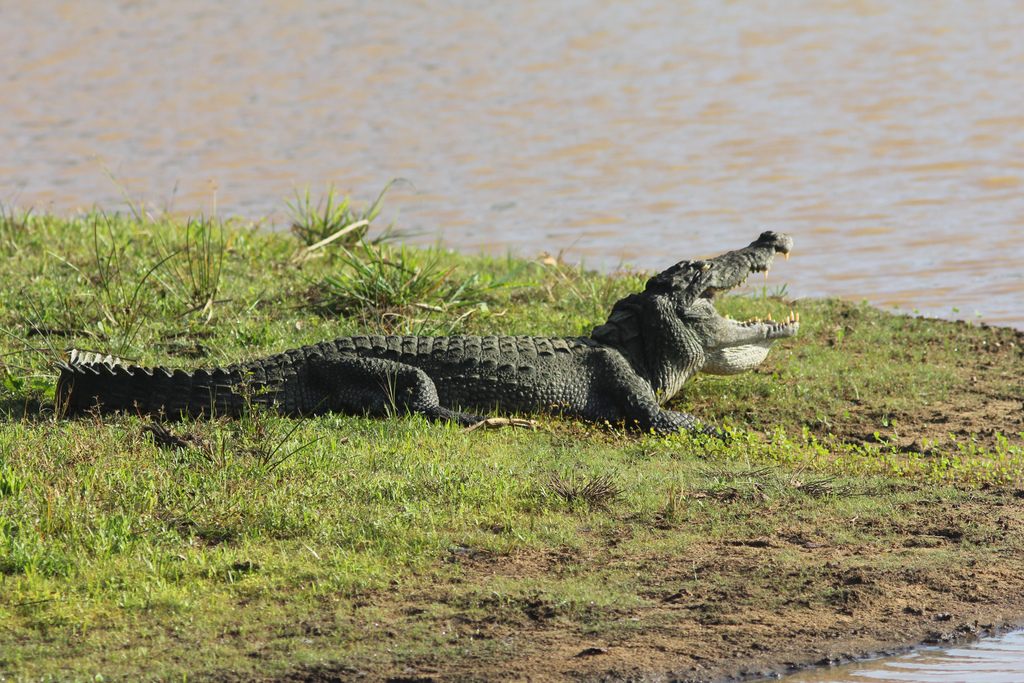
The mugger crocodile (Crocodylus palustris) is South Asia's largest reptile: a broad-snouted, freshwater apex predator found across India, Sri Lanka, Pakistan and Nepal. It grows to 5 m, aestivates underground during droughts, and is the crocodile most likely encountered at a South Asian river, reservoir or temple tank.
Three crocodile species divide the world between them in terms of fame: the saltwater crocodile of the Indo-Pacific, the Nile crocodile of Africa, and the American crocodile of the Americas. The mugger sits in a different category: the river crocodile most South Asians actually encounter, yet the one most people outside the region have never heard of.
What a mugger crocodile looks like
The first thing to notice is the snout. The mugger has the broadest, most rounded snout of any living crocodile in its genus, almost flat across the tip rather than tapering. This is the field mark that separates it at a glance from the narrower snout of a saltwater croc or the elongated, fish-catching jaw of a gharial.
Colour runs from dark olive-grey to a lighter tan, often with patches of darkening on the flanks. The scales are large and keeled. The fourth tooth in the lower jaw is not visible when the mouth is closed, a subtle point but one that separates true crocodiles from alligators in the hand.
Adults haul out at every opportunity: on mudbanks, sandbanks, or the concrete steps of South Asian ghats. Mouth-gaping is a thermoregulatory behaviour, not aggression, the reptile equivalent of sweating.
Where mugger crocodiles live
The mugger is a continental-scale species covering the entire Indian subcontinent. Its core range runs through India and Sri Lanka, extends west into Pakistan, Iran and the lower reaches of Afghanistan, and north into Nepal's Terai. It is the crocodile of rivers like the Chambal, the Mahanadi and the Indus, and equally at home in human-modified water bodies: irrigation canals, reservoirs, temple tanks and the city lakes of Udaipur and Hyderabad.
That adaptability to human-altered habitats is a double-edged thing. The mugger thrives near people in ways that most crocodilians do not, but proximity creates conflict. Washerwomen, fishermen and children swimming are all at risk in areas where large adults are present.
How the mugger feeds and hunts
The mugger hunts the way most crocodilians do: by waiting. It lies motionless at the waterline, body partly submerged, and takes prey that comes to drink or wade. The strike is brief and overwhelmingly powerful. The bite force of large crocodilians ranks among the highest of any living animal, and the mugger's broad jaw translates that force across a wide grip well-suited to large mammals.
Diet is opportunistic and shifts with size. Juveniles eat insects, frogs and small fish. Sub-adults take fish and water birds. Large adults take deer, monkeys, dogs, and domestic livestock at the waterline. Fish-eating remains a constant across all size classes.
Nesting and the dry-season trick
Females dig hole nests in sandy banks between February and April, well before the Indian monsoon. Clutches run to 25–35 eggs, incubated for around 55 days. Females guard the nest and respond to the high-pitched calls of hatching young by digging them out and carrying them to water.
The mugger has one survival trick no other crocodile uses at the same scale: aestivation. When a dry-season drought shrinks a lake to mud, muggers excavate burrows up to 4 m deep and retreat underground, entering a period of reduced metabolic activity. They emerge when the monsoon refills their water bodies, sometimes months later. This adaptation makes the mugger surprisingly resilient to seasonal drought that would strand most large reptiles.
Is the mugger dangerous?
Yes, seriously. The mugger is responsible for documented fatal attacks, mostly in India and Sri Lanka. It is less aggressive than the saltwater crocodile overall, but "less aggressive" does not mean harmless. A large adult male is a 200-400 kg ambush predator that moves faster than a human over short ground distances. Standard rules apply: stay well back from river banks and lake edges in mugger range, never wash clothes or bathe where local people warn of crocodiles, and treat any crocodile hauled out near a path as a hazard even if it appears to be sleeping.
The risk is highest at dawn and dusk, when muggers are most active, and during nesting season when females guarding eggs are particularly defensive.
The mugger in the Kaught catalog
The mugger sits at Epic in the Kaught catalog, three diamonds out of four. That rarity is observation-based: muggers are widespread across a huge range, but they are semi-aquatic, wary near people where hunted, and most active in low-light conditions. A confirmed, close sighting of a wild mugger in open water remains genuinely uncommon for most visitors to the subcontinent, which places it well above the common or rare tiers despite its distribution.
If you're in Rajasthan, the Chambal River National Gharial Sanctuary is the single best site in the world to see mugger crocodiles in high density alongside gharials and other large predators.
Mugger crocodile: frequently asked questions
What is a mugger crocodile?
The mugger crocodile (Crocodylus palustris) is a large freshwater crocodile native to the Indian subcontinent. It has the broadest snout of any living crocodile in its genus, grows to 5 m, and is South Asia's largest reptile. It sits at Epic tier in the Kaught catalog.
Where do mugger crocodiles live?
Across the Indian subcontinent: India, Sri Lanka, Pakistan, Nepal, Bangladesh and parts of Iran and Afghanistan. They prefer freshwater lakes, rivers, marshes and irrigation canals, and adapt well to reservoirs, temple tanks and other human-modified water bodies.
How big does a mugger crocodile get?
Males typically reach 3.5 to 4 m and 200 to 400 kg. Exceptional individuals touch 5 m and 450 kg. Females are notably smaller at 2 to 2.5 m. The mugger is South Asia's largest living reptile.
Are mugger crocodiles dangerous?
Yes. Muggers are responsible for documented fatal attacks, mostly in India and Sri Lanka. Less aggressive than saltwater crocodiles overall, but large adults are capable of taking livestock and people. Stay well back from the waterline in mugger habitat.
What does the mugger eat?
Juveniles eat insects, frogs and small fish. Large adults take deer, monkeys, dogs and livestock at the waterline. Fish remain part of the diet at all life stages. The mugger is an opportunistic apex predator that eats what comes within ambush range.
Why is the mugger Epic in Kaught?
Kaught's rarity reflects how often a species is observed in the wild, not conservation status. Despite a large range, muggers are semi-aquatic, wary near people and most active at twilight, making confirmed wild sightings genuinely uncommon. That places the mugger at Epic: three diamonds out of four.
The next thing you see could be
your first catch.
Kaught launches soon. Join the waitlist and be first to start a collection of the living world, one photo at a time.
Free at launch · No spam, just one email on launch day
Species data, type, rarity tier and measurements, is drawn from the Kaught catalog, built on open biodiversity records from GBIF and iNaturalist. Rarity reflects how often a species is observed in the wild, not its conservation status.