
Species spotlight
The Nile Crocodile: Africa's patient apex predator
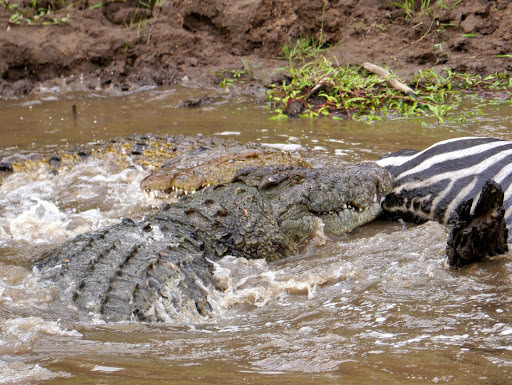
The Nile Crocodile (Crocodylus niloticus) is Africa's largest reptile: up to 6 m, up to 750 kg, an ambush predator that can take prey many times its own body weight. It is present in 26 African countries, cares for its young with unusual attentiveness for a reptile, and sits at Epic tier in the Kaught catalog.
The Nile Crocodile has been at the top of Africa's aquatic food chain for over 200 million years, essentially unchanged. A crocodilian from the Cretaceous would recognise this animal. It has found a design that works and has not deviated from it. Up to 6 m of armoured muscle, a bite force approaching 22,000 Newtons in large individuals, and an ambush strategy perfected across geological time.
How to identify a Nile Crocodile
At the water's edge, the typical view is a line of armoured ridges, a pair of eyes and two nostrils, just above the surface. From the bank, or on dry land while basking:
- Size: adults are large, 2.5 m minimum for a mature male, with large individuals clearly 4 m or more. Nothing else in African freshwater approaches this scale.
- Colour: dark olive-brown to greyish on the back, with darker cross-banding on the body and tail; pale yellowish on the underside. Young crocodiles are more contrasty.
- Head: long, tapered snout, broader at the base than the similarly sized West African Crocodile (Crocodylus suchus) but narrower than a broad-snouted or gavial. The fourth lower tooth is visible with the mouth closed, a reliable family-level character.
- Scutes: the bony dermal plates (osteoderms) on the back are heavily keeled and form clear longitudinal rows. Two neck scutes at the base of the skull are distinguishable from the body armour.
On the bank, crocodiles bask with mouths open: this is thermoregulation, allowing heat to dissipate from the mouth lining. It is not a threat display.
Habitat and range
The Nile Crocodile is the most widely distributed crocodilian in Africa, present in 26 countries from Egypt and Sudan south through East Africa to South Africa, and west through the Congo basin. It also occurs in Madagascar. The key requirement is large, permanent water: major rivers, the Great Lakes of East Africa, reservoirs and estuaries. It is not found in dry seasonal pools or fast mountain streams.
It is sometimes confused with the West African Crocodile (Crocodylus suchus), which was only formally separated as a distinct species in 2011. The two overlap in some regions of central Africa.
The ambush: how it hunts
Patience and explosive speed. A Nile Crocodile can hold position at the waterline for hours, often days, watching a game trail or river crossing. When prey approaches to drink, or enters the water, the crocodile accelerates from rest in a lunge that can cover 2 to 3 m in under a second. The jaws close with one of the strongest bite forces measured in any living animal: large individuals generate forces estimated between 16,000 and 22,000 Newtons. The grip is essentially irresistible.
Once prey is seized, the crocodile performs the death roll: a rapid rotation of the body that disorients the prey, disables struggling limbs and, for large prey, tears off manageable pieces. For prey too large to swallow whole, the crocodile may cache the carcass underwater, returning to feed as it softens. Crocodiles lack the jaw musculature to chew; everything goes in whole or in large chunks.
Prey ranges from fish (a staple for younger animals) to wildebeest, zebra, buffalo and, at the largest sizes, occasionally young hippos or other crocodiles. The diet is largely opportunistic and determined by what approaches the water.
Parental care: the unexpected tenderness of a crocodile
The Nile Crocodile is one of the most attentive reptile parents on Earth. After mating, the female excavates a nest in a sandy bank above the flood line and buries 25 to 80 eggs. She then guards the nest for the entire incubation period, approximately three months, defending it against monitor lizards, hyenas and other predators. She barely eats during this time.
When hatching approaches, the eggs begin producing a distinctive high-pitched chirp. The mother digs the nest open, gently picks up the hatchlings in her jaws (which can generate thousands of Newtons of force, yet carry hatchlings without harm), and carries them to the water. She may continue to guard them for several weeks. Males have also been observed assisting in nest-opening and escorting hatchlings.
This level of parental investment is unusual in reptiles and places crocodilians behaviourally closer to birds (their closest living relatives on the evolutionary tree) than to other reptiles.
Nile Crocodile vs Saltwater Crocodile
The Saltwater Crocodile (Crocodylus porosus) takes the size record: the largest confirmed individuals approach 6.3 m and are heavier. It also holds the measured bite force record at approximately 16,000 Newtons for its species, though the Nile Crocodile at maximum size likely matches or exceeds this. The critical difference is range: the Saltwater Crocodile is the species of the Indo-Pacific and northern Australia; the Nile Crocodile is the species of Africa.
In terms of human contact, the Nile Crocodile is responsible for more attacks per year, because it shares water sources with the densest human populations on the continent. Both animals should be treated with full caution near any freshwater in their respective ranges.
For more African wildlife, see the most venomous animals in the world ranking, which covers the Forest Cobra from the same continent. For the Nile Crocodile's bite in a global power ranking, see strongest animals in the world.
Nile Crocodile: frequently asked questions
How big does the Nile Crocodile get?
Males typically reach 3.5 to 5 metres and 225 to 750 kg; exceptional individuals can exceed 6 metres. Females are smaller, usually under 3.5 metres. It is the largest crocodilian in Africa and the second largest in the world after the Saltwater Crocodile.
Where does the Nile Crocodile live?
Sub-Saharan Africa, present in 26 countries, plus Madagascar. It inhabits freshwater rivers, lakes, estuaries and marshes, favouring large permanent water bodies with accessible banks for basking.
How does the Nile Crocodile hunt?
By ambush. It holds position at the waterline, barely visible, for hours or days. When prey approaches, it lunges with explosive speed, seizes the animal in its jaws and performs a death roll to subdue and disorient it.
Do Nile Crocodiles care for their young?
Yes. Females guard buried egg clutches for three months, then carry hatchlings in their jaws to the water when the eggs begin calling. Males have also been observed helping. This level of parental care is unusual among reptiles.
Why is the Nile Crocodile Epic tier in Kaught?
Kaught's rarity tier reflects how often a species appears in citizen-science records. Nile Crocodiles are present in 26 countries but require large freshwater habitats with river access, and most observations are made from boats or at distance. Epic reflects genuine sighting scarcity in the global iNaturalist record.
Is the Nile Crocodile the largest in the world?
No, the Saltwater Crocodile (Crocodylus porosus) is larger on average. The Nile Crocodile is the largest crocodilian in Africa and the second largest in the world. Both are apex predators capable of taking large prey.
The next thing you see could be
your first catch.
Kaught is live on the App Store and Google Play. Free to start, and your first catch is one photo away.
Free to start · Live on the App Store and Google Play
Species data, type, rarity tier and measurements, is drawn from the Kaught catalog, built on open biodiversity records from GBIF and iNaturalist. Rarity reflects how often a species is observed in the wild, not its conservation status.