
Record holders
Strongest animals in the world: 7 record-holders ranked by bite force, grip, and raw power
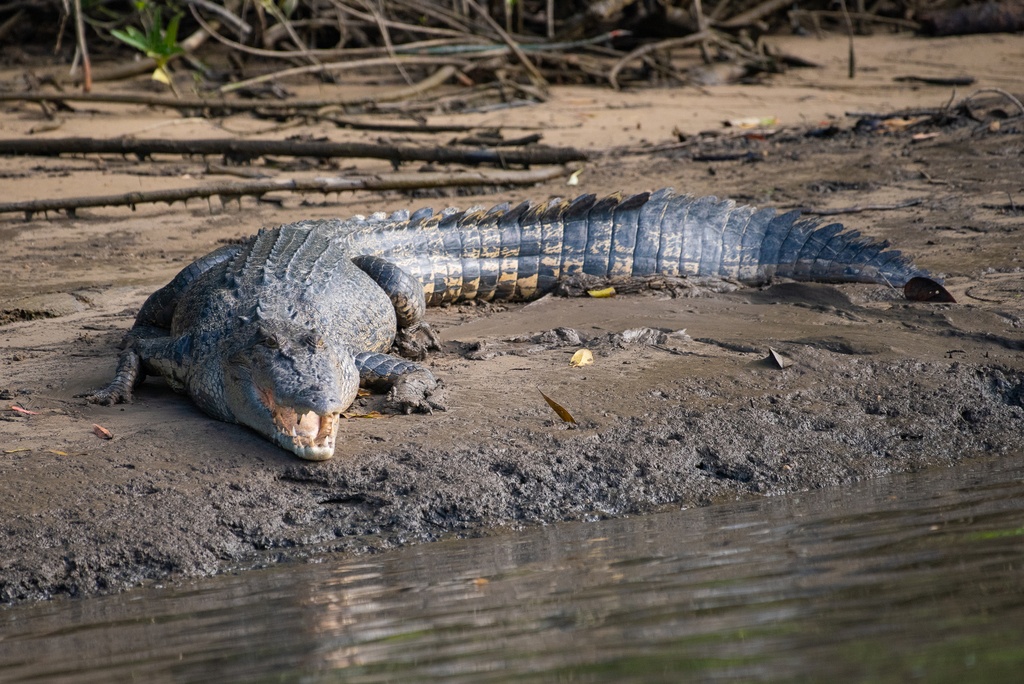
"Strongest animal" depends on the measure. For bite force, the saltwater crocodile wins at ~16,000 Newtons. For absolute pushing and carrying power, the African elephant. For relative strength (force as a multiple of body weight), insects win every category. The seven animals below each hold a genuine record in a specific dimension of physical power.
Strength is not a single number. Bite force, grip force, pushing strength, and relative-to-bodyweight power produce very different rankings. What follows is a card-by-card tour of seven catalog species, each the record holder in a specific category, with the real figures behind the claim.
Rarity tiers in the Kaught catalog reflect observation frequency in the wild, the standard you can compare across the full rarity ranking guide.
1. Saltwater Crocodile, strongest bite force of any living animal
Measured bite force: approximately 16,000 Newtons, or about 1,600 kg of pressure. This is the highest confirmed bite force of any living animal on Earth, measured directly using force-plate sensors embedded in a bite target. For scale: a great white shark's bite force is estimated at around 18,000 Newtons but has never been directly measured with the same rigor; the saltwater crocodile's measurement is the gold standard.
The force comes from jaw-closing muscles so large they occupy most of the skull's interior, leaving almost no room for a brain. Opening jaw muscles, by contrast, are weak. A strong person can hold a crocodile's jaws shut. Opening them against that grip is not possible.
The saltwater crocodile is the largest living reptile, reaching up to 6 metres and 1,000 kg in large males. It lives in coastal and freshwater environments across South and Southeast Asia, Australia, and the Pacific Islands.
2. African Savanna Elephant, greatest absolute pulling and pushing force
The African elephant is the largest land animal, with adult males reaching 6,000 kg. Raw pushing and carrying force scales with mass, and an elephant can push over standing trees, carry logs in excess of 300 kg with its trunk, and pull loads estimated at 9,000 kg. No land animal matches it for absolute mechanical work.
The trunk itself is a feat of engineering: roughly 100,000 individual muscle fascicles with no internal bone structure. It can lift over 300 kg, delicately pick up a single coin, detect water kilometres away by scent, and deliver a strike that stuns a fully-grown lion.
For grip precision alongside raw force, nothing in the land animal kingdom competes.
3. Common Hippopotamus, strongest bite force among land mammals
The hippopotamus has a bite force estimated at around 8,100 Newtons, the highest of any land mammal. Its canine teeth reach 50 cm in length and function as weapons rather than feeding tools: hippos are herbivores, but their jaws evolved for threat display and combat with other hippos.
A bite that can cut a boat in half is not a number easily conveyed by description. In practice, a hippo's jaw muscles are so hypertrophied relative to its skull that the head represents a significant fraction of total body weight. Adult males weigh up to 3,500 kg.
4. Brown Bear, greatest paw swipe force among terrestrial carnivores
A large brown bear's forelimb swipe has been estimated to generate forces exceeding 5,000 Newtons at the paw, with enough momentum to kill an elk with a single strike. The shoulder muscles of an adult male Kodiak bear (a subspecies of brown bear) weigh more than most medium-sized mammals.
Brown bears can sprint at 55 km/h, which combined with that forelimb mass produces kinetic energy comparable to a slow car impact. Digging ability is equally extraordinary: a bear can move 700 kg of rock and soil in a single foraging session excavating for ground squirrels.
Brown bears are widespread across the Northern Hemisphere, from Western Europe and Scandinavia through Russia to North America.
5. Eagle Owl, strongest talon grip of any European bird
The eagle owl's talon grip force is estimated at 300 to 500 Newtons per foot, the highest recorded for any European bird. Four talons close simultaneously on impact, each curving independently to maximise purchase on an irregular prey surface. The closure is involuntary on contact: the grip locks automatically and must be consciously released.
The hind talon (the hallux) of a large female eagle owl reaches 5 to 6 cm in curved length. Combined with the bird's mass (up to 4 kg) and the momentum of a dive at 40 to 50 km/h, the total impact force at the point of contact with prey significantly exceeds the static grip measurement.
For more detail on the eagle owl's full predatory toolkit, see the eagle owl adaptation explainer.
6. Stag Beetle, strongest jaw-to-body-size ratio of any European insect
The male stag beetle's oversized mandibles function as wrestling equipment, not feeding tools. In male-to-male combat over mates, two beetles grip each other's midsections and attempt to throw the opponent. The mandible force relative to body size is extraordinary: a male stag beetle weighing just 3 grams can grip a surface and resist a pull force many times its own weight.
For absolute relative-to-bodyweight strength, beetles as a group set records no vertebrate approaches. The dung beetle can pull 1,141 times its own body weight, the highest confirmed strength ratio of any animal. The stag beetle does not approach that figure but holds its own as Europe's largest beetle with the continent's most impressive set of mandibles.
7. Lion, greatest total hunting force of any African apex predator
A lion's bite force of approximately 4,500 Newtons is lower than the crocodile or hippo, but combine it with 180 to 250 kg of body mass, retractable claws that anchor prey against forward momentum, and a killing bite placed precisely on the trachea or carotid, and you have the most consistently effective large predator on land.
In group hunts, lions coordinate to control animals many times their individual size. A coalition of three or four males can bring down an adult giraffe weighing 1,200 kg. The total force applied in a take-down is a product of coordinated muscle power across multiple animals, not individual bite force.
The lion's strength is inseparable from its cooperative strategy, a reminder that raw force figures always need context.
What "strongest" actually measures
Every entry above holds a different record. The saltwater crocodile wins bite force but loses to the elephant on absolute carrying capacity. The eagle owl outgrips any bird in Europe but cannot match a large bear's forelimb force. The stag beetle wins the relative-to-mass competition by a margin no vertebrate can challenge.
The Kaught catalog uses dual-type tags to capture this kind of multi-dimensional character: Apex for predators at the top of their food chain, combined with habitat tags that reflect where that power is deployed. You can see how rarity and type interact across the catalog in the UK rarity ranking and the Eurasian lynx spotlight, another apex predator with a genuinely exceptional strength-to-stealth combination.
Strongest animals: frequently asked questions
What is the strongest animal in the world?
It depends on the measure. For bite force, the saltwater crocodile holds the record at around 16,000 Newtons. For raw absolute strength, the African elephant can push and carry loads no other land animal matches. For relative strength (force as a multiple of body weight), the dung beetle can pull 1,141 times its own weight.
Which animal has the strongest bite force?
The saltwater crocodile: approximately 16,000 Newtons (about 1,600 kg of pressure). A hyena bites at around 2,700 Newtons; a human at about 700 Newtons. The saltwater crocodile's measurement is the most directly verified record in the animal kingdom.
What is the strongest animal relative to its size?
The dung beetle holds the record at 1,141 times its own body weight in pulling force. Insects dominate every relative-strength category: their exoskeleton and muscle arrangement is more efficient at generating force relative to body mass than any vertebrate structure.
How strong is an eagle owl compared to other birds?
The eagle owl has the greatest talon grip force of any European bird, estimated at 300 to 500 Newtons per foot. That is comparable to a firm human handshake across a full hand, but concentrated through four curved points simultaneously.
Can a hippopotamus outbite a crocodile?
No. The saltwater crocodile's bite force of around 16,000 Newtons exceeds the hippopotamus's estimated 8,100 Newtons. The hippo's long canine teeth cause mechanical damage, but on measured force the crocodile wins clearly.
Is a gorilla stronger than a brown bear?
In upper-body pulling force, the gorilla likely leads: adult males can exert an estimated pulling force around 800 kg, roughly six times their body weight. A brown bear has greater total body mass and paw swipe force, but lower relative arm-pull strength. The comparison depends on the task.
What is the strongest bird in the world?
By talon grip force, the harpy eagle of South America is the frontrunner, with an estimated grip of up to 1,100 Newtons. In Europe, the eagle owl holds that position. Overall flight muscle power as a fraction of body weight peaks in small fast-beating wing birds like hummingbirds, a different kind of "strongest."
The next thing you see could be
your first catch.
Kaught is live on the App Store and Google Play. Free to start, and your first catch is one photo away.
Free to start · Live on the App Store and Google Play
Species data, type, rarity tier and measurements, is drawn from the Kaught catalog, built on open biodiversity records from GBIF and iNaturalist. Rarity reflects how often a species is observed in the wild, not its conservation status.