Legendary spotlight
Iberian Lynx: Europe's most range-restricted wild cat and how to identify it
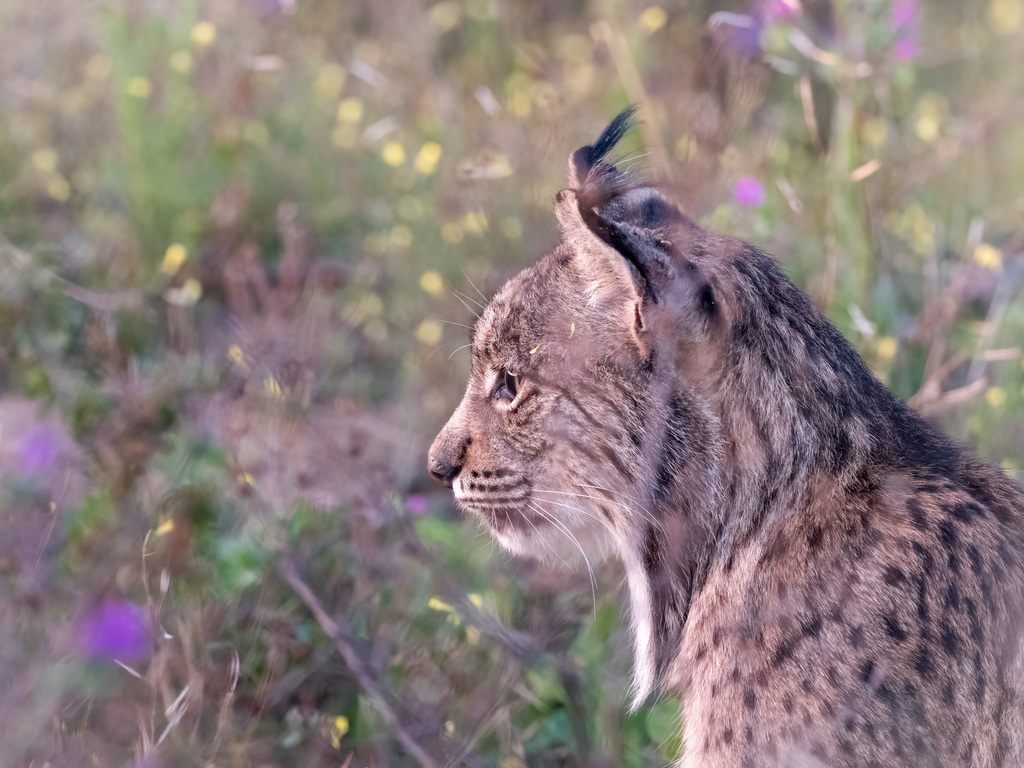
The Iberian lynx (Lynx pardinus) is Europe's most range-restricted wild cat, found only in a handful of sites in southern Spain and now Portugal. It weighs 9-15 kg, eats almost nothing but European rabbit, and carries a spot pattern as unique as a fingerprint.
Of the four lynx species alive today, the Iberian lynx occupies the smallest range by a significant margin. The Eurasian lynx stretches from Portugal to eastern Siberia. The Canada lynx spans most of boreal North America. The bobcat ranges coast to coast across the United States. The Iberian lynx lives in a handful of patches of Mediterranean scrubland in southern Spain, with breeding populations now beginning to reestablish in Portugal after decades of absence.
How to identify an Iberian lynx
The Iberian lynx is more heavily spotted than any other lynx species. The base coat is tawny to light brown, overlaid with dense dark brown or black spots that are crisper and more clearly defined than those of the Eurasian lynx. The face carries a prominent ruff of longer fur around the cheeks, and the ears are tipped with pronounced black tufts, the signature feature of all lynx species.
The spot pattern is individually unique. Researchers identify individual animals in the field by photographing the flanks, analysing the pattern, and matching it against a growing photo-ID database covering every known individual. The spots are as reliable an identifier as a fingerprint, which makes camera trap data and public wildlife photos directly useful for tracking the population.
Key field marks at a glance:
- Dense, clearly defined dark spots across the back and flanks
- Pronounced facial ruff (more developed than the Eurasian lynx)
- Black ear tufts (longer proportionally than on a bobcat)
- Very short, stubby tail with a black tip
- Long legs relative to body size, giving a high-shouldered silhouette
Where does it live and why only there?
The Iberian lynx is almost entirely defined by the European rabbit (Oryctolagus cuniculus). More than 90% of its diet is rabbit: one adult lynx needs roughly one rabbit per day. The species' range is therefore determined almost entirely by where rabbit populations are dense and stable.
The two main breeding populations are in Doñana National Park in the province of Huelva, and the Sierra Morena range across Jaén and Córdoba. Both are areas of Mediterranean scrubland, known locally as maquis or monte, with dense stands of rosemary, cistus, and gum rockrose providing cover for both the lynx and its prey. Since the mid-2010s, animals have been translocated to other suitable areas in Spain and Portugal, and breeding has been confirmed in some of these new sites.
The Iberian lynx is nocturnal to crepuscular, most active at dawn and dusk. It hunts by stalking through low scrub, using cover to approach within close range before rushing. It will also take ducks, herons, and deer fawns when rabbits are scarce, but this flexibility has limits: without a stable rabbit population in the territory, an Iberian lynx cannot maintain condition.
The spot pattern as a field tool
For a field observer, the individually unique spot pattern offers an unusual opportunity. A clear lateral photograph of an Iberian lynx is not just a sighting record: it is potential identification data. Submit a lateral photo to iNaturalist with the Iberian lynx taxon and the location, and researchers can potentially link it to an identified individual from the monitoring database.
This makes the Iberian lynx one of the few wild cats where a single wildlife photo by a member of the public contributes directly to individual-level population monitoring. In wild cat identification, this is unusual. Most cat species are too uniformly patterned or live in habitats where lateral photos are almost impossible to obtain.
What distinguishes it from a bobcat or Eurasian lynx?
The bobcat (Lynx rufus) is similar in size but less heavily spotted and lacks the Iberian lynx's dense facial ruff. The ear tufts are shorter. The bobcat's tail may show faint barring rather than a clean black tip.
The Eurasian lynx (Lynx lynx) is considerably larger (18-30 kg versus 9-15 kg for the Iberian) and less densely spotted or may appear almost plain grey in some populations. In the field, the Eurasian lynx's much larger size, broader paws, and less dramatic facial ruff distinguish it. The two species do not currently overlap in range.
For other apex predators in European habitats, the wolf and brown bear share some of the Iberian lynx's range in the Sierra Morena, though in different microhabitats.
Three facts worth knowing
- A male Iberian lynx territory covers 10 to 20 km². He will scent-mark every few hundred metres with urine and scratch marks on rocks and trees, creating a boundary legible to other lynx for days.
- The species has one of the most specific diets of any large European carnivore. The European rabbit itself has suffered serious population crashes from myxomatosis and rabbit haemorrhagic disease since the 1950s, and the lynx range has contracted with it.
- Females raise kittens alone. Litters average two to three kittens. Juvenile mortality is high: surviving kittens typically disperse at 10 to 14 months to find new territories, and dispersal across roads and agricultural land is a significant source of mortality for young animals.
Iberian lynx: frequently asked questions
What is the Iberian lynx?
Lynx pardinus is a medium-sized wild cat found only in southern Spain, with small populations now expanding into Portugal. It weighs 9-15 kg and reaches 85-110 cm body length. It is the wild cat with the most restricted natural range of any species in Europe.
How do you identify an Iberian lynx?
Dense dark spots on a tawny coat, prominent facial ruff, tufted ears, and a short tail with a black tip. The spots are denser and more defined than on any other lynx. Each individual's pattern is unique, like a fingerprint, and can be used for photo-ID.
Where does the Iberian lynx live?
Southern Spain, with breeding populations in Doñana National Park (Huelva) and the Sierra Morena range (Jaén and Córdoba). Small populations have recolonised parts of Portugal. It favours Mediterranean scrubland where European rabbit is abundant.
What does the Iberian lynx eat?
Over 90% European rabbit. One adult needs roughly one rabbit per day. The Iberian lynx's range is almost entirely determined by where rabbit populations are large and stable. It takes waterfowl, deer fawns, and small mammals when rabbits are scarce.
Is the Iberian lynx dangerous to people?
No. The Iberian lynx is secretive, nocturnal, and strongly avoids humans. Wild sightings are brief and the animal retreats at the first sign of a person. There are no recorded unprovoked attacks on humans.
How rare is the Iberian lynx in Kaught?
Epic tier: three diamonds out of four. Kaught rarity reflects observation frequency. The Iberian lynx has an extremely restricted range confined to a handful of areas in southern Spain. Outside those sites, a sighting is essentially impossible; within them, the animal is nocturnal and avoids detection.
The next thing you see could be
your first catch.
Kaught launches soon. Join the waitlist and be first to start a collection of the living world, one photo at a time.
Free at launch · No spam, just one email on launch day
Species data, type, rarity tier and measurements, is drawn from the Kaught catalog, built on open biodiversity records from GBIF and iNaturalist. Rarity reflects how often a species is observed in the wild, not its conservation status.