Behaviour explainer
Why spotted hyenas win more hunts than lions
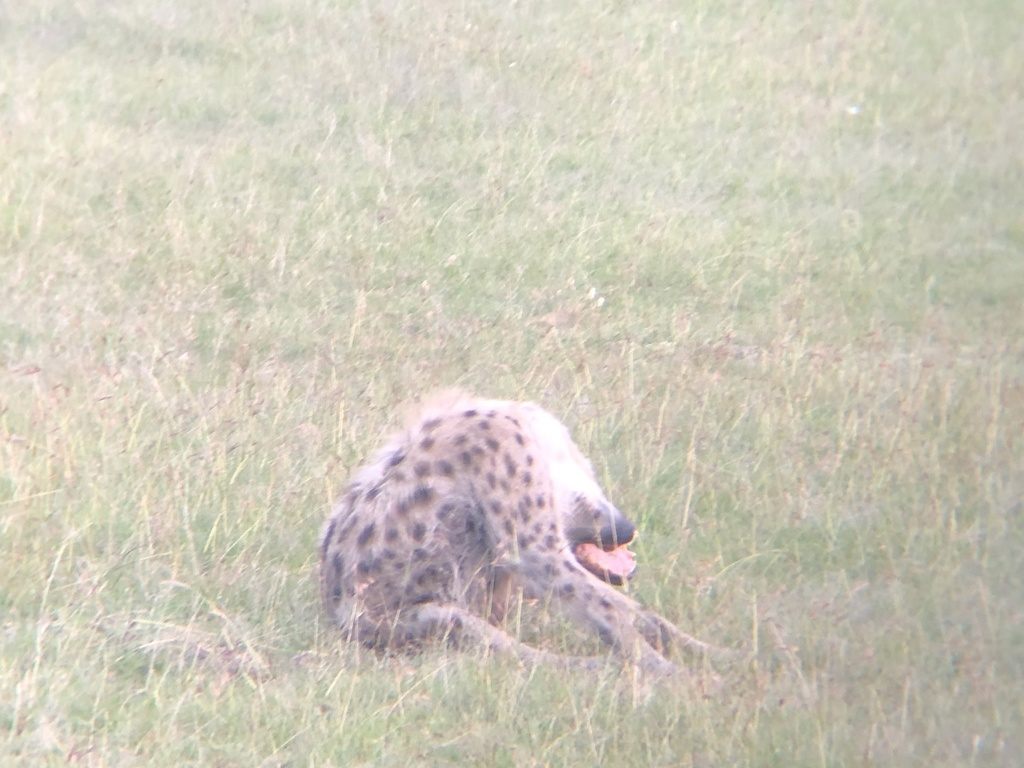
The spotted hyena (Crocuta crocuta) succeeds on 70 to 80% of hunts, far outperforming lions at 17 to 30%. It is Africa's most effective large predator: a matriarchal, clan-living endurance hunter with a bone-crushing bite, a pseudo-penis on every female, and a social system more complex than most primates.
Most people's mental image of the spotted hyena is of a scavenger skulking at the edges of a lion kill. Long-term field research across the Serengeti and Masai Mara overturned that image decades ago. In those ecosystems it is often lions stealing from hyenas, not the other way around.
The endurance hunting system
Lions are ambush predators. They close the gap in a short burst (maximum around 400 m) and kill fast or give up. Spotted hyenas hunt differently: they chase prey at a sustained 50 to 60 km/h for distances of up to 5 km, running targets to exhaustion before the clan closes in for the kill.
The physiology supports this. The hyena's hindquarters are lower than its shoulders, giving it a distinctive sloping stance that is actually a gait adaptation for long-distance travel. Its heart is proportionally large for its body mass. Its feet are unusually hard-padded and designed for continuous ground contact, not the explosive claw-grip of a cat.
Once prey slows enough, the clan tears it apart. Unlike big cats, hyenas kill by disembowelling and biting into the body cavity rather than a precision throat or nape bite. It is faster for a group, and allows multiple clan members to feed simultaneously.
The bite that eats bones
The spotted hyena has one of the most powerful bites of any land predator relative to body size. Bite forces have been measured at around 4,500 Newtons in large adults, exceeding that of a lion despite the hyena being much lighter. Crucially, this force is not just for killing: it is for bone-crushing. Hyenas routinely consume the femurs of wildebeest and zebra whole, digesting them with highly acidic stomach contents. Nothing goes to waste. The white droppings of spotted hyenas are calcium-rich bone residue, distinct from any other large predator's scat.
This ability to process carcasses completely means spotted hyenas extract more energy per kill than any competing large carnivore. It also means they can thrive at lower prey densities than lions, which need higher encounter rates to sustain a coalition.
A matriarchy, and why it matters
Spotted hyena clans of 5 to 90 individuals are run entirely by females. The lowest-ranking female in the clan ranks above any adult male. This is not just a social quirk: it has practical consequences for who eats first, who breeds with whom, and which cubs survive.
Female spotted hyenas are on average larger than males and have significantly elevated testosterone and androgen levels throughout their lives, including in the womb. This produces the pseudo-penis, an enlarged clitoris in each female that closely mimics the male organ. Every social greeting, dominance check and mating encounter involves this structure. Cubs are born through it, making hyena birth one of the most physiologically challenging deliveries in the mammal world. Firstborn cubs in inexperienced mothers frequently die during this process.
The reason for this unusual biology is still debated. The leading hypothesis connects elevated androgens to the intense competitive environment of communal feeding, where females competing for access to kills benefit from the same aggression-linked hormones as males.
Calls and communication
The "whoop" call is the most recognisable sound in the African night and carries over 5 km of open savanna. It functions as a long-range location signal: a hyena separated from its clan whoop-calls, others respond and the group reconverges. The famous "giggle" is not laughter, it is a submissive signal given by a lower-ranking animal to a dominant one, often while trying to hold on to food under threat.
Spotted hyenas have a vocabulary of at least 11 distinct calls, each with a precise social function. Their intelligence has been formally tested and compared to the smartest animals: in cooperative problem-solving tasks requiring one animal to release a mechanism while another feeds, hyenas have significantly outperformed lions tested on the same apparatus.
Hyena vs lion: the real relationship
Lions and spotted hyenas compete intensely for food and territory. Lions kill hyenas when they can. Hyenas steal lion kills opportunistically and mob lions in large groups. Hans Kruuk's long-term work in the Serengeti in the 1970s documented that lions took hyena kills more often than hyenas stole from lions, directly overturning the scavenger reputation. In the Kalahari and other ecosystems without large lion prides, hyenas are the unambiguous apex predator.
Compare this with African wild dogs, which succeed on around 80% of hunts but in small packs against smaller prey. Hyenas do it at scale, in larger groups, against animals as large as adult zebra, making them by most ecological measures the most effective large predator on the continent.
Spotted hyena: frequently asked questions
Are spotted hyenas more effective hunters than lions?
Yes. Spotted hyenas succeed on 70 to 80% of hunts vs lions' 17 to 30%. Their endurance hunting strategy, clan coordination and powerful bite allow them to run prey to exhaustion across long distances, an approach lions cannot sustain.
What do spotted hyenas eat?
Mostly freshly hunted prey: wildebeest, zebra, gazelle and large ungulates taken in cooperative chases. Research shows they kill the majority of carcasses they eat in the Serengeti, including many later stolen by lions. They also scavenge opportunistically.
Why are hyena clans matriarchal?
Female spotted hyenas are larger than males and have higher androgen levels, driving a hierarchy in which the lowest-ranking female outranks any adult male. This biology is thought to be linked to the competitive communal feeding environment where aggression determines food access.
What is the spotted hyena's pseudo-penis?
An enlarged clitoris that closely resembles a penis, complete with pseudo-scrotum. All social greetings, dominance checks and mating happen via this organ, and females give birth through it. No other mammal has an equivalent structure.
Are spotted hyenas dangerous to humans?
They can be, particularly where livestock conflict is high or where they have lost fear of people. Attacks on sleeping humans occur in rural East Africa. Their bite force and group size make a provoked or habituated clan a serious threat.
How rare is the spotted hyena in Kaught?
Rare: two diamonds out of four. Spotted hyenas are nocturnal, wide-ranging and occur across vast stretches of sub-Saharan Africa, making a confirmed clear daytime encounter genuinely uncommon outside high-density game reserves. Kaught's rarity reflects observation frequency, not any conservation status.
The next thing you see could be
your first catch.
Kaught launches soon. Join the waitlist and be first to start a collection of the living world, one photo at a time.
Free at launch · No spam, just one email on launch day
Species data, type, rarity tier and measurements, is drawn from the Kaught catalog, built on open biodiversity records from GBIF and iNaturalist. Rarity reflects how often a species is observed in the wild, not its conservation status.