Exotic spotlight
Sitatunga: Africa's only truly aquatic antelope and how it disappears into a papyrus swamp
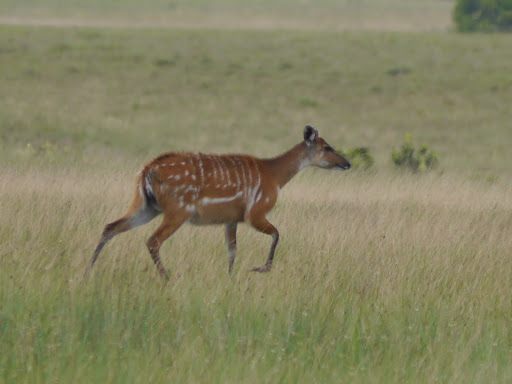
The sitatunga (Tragelaphus spekii) is the only antelope in Africa built for life in water. Hooves that splay to 18 cm, oily waterproof fur, and the ability to submerge up to the nostrils let it vanish into papyrus swamps where no predator can easily follow.
Africa has many wetland animals. The hippopotamus dominates deep water. The red lechwe and the puku wade the shallow margins. The African buffalo drinks daily and will cross rivers without hesitation. But none of these animals are built, structurally and behaviourally, for permanent life in a swamp. The sitatunga is.
The swamp-adapted body
Start with the hooves. On firm ground, a sitatunga looks awkward: its rear legs are noticeably longer than its front legs, creating a downward slope from rump to head that makes the animal appear to be perpetually walking downhill. This posture makes sense the moment it enters water. The tilted body lowers the head to water level for feeding on aquatic vegetation without submerging the neck.
The hooves themselves splay dramatically when weight is applied, reaching up to 18 cm across on a large male. The false hooves (dewclaws) are enlarged and spread outward, adding another contact surface. Together, they distribute the animal's mass across a large area, preventing sinking into soft sediment and allowing grip on floating papyrus stems that would not bear concentrated weight.
The coat is oily. Run a hand across a sitatunga's flank and your fingers come away slightly greasy. The oils repel water, maintaining insulation even after hours of wading. Males grow a shaggy, unkempt mane along the dorsal line that adds to the waterproofing. The fur traps air against the skin even when wet.
Sexual dimorphism: two very different animals
Males and females look so different that early naturalists described them as separate species. Males are large (up to 120 kg), dark chocolate-brown with age, marked with white vertical stripes and spots on the flanks, and carry long spiral horns that typically reach 60 to 90 cm, sometimes exceeding 1 m. The horns spiral once to twice and diverge outward. A male in prime condition also produces a musk detectable by a human nose from up to 30 m away, generated by glands on the face and between the hooves.
Females are smaller (around 55 kg), bright chestnut-red to orange-brown, and hornless. They carry a white chevron between the eyes and white spots and stripes similar to the male pattern but less prominent. A female sitatunga is often mistaken for a different species by observers unfamiliar with the animal.
Where to find one
Sitatunga are restricted to the continent's major swamp systems: the Congo Basin, the Okavango Delta in Botswana, the Bangweulu Swamps in Zambia, the Sudd in South Sudan, and the lake-margin papyrus beds of Lakes Victoria, Tanganyika, and Kyoga. They are also found in coastal mangroves in parts of West Africa.
The animal rarely ventures beyond 100 m from water. When it does, it is almost always at night. Daytime activity is either at the water's edge or within dense papyrus and reed beds where visibility drops to a few metres. The best viewing opportunity in accessible areas is dawn or dusk at known sitatunga sites: the Okavango Delta by mokoro canoe, or the papyrus margins of Lake Victoria from a boat.
The animal shares its habitat with other African wetland species including the African fish eagle, the shoebill, and the semiaquatic sitatunga's own tribe-mates: the nyala and greater kudu, both of which share the genus Tragelaphus but are dry-land animals.
The escape strategy
When a predator approaches, the sitatunga's primary response is to walk deeper into the swamp rather than to run. Leopard, wild dog, and spotted hyena all follow prey onto open ground effectively. None of them are strong swimmers, and papyrus stands are physically impenetrable to a running predator at speed.
A threatened sitatunga will submerge itself to the nostrils, standing motionless with only eyes, nostrils and the tips of the ears above the water line. The scent trail stops at the water's edge. Crocodile are the primary aquatic threat, and the sitatunga avoids deeper water and fast-flowing channels where crocodile lie in wait. The escape into water is therefore not limitless: the animal has calibrated it to the exact depth where terrestrial predators cannot follow but crocodile density is low.
Why Epic in Kaught?
The sitatunga earns three diamonds, the Epic tier, because confirmed sightings are genuinely uncommon in biodiversity records relative to most African ungulates. The reason is access: its swamp habitats are largely inaccessible by vehicle, require boats or specialist guides to navigate, and the dense papyrus makes reliable observation difficult even when the animal is present. A photo clear enough for identification in poor light and vegetation cover is a real achievement.
For comparison, the impala sits at the common tier despite being a prey species in the same African ecosystem. The contrast is entirely about habitat accessibility, not animal abundance.
Sitatunga: frequently asked questions
What is a sitatunga?
Tragelaphus spekii is a medium-to-large swamp-dwelling antelope found in central and east Africa. Males weigh up to 120 kg and carry spiral horns. It is the only antelope in Africa truly adapted to aquatic life, spending most time wading through papyrus and reed-bed swamps.
How does the sitatunga walk in swamps?
Hooves splay to up to 18 cm wide, spreading weight across soft mud and floating vegetation. Rear legs are longer than front legs, tilting the body forward and lowering the head for browsing in water. Fetlock joints are highly flexible, lifting each hoof cleanly from deep mud.
Where does the sitatunga live?
Papyrus swamps, reed beds, and flooded forest across central and east Africa: the Congo Basin, the Okavango Delta, the Sudd (South Sudan), Lake Victoria's shoreline, and Bangweulu Swamps (Zambia). Almost never found on dry land beyond 100 m of water.
Can sitatunga swim?
Yes. Sitatunga swim readily and will submerge to the nostrils to escape predators. When a leopard or wild dog approaches, they walk into deep water and stand motionless with only the head above the surface, using water to mask scent and break the predator's approach.
How rare is the sitatunga in Kaught?
Epic tier: three diamonds out of four. Kaught rarity reflects observation frequency. The sitatunga is restricted to specific swamp habitats that are inaccessible to most observers. Even in known areas, locating it within dense papyrus requires specific access and timing.
Do male and female sitatunga look different?
Very different. Males are dark chocolate-brown with white stripes, a shaggy mane, and long spiral horns (60-90 cm). Females are smaller (~55 kg), bright chestnut-red, and hornless. The sexual dimorphism is among the most pronounced of any African antelope.
The next thing you see could be
your first catch.
Kaught launches soon. Join the waitlist and be first to start a collection of the living world, one photo at a time.
Free at launch · No spam, just one email on launch day
Species data, type, rarity tier and measurements, is drawn from the Kaught catalog, built on open biodiversity records from GBIF and iNaturalist. Rarity reflects how often a species is observed in the wild, not its conservation status.