
Species spotlight
American Crocodile: the salt-tolerant apex reptile of the Americas
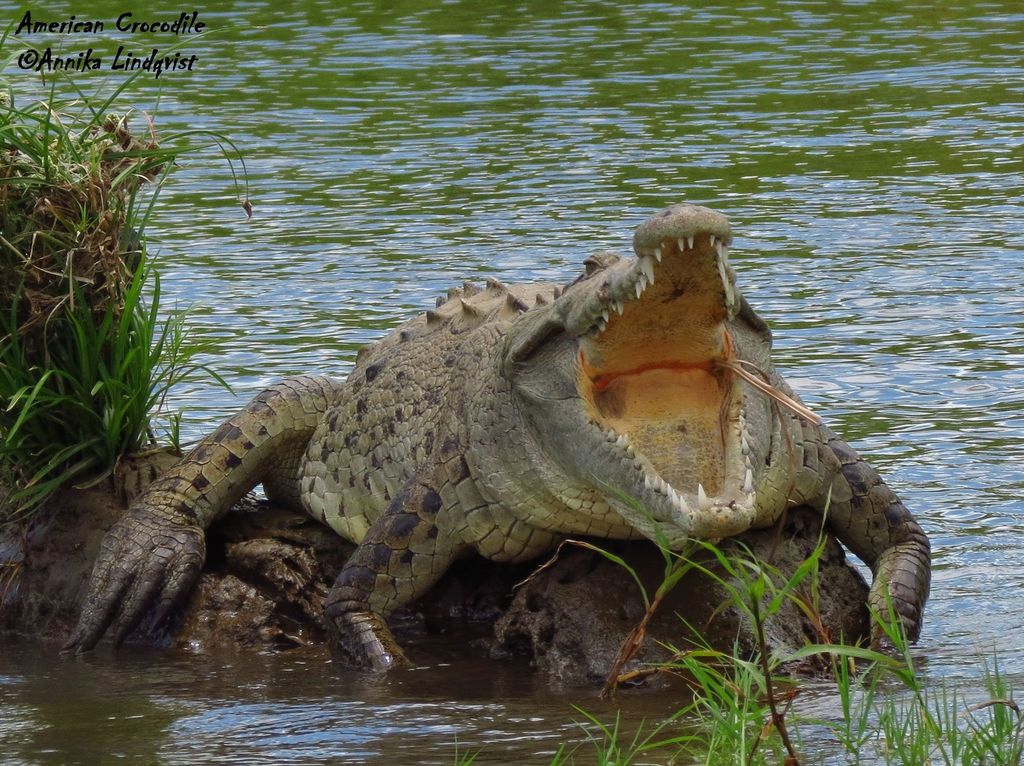
The American Crocodile (Crocodylus acutus) is a large greenish-grey reptile with a narrow, pointed snout, found in coastal mangroves, estuaries and lagoons from Florida through Central America and the Caribbean to South America. It is the only crocodilian in the Americas capable of living in full seawater indefinitely.
There are four crocodilian species in the Americas: the American alligator, the spectacled caiman, the black caiman and this one. The American Crocodile is the largest and the most ocean-capable of the group, capable of crossing open sea between Caribbean islands and living indefinitely in salt water that would challenge any of its relatives. It is also, by crocodilian standards, surprisingly shy.
How to identify an American Crocodile
The most useful field marks:
- Snout: distinctly narrow and tapering, more like a V than a U. This is the fastest way to separate a crocodile from an alligator, which has a wide, rounded, U-shaped snout.
- Fourth lower tooth: visible when the mouth is shut. The fourth tooth on each side of the lower jaw protrudes upward through a notch in the upper jaw. On an alligator, both jaws close fully and this tooth disappears.
- Colour: pale greenish-grey to olive-brown above, significantly lighter than the dark grey-black of the American alligator.
- Lingual salt glands: not visible from a distance, but functional. Tiny glands on the tongue actively secrete excess salt, allowing the animal to drink and function in seawater.
- Size: adults are large, males reaching up to 4.5 m and 400 kg. Females are smaller, typically under 3 m.
In the water, both crocodile and alligator are visible mainly as a pair of eye bumps and nostrils at the surface, which look identical. In that situation, location tells you more than morphology: saltwater mangroves and brackish coastal lagoons mean crocodile; freshwater marsh and inland swamp mean alligator.
Range and habitat
The American Crocodile has the widest range of any New World crocodilian. Its distribution runs from the southern tip of Florida, where a small and historically persecuted population still holds on around Everglades National Park and Florida Bay, south through the Caribbean islands (Cuba, Jamaica, Hispaniola, Puerto Rico and various smaller islands) and all of the Central American coast on both Pacific and Caribbean sides, continuing along the Pacific coast of Colombia, Ecuador and Peru and the Caribbean coast of Venezuela and Colombia.
It is a coastal specialist. The core habitat is mangrove estuaries, river mouths, brackish lagoons and coastal swamps. It ventures into freshwater rivers and lakes, but unlike the alligator it is equally comfortable well offshore, and has colonised islands by open-sea swimming. This salt tolerance, underpinned by the lingual salt glands, is the defining ecological advantage of the species within the Americas.
The salt gland: one adaptation that sets it apart
All crocodilians have tiny pores on their skin and tongue. In most species these are sensory, detecting pressure and vibration. In the American Crocodile and a handful of other Crocodylus species (including the saltwater and Nile crocodile), the lingual pores are also functional salt-secreting glands. They actively pump sodium and chloride ions out of the blood and onto the tongue surface, from where they rinse away with saliva or water.
This active salt excretion means the animal can maintain a stable internal salt balance even when living and drinking in full seawater. The American alligator, by contrast, has lingual pores but they are not functional salt glands, and alligators avoid saline water because they cannot regulate salt excretion at the renal level alone.
Behaviour and hunting
The American Crocodile is predominantly nocturnal. It spends daylight hours partly submerged or basking on exposed mudbanks near the water, retreating at the first sign of disturbance. In areas frequented by people, adults become almost entirely nocturnal and may be present in a lagoon for years without being seen. This behavioural wariness is part of why the species sits at the Epic tier in the Kaught catalog: knowing they are there and actually seeing one are different things.
Hunting follows the classic crocodilian template: absolute patience at the waterline, then an explosive lunge. Fish make up most of the diet throughout life. Larger adults add turtles, waterbirds and mammals. The bite force, while not measured as precisely as in the saltwater or Nile crocodile, is sufficient to crush turtle shells and seize large prey at the water's edge. Like the Nile Crocodile, this species bites and holds rather than striking and releasing; prey is drowned or killed by the grip before being swallowed.
Nesting and parental care
Females nest in sandy riverbanks, lake shores or beach margins, digging a hole in which they lay 30–70 eggs. Unlike many tropical crocodilians, the American Crocodile sometimes makes mound nests in areas where sand temperature is less reliable, incubating eggs in decomposing vegetation. The female guards the nest throughout the 75–90 day incubation period, a long-term commitment by any reptile standard.
When eggs begin to hatch, the female excavates the nest and gently carries hatchlings to the water in her mouth, the same behaviour seen in the Nile Crocodile. Hatchlings are approximately 25 cm long at birth and are vocal, calling with high-pitched chirps to orient the mother. The female may guard the hatchling group for several weeks.
American Crocodile vs American Alligator: quick comparison
If you are in Florida, the question of which species you are looking at has a simple answer in most cases:
- Habitat: saltwater or brackish mangroves: crocodile. Freshwater swamp or lake: alligator. Both species are present in the southernmost tip of Florida, one of the only places in the world where a wild crocodile and a wild alligator can occupy overlapping habitat.
- Snout shape: crocodile snout is narrow and V-shaped; alligator snout is wide and U-shaped.
- Colour: crocodiles are lighter, more olive or grey-green; alligators are darker grey to near-black.
- Temperament: American alligators will approach humans in areas where feeding has made them habituated. American crocodiles in the same region are typically more wary and retreat quickly.
See our guide to the American Alligator for a full profile of its close relative, and our strongest animal bites ranking for where crocodilian bite forces sit against other apex predators.
Three things that make this crocodile unusual
- It is the only crocodilian in North or South America capable of sustained life in full seawater, thanks to functional lingual salt glands.
- Despite a range covering three continents and dozens of islands, it is generally less aggressive toward people than its Nile or saltwater cousins, with documented attacks being significantly rarer relative to its abundance.
- In southern Florida, the American Crocodile and the American Alligator share the same coastline, the only location on Earth where two different crocodilian genera share a wild habitat. The two species rarely interact directly but can occasionally be seen on the same stretch of bank.
American crocodile: frequently asked questions
What does an American crocodile look like?
A large greenish-grey to olive-brown reptile up to 4.5 m in males, with a distinctly narrow, pointed, V-shaped snout. The fourth lower tooth is visible when the jaw is closed. The body is more slender and lighter-coloured than the American alligator, and small functional salt glands on the tongue allow it to excrete excess salt from seawater.
Where does the American crocodile live?
Coastal mangroves, estuaries, lagoons and river mouths from southern Florida through the Caribbean islands and all of Central America, south to the Pacific coast of Peru and the Caribbean coast of Venezuela. It is the most ocean-capable crocodilian in the Americas and has colonised Caribbean islands by open-sea swimming.
Is the American crocodile dangerous?
It is capable of causing serious injury and is an apex predator, but attacks on people are rare compared to the saltwater or Nile crocodile. It is typically wary and retreats from human presence rather than approaching. Treat all large crocodilians with caution, maintain distance, and avoid wading near known basking sites at night.
How is the American crocodile different from an alligator?
The crocodile has a narrower V-shaped snout, a lighter grey-olive colour, and the fourth lower tooth is visible with the mouth closed. Alligators have a wider U-shaped snout, darker colour, and the fourth tooth is hidden. Crocodiles also tolerate full seawater while alligators avoid it. In Florida both species can overlap in the southernmost coastal areas.
What does the American crocodile eat?
Fish at all ages, supplemented by turtles, waterbirds, crabs and mammals. Large adults can take prey as big as deer at the waterline. Like all large crocodilians, it is an ambush predator that lurks at the surface and strikes with explosive speed. Prey is drowned or killed by the grip before being swallowed.
Why is the American crocodile Epic in Kaught?
Kaught's rarity reflects how often a species is actually observed in the wild. The American crocodile occupies specific coastal mangrove habitats and is predominantly nocturnal, spending daylight hours submerged or in dense vegetation. A clear daylight sighting of an adult is genuinely uncommon across its range, placing it at the Epic tier.
The next thing you see could be
your first catch.
Kaught is live on the App Store and Google Play. Free to start, and your first catch is one photo away.
Free to start · Live on the App Store and Google Play
Species data, type, rarity tier and measurements, is drawn from the Kaught catalog, built on open biodiversity records from GBIF and iNaturalist. Rarity reflects how often a species is observed in the wild, not its conservation status.