
Record holders
Longest Tongues in the Animal Kingdom: 6 Ranked
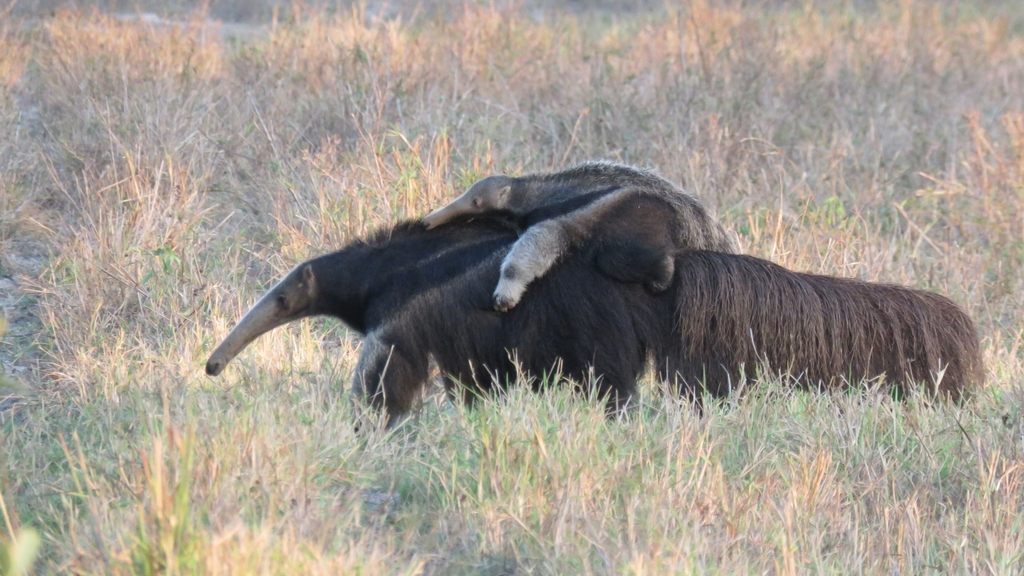
No single winner: a Giant Anteater's tongue reaches 60 cm and flicks 150 times a minute, while a Blue Whale's is the heaviest tongue of any animal, roughly as much as an elephant. A Southern Giraffe's 45 cm tongue is the longest of any land herbivore. Six real tongue records, ranked.
"Longest tongue" sounds like a single trophy, but the record splits apart the moment you ask what the tongue is actually for: scooping insects from a mound, filtering krill by the tonne, stripping leaves past thorns, or launching across open air in a fraction of a second. Line up the genuine record-holders and the length, the weight and the speed each belong to a different animal entirely. Every species below is in the Kaught catalog with its own observation-derived rarity tier.
1. Giant Anteater, a 60cm tongue it flicks 150 times a minute
A giant anteater has no teeth at all. In their place, a tongue up to 60 centimetres long, coated in sticky saliva and covered in tiny backward-pointing spines, does every bit of the feeding. It flicks in and out of torn-open ant and termite mounds up to 150 times a minute, hauling in roughly 35,000 insects a day without a single bite.
The tongue is anchored not at the jaw but deep in the chest, attached near the breastbone, which is part of how an animal with such a long, narrow snout can still fit that much length inside. Common in the catalog, one diamond: a genuinely easy species to find across its range, even if watching that tongue in action takes patience.
2. Blue Whale, the heaviest tongue of any animal alive
Where the anteater wins on reach, the blue whale wins on sheer mass. Its tongue alone can weigh around 2.7 tonnes, roughly as much as a full-grown elephant, making it the heaviest tongue of any animal on Earth, living or extinct among vertebrates. It works together with an expandable, pleated throat pouch that unfurls like an accordion.
During a single lunge, that pouch and tongue combination can take in a mouthful of water and krill greater than the whale's own body weight, before the tongue helps force the water back out through baleen plates and leave the krill behind. Common in the catalog, one diamond, found across every ocean on the planet.
3. Southern Giraffe, the longest tongue of any land herbivore
At 45 to 50 centimetres, a giraffe's tongue is the longest of any land-dwelling herbivore, long enough for the animal to groom its own ears and nostrils. It is also prehensile, able to curl fully around a cluster of acacia leaves and strip them free while the lips and tongue work together around the tree's thorns.
The front half of the tongue is pigmented a dark blue-black, a trait thought to shield the tissue from sunburn during the many hours each day it spends exposed, wrapped around leaves in direct equatorial sun. Common in the catalog, one diamond, grazing the high canopy across southern African savanna.
4. Aardvark, a 30cm tongue built for ants
An aardvark's tongue reaches about 30 centimetres, thin, round and worm-like, coated in a thick, sticky saliva that traps ants and termites on contact. It is shorter than the anteater's and does the same job by convergent evolution, two unrelated mammals on two continents arriving at the same long, sticky answer to the same problem.
Strictly nocturnal, an aardvark uses powerful spade-like claws to rip open a mound before the tongue goes to work, then moves on to the next one before dawn. Rare in the catalog, two diamonds, for an animal that is genuinely widespread but rarely seen awake.
5. Panther Chameleon, a tongue that launches twice its body length in 20 milliseconds
A panther chameleon's record isn't length so much as what the length does. Its tongue can extend to nearly twice its own body length and reach full extension in under 20 milliseconds, among the fastest muscle-powered strikes recorded in any vertebrate. The motion comes from stored elastic energy in tissue around a bony tongue core, released all at once rather than driven by ordinary muscle contraction.
A sticky, suction-cupped tip grabs the insect and the whole strike, launch to full retraction, is over before a human eye can properly register it happened. Rare in the catalog, two diamonds, perched motionless in humid Madagascar forest until something edible wanders into range.
6. Great Spotted Woodpecker, a tongue long enough to wrap around its own skull
A great spotted woodpecker's tongue only extends a few centimetres past the bill tip, modest next to the others on this list, but the structure behind it is the strangest of all six. It is anchored to an extended hyoid apparatus that splits at the throat, loops up around the back of the skull, passes close to the eye sockets, and curls forward again before reaching the tongue itself.
That looped extra length is what lets a barbed, sticky tip probe deep into tunnels a straight tongue could never reach, and some researchers think the same wraparound structure doubles as internal cushioning that helps the skull absorb thousands of daily impacts. Common in the catalog, one diamond, found wherever there are mature trees to drill.
Why "longest tongue" depends on what you're measuring
Set these six side by side and the pattern repeats: there's no single champion, only whichever record you're asking about. The anteater needs reach and repetition to harvest insects without teeth. The blue whale needs mass and an expandable pouch to filter-feed at ocean scale. The giraffe needs grip and sun protection to browse past thorns for hours. The aardvark needs the same sticky trick as the anteater, arrived at independently. The chameleon needs raw speed over length. The woodpecker needs a structure wound clean around its own skull.
A different kind of tongue entirely belongs to the animal that uses one to see the world rather than feed: the water monitor lizard's forked tongue samples scent particles out of the air. For more real records measured the same way, see the animal kingdom's most teeth and heaviest animals, and for two of the record-holders above in full, the panther chameleon's colour-changing skin and how a woodpecker survives its own drumming.
Longest tongues: frequently asked questions
What animal has the longest tongue in the world?
There's no single winner. A giant anteater's 60cm tongue is the longest relative to its own head, a blue whale's is the largest and heaviest tongue of any animal alive, and a giraffe's 45cm tongue is the longest of any land herbivore. Three different kinds of "longest."
How long is a giraffe's tongue and why is it dark?
A giraffe's tongue runs 45 to 50 centimetres, long enough to groom its own ears, and the front half is pigmented dark blue-black. That pigment is thought to protect the tip from sunburn during the many hours each day it spends wrapped around acacia leaves in direct sun.
How much does a blue whale's tongue weigh?
A blue whale's tongue alone can weigh roughly 2.7 tonnes, as much as an elephant, making it the heaviest tongue of any animal on Earth. It works with an expandable throat pouch to engulf huge volumes of water and krill in a single lunge.
How fast does a chameleon's tongue move?
A panther chameleon can launch its tongue to nearly twice its body length in under 20 milliseconds, among the fastest muscle-powered movements measured in any vertebrate. The strike relies on stored elastic energy released in an instant, not raw muscle contraction.
Why does a giant anteater have such a long tongue?
A giant anteater has no teeth at all, so its 60cm tongue, coated in sticky saliva and flicked in and out up to 150 times a minute, does all the work of gathering food: roughly 35,000 ants and termites a day from torn-open mounds.
How does a woodpecker's tongue wrap around its skull?
A woodpecker's tongue is anchored to an extended hyoid structure that splits at the throat, loops up around the back and over the top of the skull, then curls forward near the eye sockets. That extra length lets the barbed tip probe deep into tunnels beyond the bill.
Does an aardvark have a long tongue too?
Yes. An aardvark's tongue reaches about 30cm, thin, sticky and worm-like, extended night after night into torn-open ant and termite mounds. It is shorter than a giant anteater's but works on the same unrelated-animal, same-solution principle.
The next thing you see could be
your first catch.
Kaught is live on the App Store and Google Play. Free to start, and your first catch is one photo away.
Free to start · Live on the App Store and Google Play
Species data, type, rarity tier and measurements, is drawn from the Kaught catalog, built on open biodiversity records from GBIF and iNaturalist. Rarity reflects how often a species is observed in the wild, not its conservation status.