
Adaptation explainer
How do chameleons change colour? It is not pigment. It is crystals.
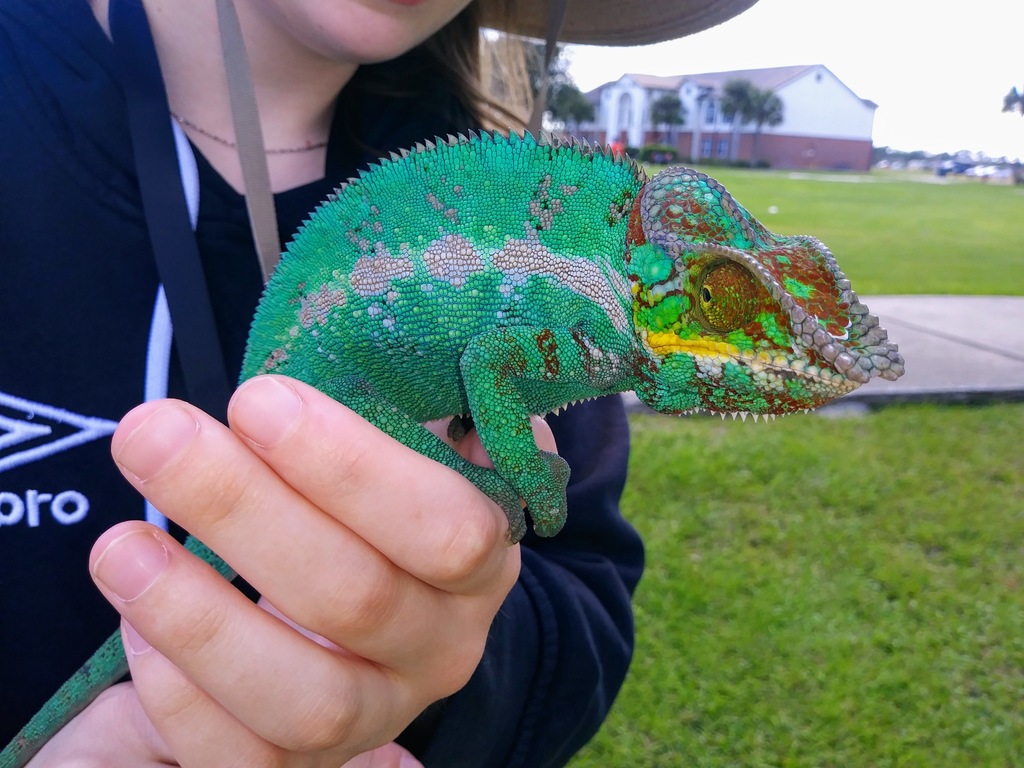
Chameleons change colour not by shifting pigments but by rearranging nano-crystal arrays inside specialised skin cells. When the crystals expand, they reflect longer wavelengths (reds, oranges, yellows). When compressed, they reflect shorter wavelengths (blues). The change communicates mood and dominance, not camouflage.
For decades textbooks described chameleon colour change as the animal moving pigment granules around inside cells, the same mechanism used by many fish and cephalopods. That picture turned out to be incomplete. A 2015 study of panther chameleons from the University of Geneva showed that the most dramatic shifts, the bright blues and greens of an excited male, involve something entirely different: a living, tunable diffraction grating made of crystals.
The two layers of iridophores
The skin of a panther chameleon contains two distinct layers of specialised cells called iridophores, sitting beneath a top layer of cells that carry conventional pigments (yellows, reds, browns).
The upper iridophore layer contains nano-crystals of guanine, arranged in a three-dimensional lattice. The lattice spacing determines which wavelengths of light are reflected back, in the same way a soap bubble's colour depends on its thickness. When the male is relaxed, the crystals pack tightly and reflect short wavelengths: blue and green tones. When he is excited, the crystalline lattice expands and the reflected wavelength shifts toward yellow and red. The transition can happen in under two minutes.
The lower iridophore layer has larger, more disordered crystals. These do not produce visible colour signals. They reflect near-infrared radiation, effectively acting as a thermal shield that reduces how much solar heat penetrates to the skin beneath. It is passive body temperature management built into the same system that produces the social display.
So what is the colour change actually for?
Camouflage is the popular answer, but the research points elsewhere. When two male panther chameleons meet, the one who can produce a brighter, more rapid colour shift almost always wins the contest. Colour signalling replaces fighting: the male with the duller display retreats. Dominant males also display bright colours when courting females, and females signal rejection by darkening their pattern and showing orange bars.
A resting chameleon in its home territory does match its background reasonably well, because its resting colour palette often aligns with the foliage it frequents. But this is background matching, not active camouflage. The animal does not scan its surroundings and deliberately match the nearest twig. The resting colour is simply the lattice in its default compressed state, which happens to be a shade of green or brown.
This matters for anyone watching a chameleon: a dramatic colour shift is almost always a social event, not a concealment event. If you see one blazing red and blue, look for a rival, a potential mate, or a handler it is unhappy about.
The panther chameleon's other adaptations
The colour is the famous feature, but the panther chameleon carries several other equally remarkable traits tied to the same arboreal lifestyle.
Zygodactyl feet. Each foot has its toes fused into two opposing bundles, two on one side and three on the other, forming tongs that grip a branch from both sides simultaneously. The grip is automatic: tendons lock the foot closed under load. The chameleon can fall asleep on a branch with no muscular effort.
Independently moving eyes. The two eyes move entirely independently, scanning through nearly 360 degrees. When an insect is spotted, both eyes converge on it simultaneously for binocular depth estimation before the tongue fires.
The tongue. The tongue launches at up to 26 body lengths per second, reaching its target in under 0.1 seconds. It is powered not by muscles but by elastic energy stored in a coiled collagen structure, which is why even a chilled, slow-moving chameleon can still shoot its tongue at full speed.
The common water monitor uses its tongue for a completely different purpose, as a chemosensory organ to taste-smell the air, illustrating how reptile tongues have been co-opted for widely different tasks across the lineage.
Colour change itself is not unique to chameleons either, it is just unusually fast and unusually social in them. The thorny devil shifts between pale and dark through the day using the same pigment-cell machinery, but for temperature control and camouflage rather than communication. Same hardware, far simpler job.
Finding a panther chameleon
The panther chameleon is endemic to Madagascar, with introduced populations on the Indian Ocean islands of Réunion and Mauritius. Within Madagascar it occurs along the northern and eastern coasts, in humid lowland forest, scrub and garden edges. Different geographic populations carry distinct resting colour patterns, called locales by reptile keepers: the Nosy Be locale is predominantly blue, the Ambanja locale vivid blue-green, the Sambava and Tamatave locales more red and orange.
In the wild, males are most visible during the dry season when they emerge to bask and patrol. They are slow-moving and, when not displaying, blend into their resting palette effectively. Look on branches 1 to 3 metres off the ground in vegetation at the forest edge, especially in the morning when males are warming up and territory patrols begin.
Kaught places the panther chameleon at the Rare tier, two diamonds. Its observation record in iNaturalist reflects a species known well in captivity but encountered in the wild mostly by travellers with a reason to look for it.
Three things worth knowing about chameleon colour
- The blue face markings of some male panther chameleons reflect UV strongly. Other chameleons and some insects can see this signal; most mammalian predators cannot, giving it a semi-private communication channel.
- Female panther chameleons live roughly one year. Males can reach five. The short female lifespan is partly a consequence of the energetic cost of repeated, large clutch egg production.
- The leafy seadragon and the chameleon arrived at elaborate camouflage from completely different evolutionary directions. The seadragon uses fixed structural appendages; the chameleon's resting colouration relies on the crystal lattice's default state. Neither actively matches its background in real time.
Chameleon colour change: frequently asked questions
How do chameleons change colour?
Chameleons change colour by adjusting the spacing of nano-crystal arrays inside specialised skin cells called iridophores. When the crystals are packed close together, they reflect short wavelengths such as blue. When the crystals spread apart, they reflect longer wavelengths such as yellow and red. A top layer of iridophores handles rapid social colour changes; a deeper layer reflects near-infrared heat.
Do chameleons change colour to camouflage themselves?
Primarily no. The main driver of colour change is social communication: displaying dominance, signalling receptiveness to mates, or warning rivals. Camouflage is a secondary benefit. A relaxed chameleon often matches its background reasonably well, but active colour shifts are social signals, not deliberate camouflage.
Which chameleon is best known for colour change?
The panther chameleon (Furcifer pardalis) of Madagascar is among the most vivid. Males can shift between greens, blues, reds, oranges and yellows within minutes during territorial encounters. Different geographic colour morphs also show distinct resting palettes.
How fast can a chameleon change colour?
Active colour changes during high-intensity encounters can occur in under two minutes. The crystal lattice rearrangement is driven by changes in the fluid surrounding the iridophore cells, which can expand or contract the lattice in seconds.
Can chameleons see colour?
Yes. Chameleons have tetrachromatic vision and can see ultraviolet light. Their colour signals likely communicate information invisible to non-UV-sensitive predators. Some patterns visible only in UV have been found on chameleon faces.
Are chameleons slow?
In movement, yes. Chameleons walk slowly and deliberately using their zygodactyl feet and a prehensile tail. Their tongue, however, launches at up to 26 body lengths per second, one of the fastest biological structures known.
Why is the panther chameleon Rare in Kaught?
Kaught's rarity tier is based on how often a species is recorded in the wild. The panther chameleon is native to Madagascar and is less commonly reported than widespread species, placing it at the Rare tier: two diamonds out of four.
The next thing you see could be
your first catch.
Kaught is live on the App Store and Google Play. Free to start, and your first catch is one photo away.
Free to start · Live on the App Store and Google Play
Species data, type, rarity tier and measurements, is drawn from the Kaught catalog, built on open biodiversity records from GBIF and iNaturalist. Rarity reflects how often a species is observed in the wild, not its conservation status.