
Adaptation explainer
Water Monitor Lizard: the forked tongue that does what a nose cannot
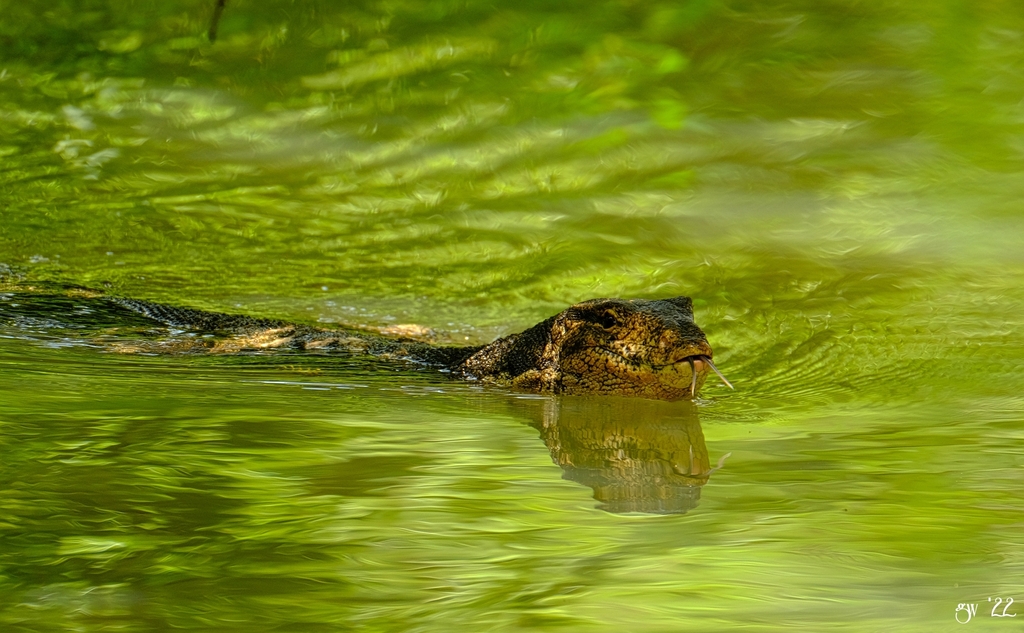
The common water monitor (Varanus salvator) is Southeast Asia's largest lizard: up to 2.5 m and 50 kg. It dominates riverbanks and urban canals from Sri Lanka to the Philippines using four key adaptations: a directional chemical sense, body armour, a propellant tail, and mammal-grade lungs.
Walk any riverbank in Bangkok, Singapore, or rural Sri Lanka and you will eventually see one: a heavy, dark-scaled shape lying motionless on a mudbank, or slipping into the water with a single undulating sweep of the tail. The water monitor is so common across urban Southeast Asia that it barely rates a second look from locals. But watch it for a few minutes and you will notice it is constantly, obsessively, doing one thing: flicking its tongue.
Adaptation 1: the forked tongue as stereo nose
The monitor's tongue is long, deeply forked, and perpetually in motion. In a single minute of active foraging, it may flick 30 to 50 times. This is not a nervous habit. It is the primary sensory apparatus.
Each flick sweeps airborne chemical particles onto the two tips of the fork. The tongue then withdraws and presses both tips into two separate pits in the roof of the mouth, known as the Jacobson's organ or vomeronasal organ. A different bundle of nerves feeds each pit to the brain.
Because the fork samples air from two points simultaneously, the monitor gets a directional signal: if more molecules arrive on the left tip, the chemical source is to the left. This is chemoreception in stereo, allowing the animal to follow a scent gradient with the same precision a dog uses its nose, but through an entirely different mechanism.
A water monitor can detect a dead fish from over 200 m away in field conditions. It can track a crab across a mudflat by scent alone. And because the organ responds to non-volatile compounds that do not evaporate into air, it can also read chemical traces left on surfaces, useful for finding eggs buried underground.
Adaptation 2: osteoderms, a coat of armour
The water monitor's skin contains osteoderms: small plates of bone embedded directly beneath the scales. These are not a shell in the way a turtle has a shell. They are distributed across the back and sides in a mosaic, adding rigidity and impact resistance to the skin without eliminating flexibility.
Osteoderms evolved independently in many reptile lineages, including crocodilians and some lizards. In the monitor, they serve two purposes: protection against the bites of rivals (water monitors fight regularly over carcasses and mating opportunities) and against the kicks and struggles of large prey.
The monitor's skin is also remarkably resistant to bacterial degradation, which matters for an animal that spends significant time in warm, bacteria-rich tropical water and regularly opens fresh wounds on carcasses.
Adaptation 3: the propellant tail
In water, the monitor holds all four legs flat against its flanks and moves exclusively with its tail, which is laterally flattened, roughly oval in cross-section, and made of heavily muscled vertebrae. The tail functions as a single oar, sweeping in smooth S-curves to generate forward thrust.
This design is efficient enough that water monitors can sustain long-distance swims across rivers, estuaries, and even short stretches of open sea. They are recorded on small islands that require a sea crossing of 500 m or more. They actively pursue fish underwater, diving for 15 to 30 minutes at a time.
On land the same tail becomes a formidable defensive weapon. A large monitor can swing it with enough force to knock a person off their feet.
Adaptation 4: mammal-grade lungs
Most lizards have simple, sac-like lungs with a smooth interior. Gas exchange happens across the wall of the sac, which limits surface area and aerobic capacity. This is why most lizards tire quickly: they rely on anaerobic metabolism, which builds up lactic acid, for anything beyond a brief burst.
Varanid monitors, the family that includes the water monitor and the Komodo dragon, have a fundamentally different lung architecture: partitioned, multi-chambered lungs with alveoli, the same basic design as mammalian and avian lungs. This gives them a much larger internal surface area for oxygen exchange.
The result is an aerobic capacity several times higher than other lizards of equivalent size. A water monitor can sustain a trot for minutes rather than seconds. It can swim long distances, chase prey through the undergrowth, and process food faster (digestion is aerobically expensive). In tropical heat, where it can be active for much of the day, this stamina advantage compounds into a dominant ecological position.
What water monitors eat, and why that matters
The monitor's diet is broad: fish, frogs, crabs, snails, birds and their eggs, rodents, domestic chickens, carrion in any quantity, and, in coastal areas, sea turtle eggs. In urban environments they have adapted to scavenge from rubbish and market offal.
This makes them one of the most important scavengers in Southeast Asian waterways, analogous to the role vultures play in African savanna. A canal or river system without monitors accumulates significantly more organic waste. In several Thai cities where monitors were culled as a nuisance, rat populations increased noticeably in the following years.
It is worth seeing what the opposite strategy looks like. The thorny devil of the Australian desert is a lizard that eats nothing but ants, one at a time, and never chases anything. Same class, same continent group of dry-country reptiles, completely inverted approach to getting fed.
See also: Nile Crocodile for another apex reptile that occupies a similar scavenger-and-predator niche in African waterways, and strongest animals in the world for a comparison of reptile bite forces.
Water monitor lizard: frequently asked questions
What is a water monitor lizard?
The common water monitor (Varanus salvator) is the largest lizard in Southeast Asia, reaching up to 2.5 m and 50 kg. It lives along rivers, in mangroves, and in urban waterways from Sri Lanka to the Philippines, and is an apex scavenger and predator.
Why does a water monitor flick its tongue?
The forked tongue collects airborne chemical particles and delivers them to the Jacobson's organ in the roof of the mouth. The two tips give a directional signal: more scent on one tip means the source is on that side. It is effectively smelling in stereo.
Is the water monitor dangerous to humans?
Not typically aggressive, but capable of a painful bite and powerful claw scratches if cornered. Treat any large reptile with respect: do not approach, feed, or corner one.
How does a water monitor swim?
The laterally flattened tail acts as a propellant, sweeping side to side while the legs fold flat. Monitors can sustain long-distance swims and have colonised islands that require a sea crossing of hundreds of metres.
What does a water monitor eat?
Water monitors are opportunistic: fish, frogs, crabs, birds, eggs, rodents, carrion, and urban waste. They are important scavengers in Southeast Asian waterways, playing a similar ecological role to vultures in savanna ecosystems.
Why is the water monitor Epic tier in Kaught?
Kaught's Epic tier reflects how seldom a species is actually recorded in field observations. Water monitors are widespread but wary, require specific riverside habitat, and are more often heard crashing into water than clearly sighted.
The next thing you see could be
your first catch.
Kaught is live on the App Store and Google Play. Free to start, and your first catch is one photo away.
Free to start · Live on the App Store and Google Play
Species data, type, rarity tier and measurements, is drawn from the Kaught catalog, built on open biodiversity records from GBIF and iNaturalist. Rarity reflects how often a species is observed in the wild, not its conservation status.