
Adaptation explainer
Mimic Filefish: the Harmless Fish Disguised as a Poisonous One
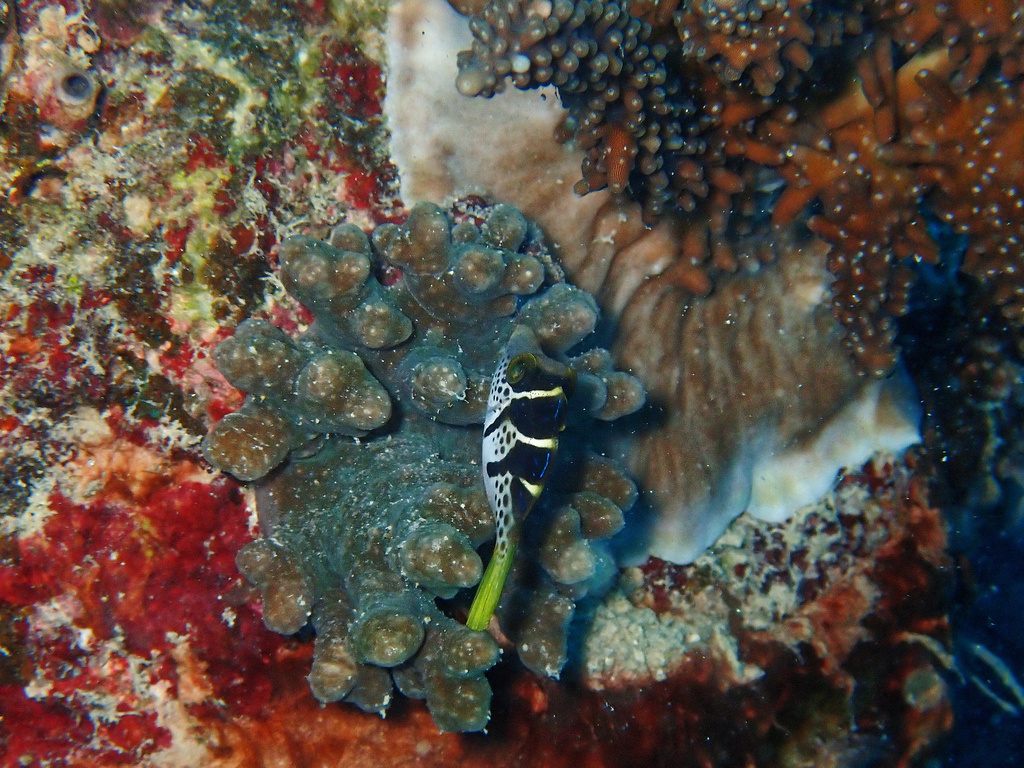
The mimic filefish (Paraluteres prionurus) is a harmless Indo-Pacific reef fish that looks almost identical to the toxic Valentini pufferfish. It carries no toxin of its own, the resemblance is pure disguise, a textbook case of Batesian mimicry that fools predators into leaving it alone.
Spot a small yellow-white fish banded with black saddles weaving through an Indo-Pacific reef, and the obvious conclusion is "don't touch that, it's a pufferfish." Most of the time, you'd be wrong. There is a second fish on the same reef, from a completely different family, that has spent its evolutionary history copying that exact warning pattern, down to the saddle placement. It's called the mimic filefish, and the copy is close enough to fool both divers and, more importantly, the predators it's actually designed for.
What is a mimic filefish?
The mimic filefish (Paraluteres prionurus), also called the blacksaddle filefish, is a small reef fish that tops out around 10 cm, roughly the length of a finger. It lives in clear lagoons and on seaward reef slopes to about 25 m deep across the tropical Indo-Pacific, from the Red Sea east to the central Pacific, the same coral reef habitat that shelters moray eels and mantis shrimp. Juveniles drift in loose small groups; adults are usually found in pairs, feeding on small invertebrates, worms and fish eggs, with the occasional mouthful of algae. On its own, there's nothing unusual about a small filefish going about reef life like this. What's unusual is who it's dressed as.
Why does the mimic filefish look like a pufferfish?
Its near-double is the Valentini pufferfish (Canthigaster valentini), also called the saddled toby, a genuinely toxic fish whose skin and organs carry tetrodotoxin, one of the most potent natural poisons known and a recurring entry on our list of the most poisonous animals in the world, concentrated enough to kill a predator that swallows it. Reef predators learn fast that a white body crossed with dark brown-black saddles is not worth eating. The mimic filefish exploits that learned avoidance without paying the metabolic cost of producing any toxin itself, a strategy biologists call Batesian mimicry: a harmless species borrowing the warning signal of a dangerous one.
This isn't just a resemblance biologists noticed and assumed was useful. On the Great Barrier Reef, researchers tested wild predatory fish with painted plastic replicas ranging from an exact copy of the pufferfish's pattern through to progressively altered versions. Predators avoided anything close to the real pufferfish's saddle pattern and approached the altered versions far more readily, direct field evidence that the resemblance is under active selection because it fools hunters, not a coincidence of two unrelated fish sharing a reef.
How to tell a mimic filefish from the real pufferfish
Up close, the disguise has seams. The clearest tell is the fins: the mimic filefish carries a long dorsal fin with 26 to 28 soft rays plus a visible spine, while the Valentini pufferfish's dorsal fin is short, just 9 to 10 rays, with no spine at all. The filefish's dorsal and anal fins also run along a longer base, giving it a slightly different outline once you know to look. A finer detail for close observation: the filefish's pectoral fin sits just in front of its first body saddle, while the pufferfish's sits just behind. The filefish also carries four small yellow spines at the base of its tail that the puffer lacks.
Behaviour gives it away too. The mimic filefish has no pelvic fins at all, so it swims using only its pectoral fins, a fast, slightly jerky style very different from the pufferfish's steadier, fin-rippling cruise. If the fish you're watching darts rather than glides, that's your filefish.
Is the mimic filefish dangerous?
No, and that's the entire point of the disguise. The mimic filefish carries no venom and no toxin; its only weapon is looking exactly like something that does. The real danger on that reef belongs to its model, the Valentini pufferfish, whose tetrodotoxin makes it unsafe to handle carelessly and lethal to eat. A predator, or a diver, that can't tell the two apart treats them the same way, which is precisely what millions of years of selection have arranged. It's a different trick from the colour-shifting disguise a chameleon uses to vanish into its surroundings, or the hide-in-plain-sight strategy of the best-camouflaged animals in the world: the filefish isn't trying to disappear, it's trying to be seen, and misread.
Why the mimicry depends on staying rare
Classic Batesian mimicry theory makes one further prediction: the disguise only works if mimics stay less common than the model they're copying. If harmless fish wearing the warning pattern became as frequent as the toxic one, predators would eventually learn that the pattern is often a safe meal after all, and the protection would collapse. In the Kaught catalog, that prediction plays out almost exactly as written: the Valentini pufferfish sits at the Common tier, recorded in the wild far more often, while the mimic filefish that copies it sits at the Epic tier, confirmed far less frequently. Real observation data lining up with a 60-year-old theory about why a copycat has to stay the minority.
Mimic filefish: frequently asked questions
What is a mimic filefish?
A small reef fish, Paraluteres prionurus, that grows to about 10 cm and lives on Indo-Pacific coral reefs. It is harmless and edible, but its colour pattern is a near-exact copy of the toxic Valentini pufferfish, which shares the same reefs.
Why does the mimic filefish look like a pufferfish?
It's Batesian mimicry: a harmless species copying the warning colours of a dangerous one. Predatory reef fish learn to avoid the toxic Valentini pufferfish's black-saddled pattern, and the filefish borrows that same pattern to be avoided too, without carrying any toxin itself.
How can you tell a mimic filefish from a real pufferfish?
Look at the fins. The filefish has a long dorsal fin with 26 to 28 soft rays and a visible spine, versus the puffer's short fin of 9 to 10 rays and no spine. The filefish also swims faster and more erratically, since it lacks pelvic fins and steers with its pectorals alone.
Is the mimic filefish venomous or poisonous?
No. The mimic filefish carries no toxin. Only its model, the Valentini pufferfish, is dangerous to eat, its skin and organs contain tetrodotoxin. The filefish's entire defence is visual: looking too much like a poisonous fish to risk eating.
Where do mimic filefish live?
Clear lagoons and seaward coral reefs to about 25 metres deep across the tropical Indo-Pacific, from the Red Sea to the central Pacific. Juveniles loosely school; adults are usually seen in pairs, generally close to the pufferfish they resemble.
Why is the mimic filefish "Epic" in Kaught?
Kaught's rarity reflects how often a species is actually recorded, not its conservation status. The Valentini pufferfish it copies is Common, logged far more often, while the filefish itself is confirmed less frequently and sits at the Epic tier, a split that happens to match how this kind of mimicry is supposed to work.
The next thing you see could be
your first catch.
Kaught is live on the App Store and Google Play. Free to start, and your first catch is one photo away.
Free to start · Live on the App Store and Google Play
Species data, type, rarity tier and measurements, is drawn from the Kaught catalog, built on open biodiversity records from GBIF and iNaturalist. Rarity reflects how often a species is observed in the wild, not its conservation status.