
Exotic spotlight
Jaguarundi: the Wild Cat That Doesn't Look Like One
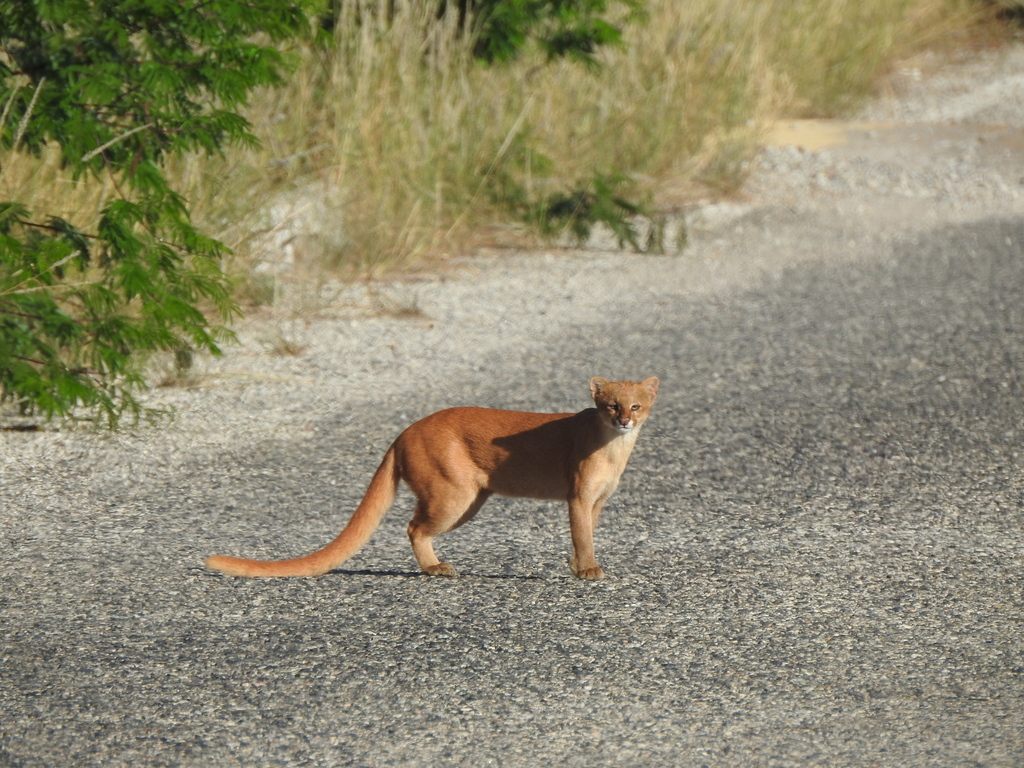
The jaguarundi (Puma yagouaroundi) is a small wild cat from the Americas with an elongated body, short legs and small ears, often mistaken for an otter or weasel. Unlike most cats it hunts by day, comes in grey or reddish colour morphs, and chirps like a bird.
Spot a long, low, reddish-brown animal slipping across a trail in Central or South America and the first guess is rarely "cat". It moves too close to the ground, too stretched out, more otter or weasel than anything from the cat family. That shape belongs to the jaguarundi, one of the most recognisable wild cats in the Americas, and one of the least cat-shaped.
What is a jaguarundi?
The jaguarundi (Puma yagouaroundi) is a small wild cat found from the US-Mexico border south through Central America and almost all of South America to northern Argentina, in habitat it shares with the species in our Amazon rainforest animals guide. It belongs to genus Puma, the same genus as the mountain lion, despite looking nothing alike: where a mountain lion is tall-shouldered and powerfully built, the jaguarundi has a long, cylindrical body, short legs, a small flattened head and small rounded ears set low on the skull. Adults run 50-77 cm in body length with a tail of 33-60 cm nearly as long again, and weigh just 4.5-9 kg, barely heavier than a large domestic cat. It comes in two colour forms: a grey to blackish "otter cat" morph, and a reddish "eyra" morph like the one pictured above, sometimes turning up in the same litter.
Why does a jaguarundi look like an otter or a weasel?
The resemblance is no accident of observation, it's convergent evolution. The thick ground cover at forest edges and scrubland the jaguarundi favours rewards a body built for moving fast and low through dense vegetation and reeds near water, the same pressure that shaped otters, weasels and mongooses into similarly long, flexible, short-legged forms. A jaguarundi can still climb when it needs to, but it hunts almost entirely on the ground, trading a cat's usual compact, pounce-built frame for something closer to a furred torpedo.
Is a jaguarundi the same animal as a jaguar?
No, and the names are the single biggest source of confusion around this cat. "Jaguarundi" comes from an old Tupi-Guarani word, not from "jaguar", and the two share no close relationship: the jaguar is a 60-110 kg big cat in genus Panthera built for ambushing capybara and caiman, while the jaguarundi is a small, slender cat in genus Puma that preys on rodents, birds and insects. It's also sometimes mistaken for a young jaguar or cougar passing through, but kittens of both those cats are heavily spotted, while an adult jaguarundi's coat is a single flat colour nose to tail.
How does a jaguarundi hunt, and what does it eat?
Jaguarundis break another cat rule: most small wild cats are nocturnal, but the jaguarundi is mainly diurnal, active through the day and most visible around dawn and midday rather than after dark. That timing may let it avoid competing directly with the ocelots and margays that share its range and hunt the same ground after dark. By day it stalks rodents, birds, lizards, frogs and large insects low in brush and reedbeds, and will also take fruit, an omnivorous streak unusual among cats. It's also one of the most vocal cats on record, with researchers logging at least 13 distinct calls, including purrs, whistles, a cat-like scream, and a short, bird-like chirp used to keep in contact with a mate or kittens.
Is the jaguarundi dangerous?
Not to people. It's shy, solitary and built to hunt animals far smaller than a human, and sightings near people almost always end with the cat vanishing into cover rather than approaching. There are no reliable records of a wild jaguarundi attacking a person. The real risk runs the other way: like many small cats, roads cut through its habitat are a far bigger threat to the jaguarundi than it will ever pose to anyone crossing one.
How rare is the jaguarundi in Kaught?
In the Kaught catalog the jaguarundi sits at the Epic tier, three diamonds out of four. That's a measure of how often the species is actually confirmed in sightings, not a statement about its conservation status: a diurnal habit should make it easier to see than most cats, but its low, fast-moving profile through dense cover means most encounters are a half-second blur rather than a clean look. It shares the Epic tier with its much larger genus-mate the mountain lion and with the bobcat, two more wild cats far more often inferred from tracks than actually seen. For more animals whose real biology sounds invented, see our list of the weirdest animals in the world.
Jaguarundi: frequently asked questions
What is a jaguarundi?
A small wild cat, Puma yagouaroundi, found from the US-Mexico border south through Central America to northern Argentina. It has a long, low-slung body, short legs and small rounded ears, and comes in grey or reddish colour morphs rather than the spots most wild cats carry.
Is a jaguarundi the same as a jaguar?
No. Despite the similar name, a jaguarundi is a small, slender cat in genus Puma weighing under 9 kg, while a jaguar is a 60-110 kg big cat in genus Panthera. The name comes from an old Tupi-Guarani word, not from "jaguar", and the two are not close relatives.
Why does a jaguarundi look like an otter or weasel?
Convergent evolution. Moving fast and low through dense scrub and reeds favoured a long, cylindrical body and short legs, the same pressure that shaped otters, weasels and mongooses. The jaguarundi can climb, but it hunts almost entirely on the ground.
Is the jaguarundi dangerous to humans?
No. It's shy, solitary, and hunts animals far smaller than a person. There are no reliable records of a wild jaguarundi attacking someone; most sightings end with the cat disappearing into cover rather than approaching.
What does a jaguarundi eat?
Mostly rodents, birds, lizards, frogs and large insects, stalked low through brush during the day. It's also one of the few cats known to regularly eat fruit, and one of the most vocal, using at least 13 distinct calls including a bird-like chirp.
Why is the jaguarundi "Epic" in Kaught?
Kaught's rarity reflects how often a species is actually confirmed in the wild, not its conservation status. A diurnal habit should make the jaguarundi easier to see than most cats, but its fast, low profile through dense cover means most encounters are a brief blur.
The next thing you see could be
your first catch.
Kaught is live on the App Store and Google Play. Free to start, and your first catch is one photo away.
Free to start · Live on the App Store and Google Play
Species data, type, rarity tier and measurements, is drawn from the Kaught catalog, built on open biodiversity records from GBIF and iNaturalist. Rarity reflects how often a species is observed in the wild, not its conservation status.