
Adaptation explainer
How woodpeckers avoid brain damage, and why the old explanation was wrong
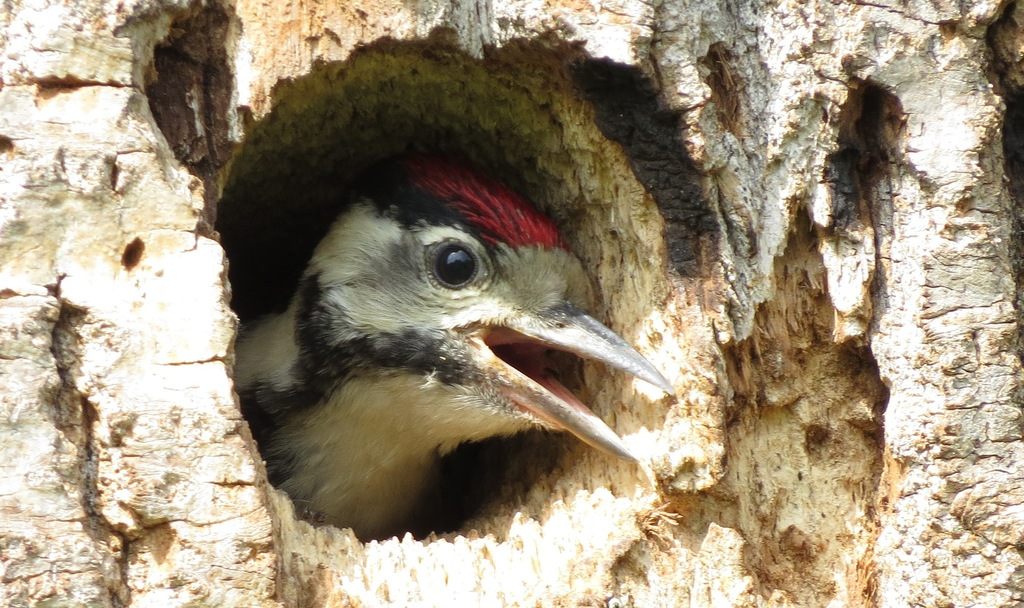
A woodpecker can strike wood up to 12,000 times a day without brain damage. High-speed filming shows its skull doesn't cushion each blow, it's actually rigid. The brain survives because the impact is over in under a millisecond, travels almost perfectly straight, and its own tiny mass keeps the real force far below anything that could injure it.
A woodpecker drums on a dead branch with a force that would concuss a person outright, then does it again roughly twelve thousand times before the day is over. For decades the explanation was tidy: a built-in crash helmet, spongy bone and a boomerang-shaped tongue bone wrapped around the skull like a seatbelt. High-speed cameras have since shown that story is largely wrong. Here's what's actually happening inside a woodpecker's head every time its beak meets wood.
How hard does a woodpecker actually hit?
A Great Spotted Woodpecker can strike a branch up to 20 times a second in a drumming burst, each strike decelerating the head from full speed to a dead stop in a couple of milliseconds. Researchers have long measured peak deceleration forces around 1,200 to 1,400 times the force of gravity on individual strikes, among the most extreme repeated impacts any vertebrate skull is known to tolerate. Multiply that by up to 12,000 strikes a day of drumming and foraging, and the real puzzle comes into focus: why doesn't the brain turn to jelly?
The old theory: a built-in crash helmet
The explanation repeated in nature documentaries for decades had three parts. Spongy, strut-like bone at the front of the skull was supposed to absorb shock like packing foam. An unusually long hyoid bone, the structure that anchors the tongue, wraps around the back of the skull, over the top and down to the nostril, and was cast as an internal seatbelt. And a very narrow gap between brain and skull was said to stop the brain from rattling around on impact. Put together, nature documentaries sold it as a built-in crash helmet.
What high-speed footage actually found
A 2022 study in Current Biology filmed Great Spotted Woodpeckers drumming at several thousand frames per second and measured how much the skull actually deformed on impact. The answer: barely at all. The skull behaves as a rigid structure, not a spring or a cushion, decelerating the brain at essentially the same rate as the beak tip. A flexible, shock-absorbing skull would, if anything, be counterproductive: any cushioning would simply prolong the time soft brain tissue spends under strain, which is the opposite of what protects it.
So what actually protects the brain?
Three real factors do the work. Size: the brain weighs only a few grams, and force scales with mass, so even brutal deceleration translates into a small total force on the tissue itself, well under known injury thresholds. Direction: human concussions come overwhelmingly from rotational or shearing force that twists the brain inside the skull, not straight-line deceleration. A woodpecker drives its beak dead-on into the wood along a single axis, so almost all the force travels straight through in one line, the kind of force a brain tolerates best. Duration: each strike lasts roughly half a millisecond, too brief for the sustained pressure that actually damages tissue.
What its beak, eyes and feet are still doing to help
None of this makes the woodpecker's design a myth. The upper and lower parts of the bill slide very slightly against each other on impact, bleeding off a little reaction force before it ever reaches the skull. Stiff feathers cover the nostrils to filter wood dust and splinters kicked up by every strike. A nictitating membrane, a third, inner eyelid, closes a fraction of a second before contact to shield the eye and help stop it from being thrust forward by the shock. Reinforced tail feathers brace the whole body against the trunk like a kickstand, and zygodactyl feet, two toes forward and two back, lock onto bark so none of the strike's energy is wasted on losing grip.
How rare is the Great Spotted Woodpecker in Kaught?
In the Kaught catalog the Great Spotted Woodpecker sits at the Common tier, one diamond out of four. That's a reminder that Kaught's rarity reflects how often a species is actually confirmed in the wild, not how remarkable its biology is. It's found across nearly all of Europe and temperate Asia, and it drums loudly for the specific purpose of announcing where it is, so confirmed sightings and sounds stack up quickly, which is exactly what keeps it at Common.
For other animals whose bodies solve an equally hard survival problem, how bats echolocate and how barn owls hunt in darkness cover sound-based senses pushed to their limits, animals with extreme senses rounds up more record-breaking adaptations, and the mantis shrimp's eyes and punch shows what else evolution can do with speed and force.
Woodpeckers and brain damage: frequently asked questions
How do woodpeckers avoid brain damage?
Mostly because the forces involved are tiny in absolute terms. Its brain weighs only a few grams, each strike lasts under a millisecond, and the impact travels almost perfectly straight along the beak's axis rather than twisting the brain, the rotational motion that actually causes concussions in larger-brained animals.
Do woodpeckers get concussions?
There's no evidence that they do. Human concussions come mainly from rotational force, but a woodpecker's strikes are nearly pure straight-line impacts, and its tiny, tightly packed brain experiences forces far below any documented injury threshold despite the extreme deceleration involved.
Is it true a woodpecker's skull works like a crash helmet?
No, that popular explanation has been overturned. High-speed video from a 2022 study showed the skull barely deforms on impact, behaving as a rigid structure rather than a cushioning shock absorber. A flexible, cushioning skull would actually prolong brain strain, not reduce it.
How hard does a woodpecker actually hit?
A Great Spotted Woodpecker can strike up to 20 times a second and roughly 12,000 times in a single day. Researchers have measured peak deceleration forces around 1,200 to 1,400 times gravity on individual strikes, among the most extreme repeated impacts tolerated by any vertebrate.
How do woodpeckers protect their eyes while drumming?
A nictitating membrane, a third, inner eyelid, closes a fraction of a second before the beak hits wood. It shields the eye from flying debris and is thought to help stop the eye from being thrust forward by the shock of each impact.
Why is the Great Spotted Woodpecker "Common" in Kaught?
Kaught's rarity tracks how often a species is actually confirmed in the wild, not how impressive its biology is. The Great Spotted Woodpecker is widespread across Europe and temperate Asia and drums loudly to announce itself, so confirmed sightings and sounds stack up fast, keeping it at Common.
The next thing you see could be
your first catch.
Kaught is live on the App Store and Google Play. Free to start, and your first catch is one photo away.
Free to start · Live on the App Store and Google Play
Species data, type, rarity tier and measurements, is drawn from the Kaught catalog, built on open biodiversity records from GBIF and iNaturalist. Rarity reflects how often a species is observed in the wild, not its conservation status.