
Evolution story
Paradoxical Frog: the Amphibian That Shrinks as It Grows Up
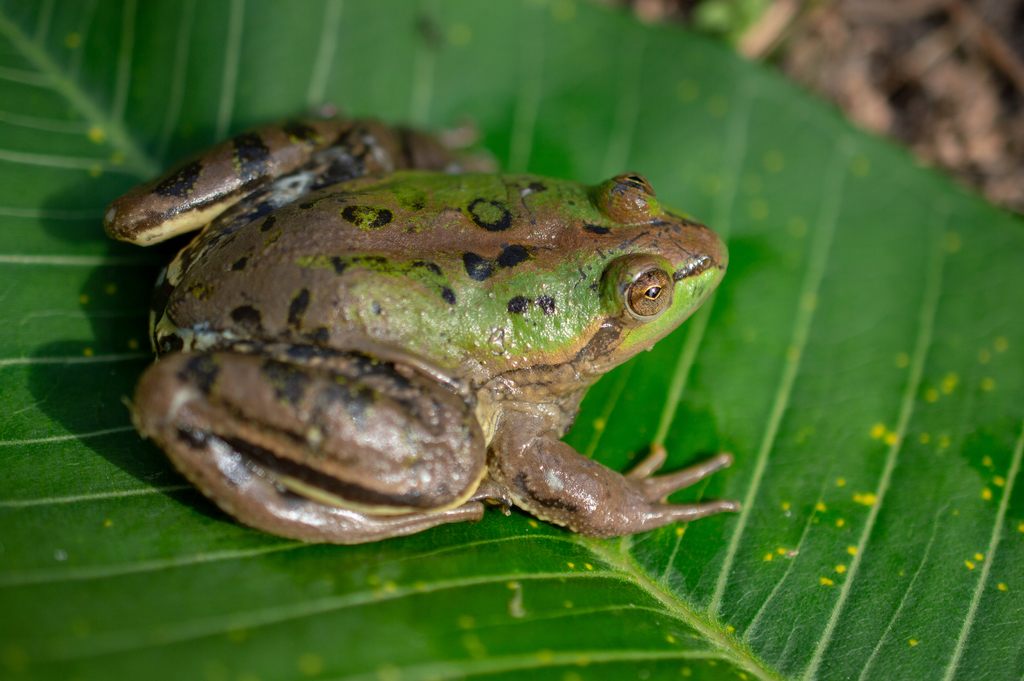
The paradoxical frog (Pseudis paradoxa) gets its name backwards from how growth normally works: its tadpole can reach 27 cm, the longest of any frog, then shrinks through metamorphosis into an ordinary adult of just 3.4-7.6 cm. The size mostly disappears with the resorbed tail, and the strategy lets it cash in on fast tadpole growth in food-rich wetlands before the water dries up.
Growth is supposed to run one direction. An animal starts small and gets bigger until it reaches its adult size, then stops. The paradoxical frog breaks that rule on purpose. Its tadpole is one of the largest ever measured, up to four times longer than the frog it eventually becomes, and the name "paradoxical" comes directly from naturalists trying to make sense of an animal that appears to shrink as it grows up.
What is the paradoxical frog?
Pseudis paradoxa is a fully aquatic tree frog from tropical South America, found across the Amazon basin, the Guianas, Venezuela and Trinidad, with a separate population in Colombia's Magdalena valley. It belongs to the family Hylidae, the true tree frogs, though it has none of the climbing habits that name implies: adults rarely leave the water, swimming and basking at the surface of ponds, lagoons and flooded grassland both day and night. Adult colouring runs from green to brown with dark mottling or stripes, and its long hind toes carry an extra joint it uses to stir up mud, either to vanish into the murk or to flush out a meal.
How big does the "world's largest tadpole" actually get?
A paradoxical frog tadpole can reach roughly 27 cm (11 in) nose to tail, the longest tadpole recorded for any frog species on Earth. For comparison, the adult frog it metamorphoses into measures just 3.4-7.6 cm snout to vent, about a quarter to a third of the tadpole's length. Tadpole size isn't fixed either: in large, warm, temporary waters with plenty of algae to eat and few predators around, tadpoles grow noticeably bigger than those crowded into smaller, more competitive ponds.
Why does it shrink when it becomes an adult?
The honest answer is that no single study has fully nailed down the mechanism, but the outline is clear enough. Over half of that 27 cm tadpole is tail and the swimming muscle wrapped around it. At metamorphosis, which can happen in as little as ten days, the tail is resorbed entirely, the way every tadpole's tail disappears, just on a far larger scale here. That alone accounts for most of the dramatic size change.
The strategy behind it looks like an adaptation to boom-and-bust wetlands. A tadpole that keeps eating algae and growing for as long as a temporary lagoon allows gets a head start other frogs can't match, storing up growth as a tadpole rather than racing through a vulnerable froglet stage. Researchers have also found that several of its internal organs, including the lungs, intestines and gonads, already resemble adult tissue microscopically while the animal is still a giant tadpole, so part of growing up has effectively already happened before metamorphosis even starts. When conditions turn, the water receding or a predator population rising, the frog "cashes in" that banked growth fast and leaves the oversized larval body behind.
Is the shrinking a trick, or does the body actually get smaller?
Both, in a sense. Losing a tail that makes up more than half the tadpole's total length explains the bulk of the size drop, and that part is closer to shedding than shrinking. But the body proper, independent of the tail, also ends up smaller and more compact in the adult than the late-stage tadpole's torso, since tissue is broken down and resorbed rather than simply rearranged. It's a genuine case of an animal's body mass dropping sharply at a single life stage, not an illusion of proportion.
Where does it live, and what does it eat?
As tadpoles, paradoxical frogs graze almost entirely on algae, fuel for that oversized growth spurt. Adults switch to a carnivorous diet of flies, beetles, true bugs, moths and dragonflies, along with occasional larger prey like small crabs or other frogs, hunted in and around the still or slow-moving water they rarely leave. The same long-toed hind feet used to stir up the bottom for a meal double as a defence, kicking up a cloud of silt to vanish into when something larger comes hunting.
Is the paradoxical frog dangerous, or useful to people?
It carries no venom and poses no threat to anyone who comes across one. If anything, the opposite may turn out to be true: in 2008, researchers isolated a skin compound called pseudin-2 that protects the frog from infection, and found that a synthetic version stimulates insulin secretion in pancreatic cells without the toxicity that blocks many other candidate compounds. That line of research is still being explored as a possible lead for future type 2 diabetes treatments, a useful side effect of a frog that evolved the peptide purely to guard its own skin.
How rare is the paradoxical frog in Kaught?
In the Kaught catalog the paradoxical frog sits at the Epic tier, three diamonds out of four. That reflects how often it's actually confirmed in the field, not how unusual its biology is: an animal that spends nearly its whole life submerged or screened by floating vegetation in remote, seasonal South American wetlands is simply hard to put in front of a camera, giant tadpole stage included. It isn't the only amphibian in the catalog that rewrites the rules of growing up: the greater siren takes the opposite route, keeping its larval gills for life instead of ever finishing metamorphosis, while the glass frog and common rain frog show just how far frog adaptations can stretch once you start looking past the obvious. For more animals whose real biology sounds invented, see our list of the weirdest animals in the world.
Paradoxical frog: frequently asked questions
What is a paradoxical frog?
A South American tree frog, Pseudis paradoxa, named for a tadpole that grows far larger than the adult it becomes. It lives almost entirely in water, in ponds, lagoons and seasonal wetlands across the Amazon basin, the Guianas, Venezuela and Trinidad.
Why does the paradoxical frog shrink as it grows up?
Its tadpole grows fast in large, warm, food-rich wetlands with few predators, banking that extra size as energy. At metamorphosis it resorbs its oversized tail and body tissue, converting that stored growth into an ordinary-sized adult built to leave the water before it dries.
How big is a paradoxical frog tadpole?
Up to about 27 cm (11 in), the longest tadpole recorded for any frog species. The adult it becomes measures only 3.4-7.6 cm snout to vent, roughly a quarter to a third of the tadpole's length.
Is the paradoxical frog's whole body shrinking, or just the tail?
Mostly the tail, which makes up over half the tadpole's length and is fully resorbed at metamorphosis. But the body itself also shrinks measurably, since several internal organs mature to near-adult form while still inside the oversized tadpole.
Is the paradoxical frog dangerous or venomous?
No. It carries no venom and poses no threat to people. Its skin does produce a compound called pseudin-2, which protects it from infection and is being studied by researchers for a possible role in treating type 2 diabetes in humans.
Why is the paradoxical frog "Epic" in Kaught?
Kaught's rarity reflects how often a species is actually recorded in the wild, not its conservation status. The paradoxical frog stays submerged or screened by water plants through most of its life in remote wetlands, so a confirmed sighting is genuinely uncommon.
The next thing you see could be
your first catch.
Kaught is live on the App Store and Google Play. Free to start, and your first catch is one photo away.
Free to start · Live on the App Store and Google Play
Species data, type, rarity tier and measurements, is drawn from the Kaught catalog, built on open biodiversity records from GBIF and iNaturalist. Rarity reflects how often a species is observed in the wild, not its conservation status.