
Exotic spotlight
Wrinkle-faced Bat: the Fruit Bat That Wears Its Own Mask
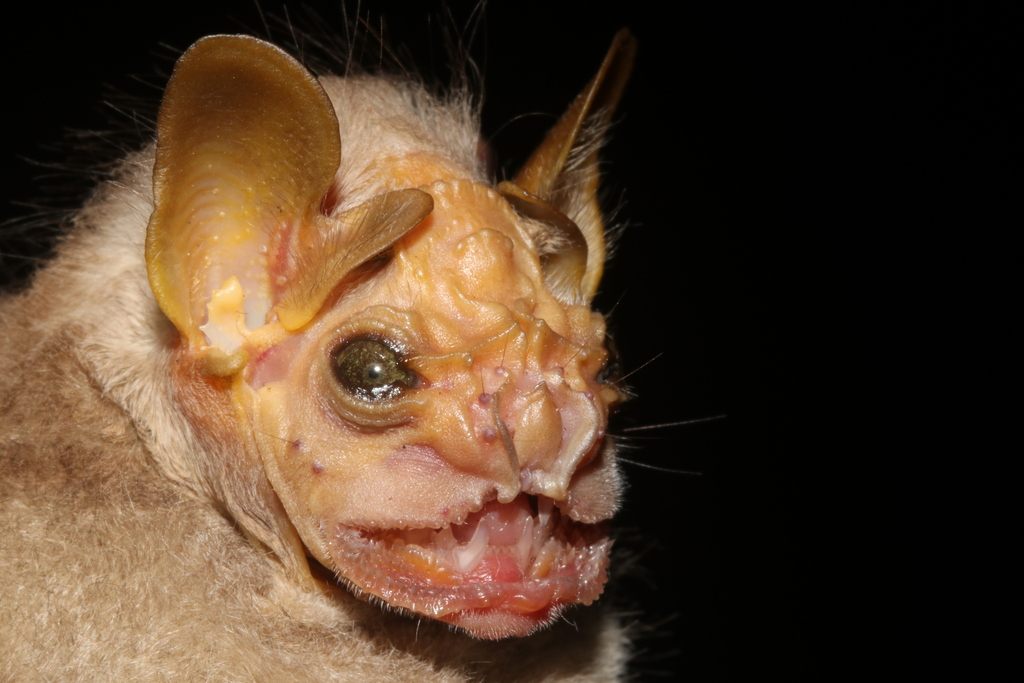
The wrinkle-faced bat (Centurio senex) is a small Central American fruit bat whose males fold a loose flap of pale chin skin up over the face like a mask during courtship. It also carries the strongest bite, relative to size, of any leaf-nosed bat, which lets it crack fruit too tough for its neighbours.
Most bat faces are built around a nose: a leaf, a flap, a horseshoe of skin shaped to focus sonar. The wrinkle-faced bat skips all of that. Instead it has a bare, deeply folded face that looks faintly like a dried apricot, and in males, a loose flap of skin under the chin that can be pulled up and worn over the whole face like a mask. It sounds like something from a costume shop. It is, instead, one of the stranger and better-documented courtship tools in the entire bat world.
What is a wrinkle-faced bat?
Centurio senex is the only species in its genus, a small, tailless fruit bat in the leaf-nosed bat family, Phyllostomidae, found from Mexico south through Central America to Colombia and Venezuela, with a separate population on Trinidad and Tobago. It's modest in size for the family: body length of roughly 55-70 mm and a weight of 17-28 g, with females running slightly larger than males. Its coat is a drab brown to yellowish-brown, unremarkable at a glance. The face is where everything interesting happens: hairless, covered in convoluted folds of skin, with no trace of the nose-leaf that gives most of its relatives their name.
It also keeps different company than most bats. Rather than packing into caves or hollow trees, a wrinkle-faced bat typically roosts alone or in groups of just two or three, tucked under a tree's leaves or in a tangle of vines, in lowland tropical and deciduous forest from sea level up to about 1,400 m, though it's most common below 1,000 m. That solitary, exposed roosting style is part of why it's so rarely documented: there's no colony to stumble on, just one or two animals tucked into a single leaf somewhere in a very large forest.
Why does it wear a mask?
The wrinkles themselves are more pronounced in males than in females, but the true mask is a separate structure: a pale, velvety fold of loose skin hanging from the chin, which an adult male can raise up to cover his face almost entirely. Exactly what it was for sat unresolved for decades. The first detailed look at the species behaving naturally in the wild only came in 2020, when researchers from the University of Costa Rica filmed males gathering at shared display sites, a mating system called a lek.
At those sites, males hung at a consistent height, masks raised, through the first half of the night, occasionally flicking a wing tip or calling out while they waited. When a female flew in, the perched males beat their wings and fired off loud, low-frequency whistles to draw her attention. A courting pair would face off, mask still raised, before the male lowered it, the pair repositioned, and they mated. Afterward he raised the mask again and kept calling, ready for the next female to pass. Lekking like this, where males simply gather and display rather than seeking females out individually, has been confirmed in only a handful of the more than 1,400 known bat species, which made this the clearest evidence yet that the whole mask structure is built for courtship display, not defence or camouflage.
Before 2020, the mask had mostly been described from museum specimens and chance sightings, so nobody had actually watched one in use. That gap is itself telling: a trait striking enough to earn the species its common name went undocumented in the wild for as long as it did only because the animal wearing it is so rarely seen behaving naturally at all.
The strongest bite of any leaf-nosed bat
Strip away the mask and the wrinkle-faced bat is still an oddity: its skull is unusually short and wide, built almost like a bulldog's among bats. That shape gives it a bite up to 20% stronger, relative to its size, than other similarly sized bats, the strongest bite-to-size ratio recorded in the leaf-nosed bat family. The species is entirely frugivorous, and researchers think that extra bite force is a survival edge when soft, ripe fruit runs short: it can crush tougher, less-ripe fruit that other fruit bats simply can't break into, opening up a food source with far less competition for it. Some Mexican populations have even been recorded preying on seeds rather than just pulp, a diet most softer-jawed fruit bats can't fall back on.
It's a neat pairing with the mask: one structure built around the mouth to win access to food, another built around the chin to win access to a mate, on the same small, drab-coated animal most people will never get close enough to notice either one.
How rare is the wrinkle-faced bat in Kaught?
In the Kaught catalog the wrinkle-faced bat sits at the Epic tier, three diamonds out of four. That's a measure of how often it's actually confirmed in the field, not a statement about its overall numbers. A bat that roosts alone or in groups of two or three, skips the caves most bat surveys check, and was only caught on camera displaying in the wild for the first time in 2020, is simply a hard one to put in front of a lens. For more bats whose everyday biology sounds made up, see our guides to the vampire bat and the lesser false vampire bat, and for how that chin-flap bite compares to the rest of the animal kingdom, our ranking of the strongest animal bites in the world. It also earns a place among the weirdest animals in the world, mask and all.
Wrinkle-faced bat: frequently asked questions
What is a wrinkle-faced bat?
A small, tailless fruit bat (Centurio senex) from the forests of Mexico, Central America and northern South America. It weighs about 17-28 g, has a drab brown to yellowish coat, and a bare, deeply folded face with no nose-leaf, unusual for its family of leaf-nosed bats.
Why does the wrinkle-faced bat wear a mask?
Adult males grow a loose, pale flap of skin under the chin that they raise up over the face like a mask. A 2020 field study in Costa Rica found males wear it while displaying at communal courtship sites, lowering it only in the instant before mating, which points to a role in attracting females rather than defence.
Do female wrinkle-faced bats have a mask too?
Not really. Females have the same deeply wrinkled facial skin but lack the raisable chin flap, and their wrinkles are far less pronounced overall. The full mask is a male trait, tied to courtship rather than something both sexes use equally.
What does the wrinkle-faced bat eat?
Fruit, exclusively. Its skull is unusually short and wide, giving it a bite up to 20% stronger relative to its size than similarly sized bats, the strongest of any leaf-nosed bat. That lets it crack tougher, less-ripe fruit other fruit bats cannot manage.
Where does the wrinkle-faced bat live?
Lowland tropical and deciduous forest from Mexico south through Central America to Colombia and Venezuela, plus a separate population on Trinidad and Tobago. Unlike most bats it skips caves, roosting alone or in groups of 2-3 under leaves and vine tangles.
Why is the wrinkle-faced bat "Epic" in Kaught?
Kaught's rarity reflects how often a species is actually recorded in the wild, not its conservation status. The wrinkle-faced bat roosts alone or in tiny groups, skips the caves most bat surveys check, and was only filmed displaying in the wild for the first time in 2020, all of which make a confirmed sighting genuinely uncommon.
The next thing you see could be
your first catch.
Kaught is live on the App Store and Google Play. Free to start, and your first catch is one photo away.
Free to start · Live on the App Store and Google Play
Species data, type, rarity tier and measurements, is drawn from the Kaught catalog, built on open biodiversity records from GBIF and iNaturalist. Rarity reflects how often a species is observed in the wild, not its conservation status.