
Legendary spotlight
The Blind Mole Rat: the mammal so hard to see, one population vanished from the record for 39 years
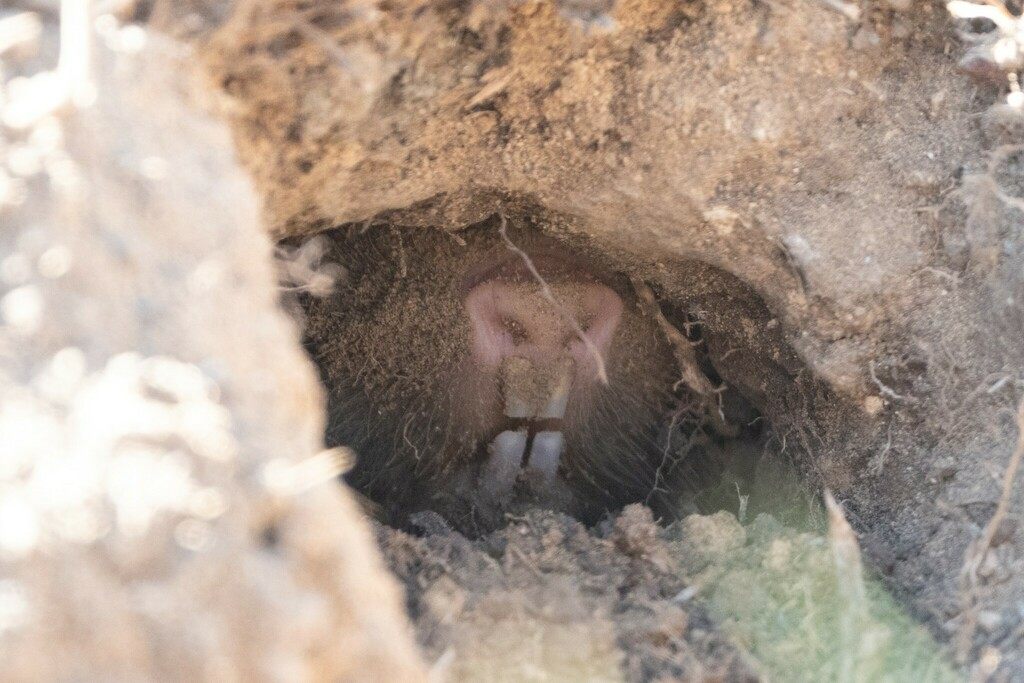
The lesser blind mole rat (Spalax leucodon) is a legendary-tier Balkan rodent that lives its entire life underground, with sealed, light-sensing eyes and teeth used as digging tools. One Croatian population went unrecorded for 39 years before resurfacing in 2023.
Somewhere under a Balkan hay meadow right now, a blind mole rat is digging, and there is a real chance it will live its whole life, feed, breed and die, without a single person ever laying eyes on it. In the Kaught catalog it sits at the Legendary tier, four diamonds out of four. Most Legendary animals earn that rank by being shy, fast or brilliantly camouflaged. This one earns it by never coming above ground at all.
How to identify a blind mole rat
You are far more likely to find its earthworks than the animal itself, but the field marks are unmistakable if a tunnel is ever exposed:
- Eyes: sealed completely under a layer of skin and fur, about 1 mm across. From the outside there is no eye to see at all.
- Ears: no external flap, just small openings flush with the head, built to keep soil out rather than catch sound from a distance.
- Tail: none visible externally, a short stub at most.
- Teeth: two long, pale, forward-jutting incisors that sit in front of its closed lips, its main tool and its most recognisable feature.
- Build: a stout, cylindrical body about 15-20 cm long with dense fur that lies flat in either direction, so it can reverse back down a tunnel as easily as it moves forward.
Its eyes are a workaround rather than a loss: they cannot form an image, but they still work as a light meter, telling the animal when a tunnel has broken through to daylight. It is one of several wild solutions to sensing the world without ordinary eyesight, alongside the touch-mapping star-nosed mole and other extreme-sense specialists covered in animals with extreme senses.
Where the blind mole rat lives
Its range covers a wide arc of the Balkans and southeastern Europe: Albania, Bosnia and Herzegovina, Bulgaria, Croatia, Greece, Hungary, North Macedonia, Moldova, Romania, Serbia, Montenegro, Turkey and Ukraine. Within that range it keeps to grassy steppe, hill and mountain meadow, orchards, vineyards and farmland, almost anywhere the soil is soft enough to tunnel through.
"The blind mole rat" is really shorthand for a tangle of closely related, geographically separated populations. Researchers have described dozens of distinct chromosomal forms across the complex, and some authorities now split the genus entirely, placing it in Nannospalax rather than Spalax. The Kaught catalog uses the long-standing name Spalax leucodon.
How it digs with its teeth, not its claws
Most burrowing mammals dig with their front claws. The blind mole rat barely uses its claws at all. Its incisors do almost all the work, loosening soil while the mouth stays closed, kept out of its airway by a flap of skin behind the teeth so dirt never reaches its throat. Powerful jaw muscles drive the digging, and the incisors grow fast enough to replace the wear from a lifetime of excavation.
Once the soil is loosened, it packs earth with its broad snout and kicks it out behind with its hind feet, working backward through the tunnel as it goes. Its burrow system runs on two levels: shallow foraging tunnels just under the surface, stretching for long distances and pushing up mounds of loose earth as they go, and a deeper level of nesting and food-storage chambers below. It is a different engineering approach to the Eurasian beaver, another rodent whose teeth, not its paws, do the heaviest structural work.
Why you'll probably never see one alive
A blind mole rat almost never comes to the surface on purpose. The mounds it leaves behind, not the animal, are what most people in the Balkans actually encounter. A live sighting usually depends on a tunnel being accidentally opened, by a plough, a flood, or a predator digging it out, which is roughly how the photograph on this page came to exist at all.
How rare is rare? In Croatia, no one recorded the species alive between 1984 and 2023, when it turned up again at Vučedol. That is not a comment on its conservation status, Kaught's rarity tiers never are, it is simply how long a genuinely subterranean animal can go between confirmed records even when researchers are looking for it. The desert monitor lizard and the Eurasian lynx carry the same Legendary tier for similar reasons: not because they are scarce on paper, but because actually seeing one is its own kind of achievement. For another animal built around the same problem, see the desert monitor.
The mole rat's hidden superpower
A life spent in sealed, oxygen-poor tunnels has made the blind mole rat a minor celebrity in ageing research. It shows unusually strong resistance to low-oxygen conditions, lives far longer than similarly sized rodents, and appears remarkably resistant to cancer. Studies across its wider genus have found lab mole rats surviving oxygen levels of around 3 percent, conditions a lab rat tolerates for only a couple of hours, for up to 14 hours at a stretch, with some relatives living past 20 years. For an animal that never leaves a sealed tunnel, those traits are not a curiosity, they are the cost of admission.
The blind mole rat in the Kaught catalog
In Kaught, the blind mole rat registers as a Legendary Mammal, four filled diamonds out of four, catalog No. 342. That tier is not a statement about threat status, it is a record of how rarely the species is actually logged by real observers, and for an animal that spends its entire life sealed underground, the number stays about as low as it gets. If obscure, catalog-worthy mammals are your thing, the toothy, day-active numbat is a similarly unlikely entry from the other side of the world.
Three things that make the blind mole rat remarkable
- Taxonomists have described dozens of distinct chromosomal forms across the species complex, enough that some treat several as separate species outright. The genus itself is now contested, split by some researchers into Nannospalax.
- Its close relatives are a reference point for human ageing research: resistance to cancer, tolerance of very low oxygen, and lifespans far beyond what a rodent that size should manage.
- It is not related to the African naked mole rat at all. The two look and live alike because unrelated lineages, on different continents, independently arrived at the same solution to life underground.
Blind mole rat: frequently asked questions
What does a blind mole rat look like?
A stout, cylindrical rodent about 15-20 cm long with thick reddish-brown to grey fur, no visible tail, no external ears, and no eyes you could actually see: they are sealed under a layer of skin and fur. Two long pale incisors project in front of its closed lips.
Where does the blind mole rat live?
Across the Balkans and southeastern Europe, including Albania, Bosnia and Herzegovina, Bulgaria, Croatia, Greece, Hungary, North Macedonia, Moldova, Romania, Serbia, Montenegro, Turkey and Ukraine, in grassy steppe, hill pasture, meadows and farmland.
Is the blind mole rat actually blind?
Not entirely. Its eyes are tiny, about 1 mm across, and sealed beneath skin and fur. They cannot form an image but can still sense whether it is light or dark, enough to tell the animal when a tunnel has broken through to the surface.
How does a blind mole rat dig without claws?
It digs almost entirely with its two long incisors, which sit outside its closed lips so it can dig with its mouth shut. A skin flap keeps soil out of its throat, and it pushes loosened earth aside with its snout and kicks it out with its hind feet.
Why is the blind mole rat Legendary in Kaught?
Kaught's Legendary tier reflects how rarely a species is actually recorded in the wild, not any conservation status. The blind mole rat spends its entire life in sealed tunnels, so a live sighting is extraordinary. One Croatian population went unrecorded for 39 years before resurfacing in 2023.
How do you find evidence of a blind mole rat?
Look for raised mounds of loose soil pushed up along meadows, pasture and field edges across the Balkans, with no visible entrance hole. The mounds are usually the only sign most people will ever get; an actual sighting typically needs a tunnel accidentally exposed by ploughing or flooding.
Is the blind mole rat the same as the naked mole rat?
No. They are unrelated rodents that evolved similar tunnelling lifestyles independently. The blind mole rat (family Spalacidae) lives across Europe and Asia; the naked mole rat (family Bathyergidae) lives in East Africa. Their resemblance is convergent evolution, not close kinship.
The next thing you see could be
your first catch.
Kaught is live on the App Store and Google Play. Free to start, and your first catch is one photo away.
Free to start · Live on the App Store and Google Play
Species data, type, rarity tier and measurements, is drawn from the Kaught catalog, built on open biodiversity records from GBIF and iNaturalist. Rarity reflects how often a species is observed in the wild, not its conservation status.