
Exotic spotlight
Lion-tailed Macaque: the Monkey Wearing a Lion's Mane
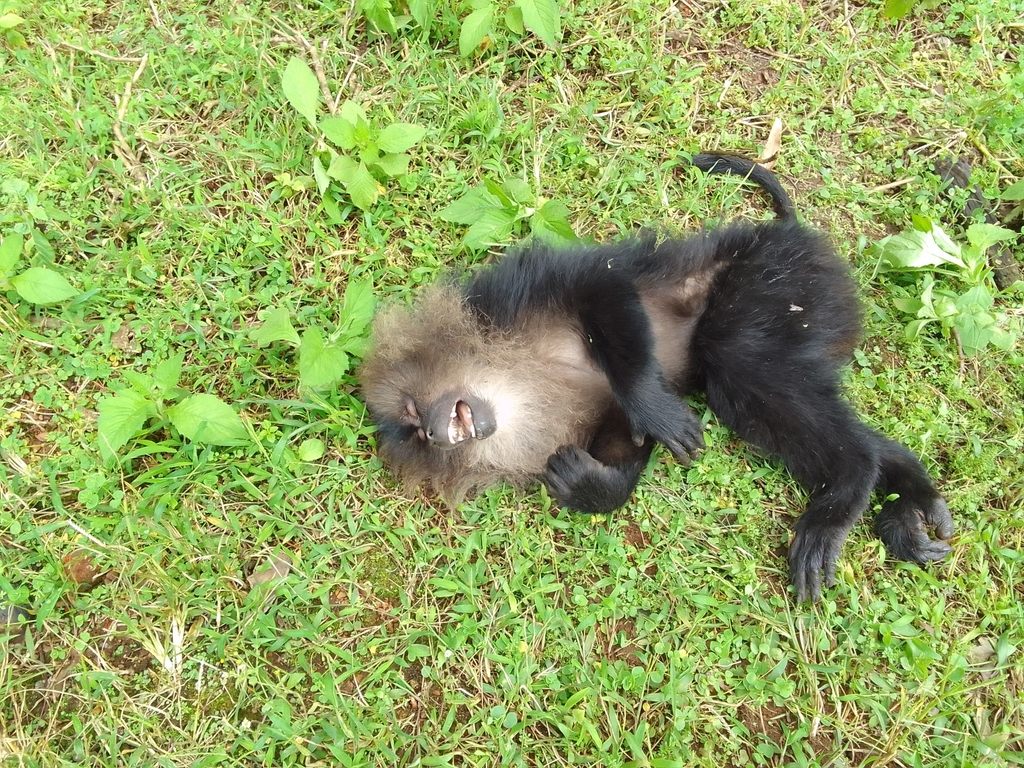
The lion-tailed macaque (Macaca silenus) is an Old World monkey that lives only in the rainforest canopy of India's Western Ghats. A silver-white mane rings its black face, its tail ends in a dark tuft, and only the troop's dominant male gives the loud whoop call that marks its territory.
Most monkeys in the genus Macaca are generalists: rhesus macaques raid temple steps, long-tailed macaques work beaches and car parks. The lion-tailed macaque does the opposite. It has committed entirely to one habitat, the unbroken upper canopy of tropical rainforest, and refuses to compromise. That single-mindedness is exactly what makes it one of the more striking, and more elusive, animals you could ever catch on camera.
What is a lion-tailed macaque?
The lion-tailed macaque (Macaca silenus) is an Old World monkey found nowhere on Earth except the Western Ghats, a mountain range running down the west coast of South India. Locally it is also called the wanderoo. Its body is glossy black from head to tail, broken only by a thick silver-white mane that sweeps back from the cheeks, past the chin and around the jaw, framing the dark face so cleanly that early naturalists likened it to a lion's. The thin tail, about 25 cm long, carries a dark tuft at the tip, more pronounced in males than females, which is where the common name comes from.
It is a smaller macaque, with a head-body length of roughly 42-61 cm. Males run noticeably larger than females, 5-10 kg against 3-6 kg, a gap of around a third, and also carry bigger canine teeth and a bolder tail tuft.
How is it different from other macaques?
The genus Macaca has around 23 species scattered from North Africa to Japan, and almost all of them have made a good living off humans: rhesus macaques work temple steps and city rooftops across South Asia, long-tailed macaques pick through beach resorts and car parks across Southeast Asia. The lion-tailed macaque is the outlier. It has none of that flexibility, no taste for scraps, no tolerance for cleared land, and no interest in people at all. Where its cousins are famous for adapting to almost anywhere, this one has adapted to exactly one thing, continuous rainforest canopy, and nothing else will do.
Where does it live, and why so little else?
This is a true canopy specialist. A lion-tailed macaque spends almost its entire life in the upper storey of tropical evergreen and monsoon forest, moving branch to branch rather than walking the ground, and only comes down when the canopy itself has been broken up by clearings or roads. That strict requirement for continuous forest cover is also why its range has fractured into isolated pockets scattered across Karnataka, Kerala and Tamil Nadu: a macaque troop raised entirely in the treetops has little reason, and little inclination, to cross open ground to reach the next patch of forest. For a very different set of canopy and understory specialists on the opposite side of the world, see our guide to Amazon rainforest animals.
How does it live in a troop?
Troops run 10-20 strong, occasionally up to 34, built around a core of related females with usually one breeding male in charge, though a troop can carry up to three adult males at once. Diet is mostly fruit, topped up with flowers, leaves, nuts, seeds, insects and the occasional small vertebrate, and like several Old World monkeys it forages with built-in cheek pouches, stuffing them full so it can keep moving through the canopy rather than stopping to chew every mouthful on the spot. Troop life is intricate enough that lion-tailed macaques recognise individuals, track social rank and coordinate as a unit, the kind of social complexity that puts primates consistently near the top of any real ranking of the smartest animals in the world.
Why do only the males give a loud call?
Here the species does something no other macaque does: only the males give a loud, far-carrying call, popularly described as a "whoop", to announce a troop's presence and warn rivals off without anyone having to be seen. Researchers studying captive groups have documented up to 17 distinct vocal patterns in all, combined with facial expressions and posturing for communication inside the troop, and the long-distance call itself has been shown to be acoustically shaped for exactly the job it does: punching through the acoustic clutter of a dense rainforest canopy. Another Western Ghats and South Asian rainforest specialist that relies on a loud, far-carrying signal of its own, a hollow bill casque that amplifies its call like a resonating chamber, is the oriental pied hornbill.
Is the lion-tailed macaque dangerous?
Not to people. It is a shy, retreating animal that would rather vanish back into the canopy than confront anyone, and there is nothing in its natural behaviour that makes it a threat. The one practical friction point is at the forest edge: troops living close to plantations will sometimes raid crops for an easy meal, so the same rule applies here as with any wild primate: keep your distance, and never feed one. It joins a short list of elusive, rarely-seen forest mammals that reward patience rather than pursuit, alongside animals like the jaguarundi, a small cat that is just as easy to miss.
Two more things worth knowing
- Troops rarely clash directly. When one male's whoop reaches a neighbouring troop, the usual response is an answering call rather than an advance, which lets troops space themselves out through a shared stretch of canopy without ever having to meet face to face.
- The pouches do double duty. The same cheek pouches it uses to stockpile fruit on the move also let a foraging macaque grab food fast and retreat into cover to actually eat it, useful cover for a species that spends so little time anywhere near open ground.
How rare is the lion-tailed macaque in Kaught?
In the Kaught catalog the lion-tailed macaque sits at the Epic tier, three diamonds out of four. That measures how often the species is actually confirmed in sightings, not its conservation status: because it stays high in continuous canopy and almost never comes down, even people spending real time inside its known range in the Western Ghats can go a long while without a clean, confirmed look at one. A loud whoop carrying through the trees is often the closest most visitors get.
Lion-tailed macaque: frequently asked questions
What is a lion-tailed macaque?
An Old World monkey, Macaca silenus, found only in the rainforest canopy of the Western Ghats in South India. Its body is entirely black except for a thick silver-white mane that rings the face from cheek to chin, and its thin tail ends in a dark tuft.
Why does it have a mane around its face?
The silver-white mane is simply the species' natural colouring, the rest of its coat is black. It frames the dark face so sharply that early naturalists compared it to a lion's mane, which is how the species got its common name.
Where do lion-tailed macaques live?
Only in pockets of continuous tropical rainforest in the Western Ghats mountains of Karnataka, Kerala and Tamil Nadu, India. They are canopy specialists that rarely descend to the ground unless the forest cover has been broken up.
Why do only male lion-tailed macaques give loud whoop calls?
The lion-tailed macaque is the only macaque species in which males alone give a loud call to advertise territory. The whoop is pitched and shaped to carry through dense forest canopy, warning rival troops without the male having to be seen.
Is the lion-tailed macaque dangerous to humans?
No. It is shy around people and retreats into the canopy rather than confronting anyone. Troops living near forest-edge plantations will sometimes raid crops, so the usual rule applies: keep your distance and never feed a wild troop.
Why is the lion-tailed macaque "Epic" in Kaught?
Kaught's rarity reflects how often a species is actually confirmed in the wild, not its conservation status. The macaque stays high in unbroken canopy and rarely comes down, so even inside its known range a clean, confirmed sighting is uncommon.
The next thing you see could be
your first catch.
Kaught is live on the App Store and Google Play. Free to start, and your first catch is one photo away.
Free to start · Live on the App Store and Google Play
Species data, type, rarity tier and measurements, is drawn from the Kaught catalog, built on open biodiversity records from GBIF and iNaturalist. Rarity reflects how often a species is observed in the wild, not its conservation status.