
Exotic spotlight
The Numbat: the Marsupial That Hunts by Day and Carries More Teeth Than Any Mammal
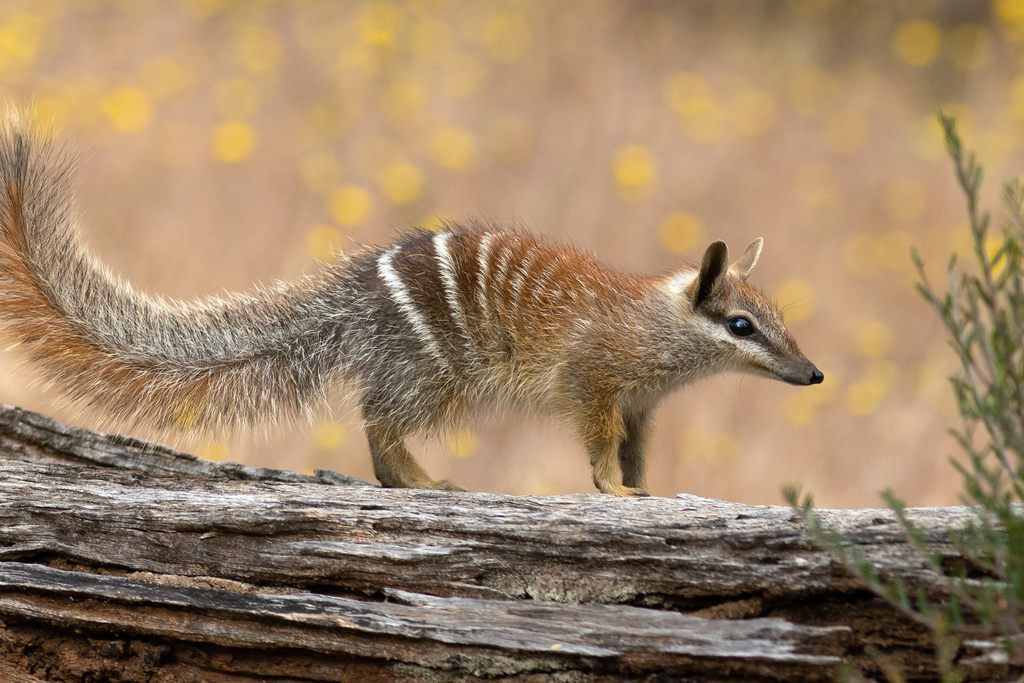
The numbat (Myrmecobius fasciatus) is a small Australian marsupial that eats almost nothing but termites, up to 20,000 a day, lapped up with a 10 cm tongue. It is the only diurnal marsupial and carries about 50 teeth, more than any other land mammal, none of which it chews with.
Most marsupials make their living in the dark. Kangaroos graze at dusk, bandicoots dig at night, and the handful of marsupial carnivores do their hunting under cover of darkness. Then there's the numbat, a small, striped, furiously busy exception that does everything backwards: it's out at nine in the morning, head down in the leaf litter, because the only food worth eating is awake then too.
What a numbat looks like
A numbat is roughly squirrel-sized, with a slender body, a pointed snout and a long, bushy tail nearly as long as everything in front of it. The coat runs from rust-red to grey-brown, broken across the rump and lower back by white stripes edged in black, the clearest field mark at any distance. A dark stripe runs through each eye like a bandit's mask, and the tail is held up and fanned when the animal is alert. Despite the old nickname "banded anteater," it isn't an anteater, and the "ant" part of that name is mostly wrong too.
A termite specialist, full stop
Diet is where the numbat gets genuinely strange. Most insect-eating mammals take whatever turns up. The numbat eats almost nothing except termites, a single prey group, in quantities that sound implausible: up to 20,000 a day. It finds them by scraping open the shallow galleries termites build just beneath loose soil and leaf litter, using strong, slightly curved front claws to rip the surface open in seconds. What follows is less biting than licking: a tongue roughly 10 cm long, nearly half the animal's body length, flicks in and out of the exposed gallery, coated in sticky saliva the termites can't escape.
The only marsupial that keeps daylight hours
Nearly every marsupial on Earth is nocturnal or at least active mainly at dawn and dusk. The numbat is the confirmed exception, active almost entirely during daylight, and the reason traces straight back to its termites. Termite tunnels sit close enough to the surface that soil temperature controls when the insects are reachable: as the sun warms the topsoil through the morning, termites move up into the shallow galleries a numbat's claws can actually open, then retreat deeper as the ground cools toward evening. A numbat that kept nocturnal hours, like almost every other small Australian marsupial, would be digging into empty tunnels. So it flipped its whole schedule instead, foraging through the heat of the day and retreating at dusk into a hollow log or a self-dug burrow lined to keep out foxes, cats and dingoes, exactly when most of its relatives are just getting started.
Fifty teeth, and almost none of them doing any work
Here's the detail that sounds like a contradiction until you see the jaw itself: the numbat carries around 50 teeth, more than any other land mammal manages, yet it barely chews with any of them. Because termites are small, soft and swallowed in a steady stream straight off the tongue, there's nothing for a grinding molar to do, and over evolutionary time the numbat's teeth have shrunk to small, poorly rooted pegs that barely clear the gum line. It's a trait that outlived the job it evolved for: more hardware than any mammal on the list of record tooth counts, and less practical use for any of it.
Where to actually find one
Numbats once ranged across a much wider swathe of southern Australia. Today the two naturally occurring wild populations are confined to a small corner of the southwest: the Dryandra Woodland and the Perup forest, both dry eucalypt woodland with the one feature a numbat can't do without, plenty of old, hollow logs and fallen timber to den in. Reintroduced populations exist at a handful of other protected sites, but seeing one in the wild still means being in the right patch of Western Australian woodland in the middle of the day, not the easiest window for most visitors used to looking for mammals at dawn or dusk. It is legally protected across its range, a legal status distinct from Kaught's own rarity tier below.
Is a numbat dangerous?
Not in the slightest. A numbat has no venom, no meaningful bite, and nothing resembling an aggressive streak toward people or pets. It is solitary, intensely shy, and built for running rather than fighting: startle one and it bolts in short, fast bursts for the nearest hollow log, not toward you.
How rare is the numbat in Kaught?
In the Kaught catalog the numbat sits at the Rare tier, two diamonds out of four. As always, that's a measure of how often the species is actually logged by real observers, not a statement about threat level. A numbat that forages in daylight sounds like it should be easy to record, but a tiny remaining range, genuine shyness, and a habit of vanishing into the nearest log the moment it's disturbed keep confirmed sightings well below what you'd expect from a species active at the one time of day everyone else is out looking.
Three things worth knowing about the numbat
- It is the only living member of its own family, Myrmecobiidae, an ancient marsupial lineage with no close living relatives, the nearest comparison is still a reach across the wider marsupial carnivore group.
- Unlike kangaroos and most other marsupials, a female numbat has no true pouch. Up to four young simply cling to crimped hair around her four nipples for roughly six months, growing so large by the end that she struggles to walk.
- Despite being out in full daylight, a numbat relies more on smell than eyesight to find termite galleries hidden under leaf litter and loose soil, locating them from several centimetres down without ever seeing the insects themselves.
The numbat isn't the only Western Australian specialist built around a single, unglamorous food source, the thorny devil runs the same play with ants a continent over, trading claws and a tongue for a skin that drinks water by capillary action. And the numbat's missing pouch is worth reading against the very different strategy kangaroos settled on: a joey the size of a jellybean, covered in why kangaroos have pouches. Fifty teeth or not, this is one marsupial that earns its own category among the weirdest animals in the world.
Numbat: frequently asked questions
What is a numbat?
The numbat (Myrmecobius fasciatus) is a small, termite-eating marsupial native to Western Australia. It has a rust-brown coat banded with white and black stripes across the rump, a long bushy tail and a pointed snout, and is the sole living member of its own family, Myrmecobiidae.
What does a numbat eat?
Almost nothing but termites, up to 20,000 a day. It rips open shallow termite galleries with strong front claws, then laps up the insects with a sticky tongue roughly 10 cm long, nearly half its body length. It very rarely eats ants despite the old nickname "banded anteater."
Why is the numbat active during the day?
Termites retreat into tunnels just under the soil surface once the sun warms the topsoil, so the numbat forages by day to follow them, unlike almost every other marsupial, which is nocturnal. It dens up at night, sheltering from predators in a hollow log or burrow.
Does a numbat have teeth?
Yes, around 50 of them, more than any other land mammal, but they barely function. Because termites are swallowed almost whole rather than chewed, the numbat's teeth and jaw muscles have degenerated into small, poorly developed pegs that do very little real biting.
Where do numbats live?
In dry eucalypt woodland in the southwestern corner of Western Australia, mainly the Dryandra and Perup woodlands. They shelter by night in hollow logs or burrows lined to keep out predators, and once ranged much more widely across southern Australia.
Is a numbat dangerous?
No. Numbats have no venom, no notable bite, and no aggressive streak toward people or pets. They are shy and solitary, and a disturbed numbat simply runs for the nearest hollow log rather than confronting whatever startled it.
Why is the numbat "Rare" in Kaught?
Kaught's Rare tier reflects how often a species is actually logged by real observers, not conservation status. The numbat is genuinely scarce to record: it survives in a small part of Western Australia, is shy, and isn't encountered as often as a common garden species.
The next thing you see could be
your first catch.
Kaught is live on the App Store and Google Play. Free to start, and your first catch is one photo away.
Free to start · Live on the App Store and Google Play
Species data, type, rarity tier and measurements, is drawn from the Kaught catalog, built on open biodiversity records from GBIF and iNaturalist. Rarity reflects how often a species is observed in the wild, not its conservation status.