
Adaptation explainer
The Eurasian Beaver: how it engineers rivers and why the landscape changes when it moves in
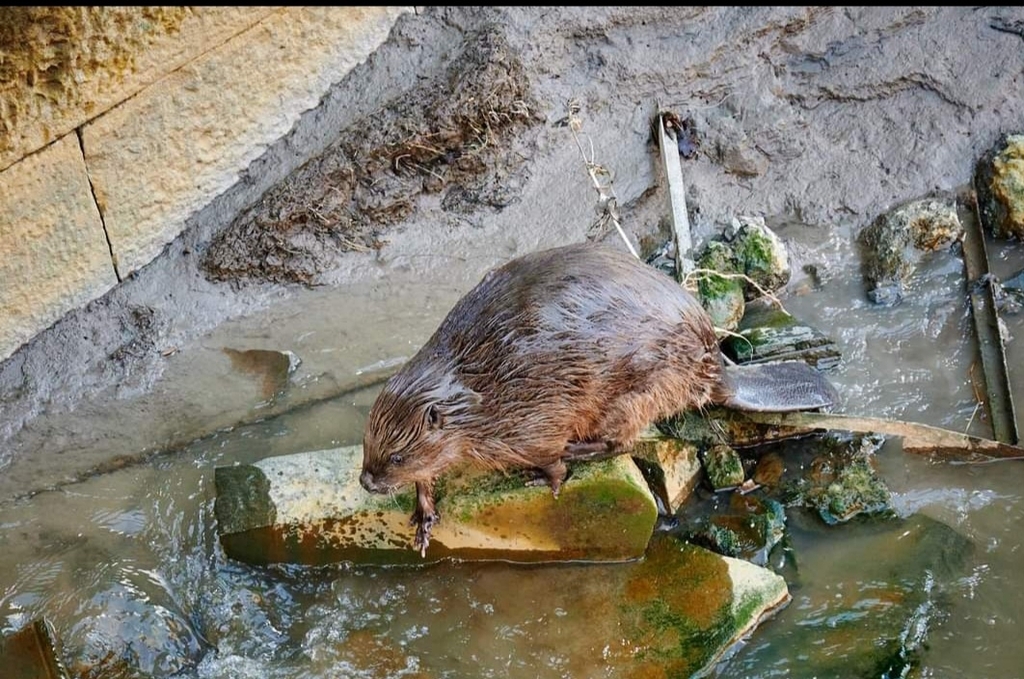
The Eurasian beaver (Castor fiber) is Europe's largest rodent and its most dramatic landscape engineer. It fells trees, builds dams that flood entire valley sections, and creates wetlands that persist for decades. Epic tier in the Kaught catalog, largely nocturnal and secretive, best seen at dusk on slow rivers with dense bankside woodland.
Walk up a valley where beavers have been active for a few years and the difference from a beaver-free stream is immediate. Where there was a shallow, fast-moving channel there is now a network of ponds, connected by slower water, edged with reed beds and willow scrub. Dragonflies hover where there were none before. Otters move through at night. The bankside trees show characteristic pointed stumps: clean, cone-shaped, the unmistakable work of the largest rodent in Europe.
How to identify a Eurasian beaver
The beaver is hard to misidentify once seen. It is a large, compact mammal with:
- Rich brown fur, slightly oily and water-resistant, darker on the head and back.
- A flat, paddle-shaped tail covered in dark grey scales rather than fur, about 30 cm long. No other European mammal has this tail.
- Large orange-tinted incisors, stained by iron compounds embedded in the enamel that harden the cutting edge. The orange is visible at a distance.
- A heavy, low-slung body on short legs, moving with a slight waddle on land but powerfully in water, using the hind feet and tail for propulsion.
In the water, a swimming beaver shows only the rounded back and flat tail, which it uses as a rudder. When alarmed it dives with a loud tail-slap on the surface, a warning sound audible from 100 metres.
The biology of tree-felling
The beaver's incisors grow continuously throughout its life, worn down only by the wood they cut. The cutting mechanism is a chisel: the lower teeth cut upward while the upper teeth act as a brace. The beaver circles the base of a tree, gnawing a notch all the way around until the trunk is thin enough to topple under its own weight. A 10 cm diameter willow takes about 15 minutes to fell; a 30 cm trunk may take several nights.
The beaver does not control the direction of fall. Trees fall where the wind takes them, which is why a busy beaver site often has felled trunks pointing in all directions. Once down, the trunk is cut into sections and branches are stripped for food or construction. Stripped lengths of bark are sometimes cached underwater near the lodge entrance as a winter food supply.
Dam building: the engineering adaptation
The dam itself is not a goal. It is a means to an end. A beaver dam slows or stops water flow to raise the level of a pool around the beaver's lodge. The lodge is a domed structure of branches and mud built in the middle of the pond. Its entrance tunnel opens below the water line, so predators cannot follow without diving, and in winter the water around the entrance stays ice-free even when the pond surface freezes, giving the beaver access to its underwater food cache.
Construction uses whatever material is available: sections of tree trunk wedged into the streambed, packed with mud, moss, grass and smaller sticks. The beaver applies mud by carrying it pressed under the chin and forelegs. Dams are continuously repaired: any water flowing through a gap produces a sound stimulus that triggers repair behaviour. Beavers have been observed working throughout the night to seal leaks.
The hydrological effects extend far beyond the pond itself. A beaver dam raises the local water table, pushing moisture into the surrounding soil for hundreds of metres. Wetlands form in areas that were dry. Water is retained in the landscape rather than running off rapidly, reducing flood peaks downstream and maintaining base flow in dry periods. A single beaver family on a small tributary can measurably alter the hydrology of the catchment below it.
What beavers eat
Beavers are strict herbivores. In summer they feed primarily on aquatic plants, grasses and the leaves of bankside trees. In autumn the diet shifts to bark and cambium, the soft nutritious layer just beneath the bark, and the beaver begins building an underwater cache of branches near the lodge entrance for use through winter. Willows, aspens and alders are preferred, though they will take almost any bankside broadleaf.
The flat tail plays no role in construction or patting mud (a common misconception). It functions as a fat-storage organ in autumn, a counterbalance while sitting to eat, and a warning device when slapped on the water surface.
Where and when to see a Eurasian beaver
Eurasian beavers are active from dusk to dawn. In summer, when nights are short, individuals sometimes emerge an hour before dark, making June and July the best months for observation. Walk slowly along the bank of a river with known beaver activity, face into the wind and wait at a point downstream of a lodge or dam.
In Europe, established wild populations exist on the Rhine, Elbe, Rhône, Danube and across Scandinavia, Poland and Russia. In the UK, free-living populations are now established on the River Otter in Devon and the River Tay in Scotland following licensed reintroductions.
Look for the evidence first: pointed stumps, gnawed sections of timber, muddy drag-marks on the bank where logs have been moved, and the dam or lodge itself. Active lodges have fresh mud applied to the surface; old lodges are overgrown and dark.
How rare is the Eurasian beaver?
The Kaught catalog rates the Eurasian beaver at Epic tier, three diamonds. Beavers are nocturnal, build their lodges in the middle of ponds, and are alert to disturbance. A clear sighting is genuinely uncommon even on rivers with established populations. The sign they leave behind is abundant; the animal itself, far less so.
For another river predator that shares beaver habitat, see common otter. For the woodland ecosystems beavers border, see British woodland animals.
Eurasian beaver: frequently asked questions
What does a Eurasian beaver look like?
A large, stocky, brown-furred rodent 80 to 100 cm long with a distinctive flat, scale-covered paddle tail and large orange-tinted incisors. Europe's largest rodent. Swims powerfully with the tail as rudder; waddling on land.
How do beavers build dams?
They fell trees by gnawing a notch around the base, cut the trunk into sections, float or drag them to the site and wedge them into the streambed, packing gaps with mud, moss and smaller sticks. Dams are maintained continuously; any flow through a gap triggers repair behaviour.
Why do beavers build dams?
To raise the pond level around the lodge, keeping the underwater entrance accessible to the beaver but inaccessible to land predators. Deep water around the lodge also keeps the entrance ice-free in winter, allowing access to underwater food caches.
Where can you see a Eurasian beaver?
On rivers and lakes across Europe and western Asia. Reintroduced UK populations are on the River Otter in Devon and the River Tay in Scotland. Best watched at dusk in summer, by waiting quietly downwind near a lodge, dam or fresh felling sign.
What do beavers eat?
Aquatic plants, grasses, leaves and bark. In autumn they cache branches underwater near the lodge for use through winter. Willows, aspens and alders are preferred; they will take most bankside broadleaves. Strict herbivores: no fish or other animal food.
How rare is the Eurasian beaver?
Epic tier in the Kaught catalog, three diamonds. Beavers are nocturnal and secretive around their lodges. Clear sightings are uncommon even on rivers with established populations. Evidence of their presence, stumps, gnawed timber and dams, is far more abundant than the animal itself.
The next thing you see could be
your first catch.
Kaught is live on the App Store and Google Play. Free to start, and your first catch is one photo away.
Free to start · Live on the App Store and Google Play
Species data, type, rarity tier and measurements, is drawn from the Kaught catalog, built on open biodiversity records from GBIF and iNaturalist. Rarity reflects how often a species is observed in the wild, not its conservation status.