
Fun facts
7 animals with extreme senses: real superpowers the biology can actually explain
Seven animals with sensory systems that go far beyond what human biology can do: a mole that identifies prey in 120 ms using 25,000 touch receptors, a shrimp with 16-colour vision, a bat that reads moth species from an echo, a platypus that hunts entirely by electric field, a bird that sees magnetic north, a snake that maps heat in the dark, and an octopus that detects light human eyes are completely blind to.
Human sensory biology is narrower than it feels. We sample a thin slice of the electromagnetic spectrum, detect a fraction of the chemical signals drifting past us, and have essentially no awareness of electric fields, polarized light or the planet's magnetic field. The animals below do not have "better" versions of human senses. Several of them have senses with no human equivalent at all. Each one carries a card in the Kaught catalog.
1. Touch: Star-nosed Mole
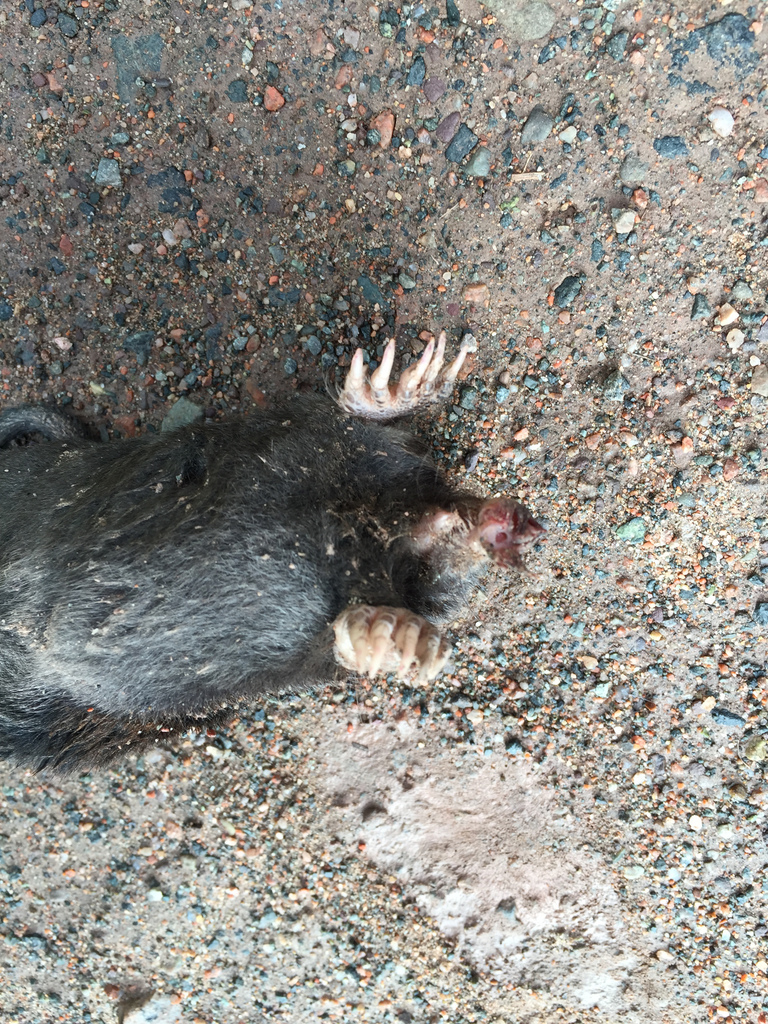
The star-nosed mole lives in waterlogged soil in eastern North America and hunts earthworms, insect larvae and small crustaceans underground and in shallow streams. Its face ends in 22 fleshy pink tentacles arranged in a star pattern around the nostrils, each packed with Eimer's organs, tiny dome-shaped mechanoreceptors that detect the slightest surface deformation.
That star contains roughly 25,000 sensory receptors across a surface area smaller than a fingertip. For comparison, a human fingertip, our most sensitive touch surface, has about 2,500. The star is roughly five times as dense.
The payoff: the star-nosed mole can identify an earthworm, grab it and swallow it in under 120 milliseconds. That is the fastest documented feeding reflex of any mammal. The star sweeps rapidly across the soil surface as the mole moves forward, building a tactile picture of the environment at a rate comparable to how a sighted animal uses its eyes.
The part of the brain devoted to processing star input is proportionally enormous, larger relative to brain size than the visual cortex of almost any other mammal. Touch is not a secondary sense for this animal. It is the primary one.
2. Colour vision: Shako Mantis Shrimp
The mantis shrimp has 16 types of photoreceptor cells. Humans have three (one each for red, green and blue). The full breakdown of its visual system is covered in the adaptation explainer, but the key point belongs here: the mantis shrimp can detect ultraviolet light, infrared light and polarized light, as well as having separate receptor channels across the entire human-visible spectrum and beyond.
Counterintuitively, behavioral experiments suggest the mantis shrimp does not necessarily discriminate between colours better than a human does. Instead, the 16-channel system appears to process color very fast without fine comparison between adjacent channels, a system optimized for speed and categorization rather than subtle distinction. The Legendary tier (four diamonds in the Kaught catalog) is independently confirmed by the scarcity of iNaturalist records for this species.
3. Sound: Greater Horseshoe Bat
The full echolocation guide covers the mechanics in depth. The short version: the greater horseshoe bat emits constant-frequency pulses at 83 kHz through its horseshoe-shaped noseleaf and listens to the returning echo with ears that rotate independently, acting as steerable sonar dishes. It can identify the species of a moth from the flutter pattern in the Doppler-shifted echo: a different wingbeat frequency for every species, as readable to the bat as a fingerprint.
This is not just detecting something in the dark. It is reading fine structural detail from a pressure wave reflected off a moving target 20 metres away, while flying, in a forest, alongside other bats doing the same thing. The noseleaf focuses the outgoing pulse into a narrow forward beam; the large ears amplify the returning signal and suppress background noise. The whole system is so finely tuned that the bat adjusts the emission frequency in real time to compensate for its own Doppler shift.
4. Electroreception: Platypus
The platypus closes its eyes, ears and nostrils the moment it dives. For the duration of the dive, which can last 30 seconds to more than a minute, the animal has no sight, no hearing and no smell. It navigates and hunts entirely by electric field detection.
The rubbery bill contains approximately 40,000 electroreceptors arranged in rows on its upper surface and 60,000 push-rod mechanoreceptors on its lower surface. Muscle contractions in any live creature produce a small electric field. The platypus detects those fields from several centimetres away, sweeps its bill from side to side as it swims along the bottom, and triangulates the prey location from the difference in signal timing between the two sides of the bill.
Electroreception of this precision is extremely rare among mammals. The platypus and its echidna relatives are the only mammalian examples known to science. The system is inherited from the earliest vertebrates: sharks, rays and many fish have it; most land vertebrates lost it. The platypus is a case of evolutionary retention rather than innovation, which makes it no less remarkable.
5. Magnetic navigation: Arctic Tern
The Arctic tern makes the longest migration of any animal, a round trip of up to 90,000 km every year between the Arctic and the Antarctic. It sees more daylight hours in a year than any other animal on Earth, but the navigation system that makes this possible is not visual, it is magnetic.
Cryptochrome proteins in the retina of birds including the Arctic tern are sensitive to the quantum spin state of electrons, which changes in the presence of a magnetic field. Current evidence suggests the tern effectively "sees" the magnetic field as a brightness or pattern overlaid on its visual field, a compass integrated into the act of seeing rather than a separate organ. This is calibrated against a sun compass based on the position of the sun relative to an internal circadian clock, giving the bird two independent navigation systems that cross-check each other across thousands of kilometres of open ocean with no landmarks.
6. Infrared detection: Western Rattlesnake
Pit vipers, of which the western rattlesnake is one of the most studied examples, have a pair of pit organs, small facial depressions between the eye and the nostril, that detect infrared radiation. The membrane inside the pit is so thin and so richly supplied with heat-sensitive neurons that it can resolve temperature differences of 0.003 degrees Celsius.
Each pit generates a thermal image of the surrounding environment, and the two pits combined provide three-dimensional depth information about the heat source's distance and direction. A mouse moving 30 cm away in complete darkness registers as a clear warm shape against the cooler background. The brain integrates the infrared image with the optical image from the conventional eyes, giving the snake two simultaneous maps of the same space that it can use independently or together depending on conditions.
In total darkness, the infrared map is the primary guide for the strike. This is why rattlesnakes hunt effectively at night without moonlight, and why a mouse in a burrow is not much safer in the dark than it would be in daylight.
7. Polarized light: Common Octopus
The common octopus is colorblind. It has only one type of photoreceptor cell, which means it cannot distinguish wavelengths (colors) in the way a trichromat like a human can. Yet octopuses match their skin color and pattern to their surroundings with extraordinary accuracy, and behavioral experiments confirm they respond differently to different colors.
The leading explanation involves polarized light. The octopus photoreceptor is sensitive to the polarization angle of incoming light, not just its intensity, and the pupil's distinctive W-shape or rectangular slit rotates as the eye moves, sweeping different polarization angles across the retina. Because different surfaces reflect polarized light differently based on their physical properties, this could allow the octopus to infer surface color from polarization information alone, essentially reading color through a mechanism completely different from the one vertebrate color vision uses.
This is a hypothesis still under active investigation, but the behavioral evidence for color discrimination in a nominally colorblind animal is solid. The full octopus intelligence profile gives context for how far its sensory and cognitive abilities extend beyond what one body plan might seem to allow.
The Kaught catalog angle
Each of these animals carries a card in the Kaught catalog with a rarity tier derived from observation frequency in the wild. The star-nosed mole and western rattlesnake are Common, one diamond, in the catalog: they are present in good numbers in their ranges, and records reflect that. The mantis shrimp sits at Legendary, four diamonds, because actual field encounters are rare despite the species being widespread. The pattern across these seven animals is a reminder that the catalog sorts by ease of spotting in the real world, not by biological interest. The most unremarkable-looking tier can sometimes hold the most extraordinary biology.
Extreme animal senses: frequently asked questions
Which animal has the best sense of touch?
The star-nosed mole. Its 22-tentacled star contains 25,000 sensory receptors in a fingertip-sized area, roughly five times more touch-sensitive than a human hand. It can identify and eat prey in under 120 milliseconds, the fastest feeding reflex of any mammal.
Which animal has the best colour vision?
The mantis shrimp has the most complex visual system of any animal, with 16 types of photoreceptor cells compared with three in humans. It can detect ultraviolet, infrared and polarized light across the entire visible and beyond-visible spectrum.
Which animal uses electroreception?
The platypus is the best-known mammal example. Its bill contains about 40,000 electroreceptors that detect the electric fields produced by prey muscle contractions underwater. It closes its eyes, ears and nostrils while diving and hunts entirely by electric field detection.
Which animal can detect magnetic fields?
The Arctic tern is one of the strongest examples, navigating 90,000 km per year using cryptochrome proteins in its eyes that are sensitive to the Earth's magnetic field, calibrated against a sun compass based on an internal circadian clock.
Which animal can detect infrared heat?
Pit vipers including the western rattlesnake, using pit organs between the eye and nostril that detect temperature differences of 0.003 degrees Celsius. The organs produce a thermal image of warm-blooded prey in complete darkness from 30 cm or more.
What sense does the common octopus use that humans do not?
Detection of polarized light. Despite being colorblind (only one photoreceptor type), the octopus can likely infer surface colors from polarization information, using a mechanism entirely different from standard vertebrate color vision. This is still an active area of research.
The next thing you see could be
your first catch.
Kaught is live on the App Store and Google Play. Free to start, and your first catch is one photo away.
Free to start · Live on the App Store and Google Play
Species data, type, rarity tier and measurements, is drawn from the Kaught catalog, built on open biodiversity records from GBIF and iNaturalist. Rarity reflects how often a species is observed in the wild, not its conservation status.