
Legendary spotlight
The Desert Monitor: one of the hardest lizards to actually see in the Sahara and Middle East
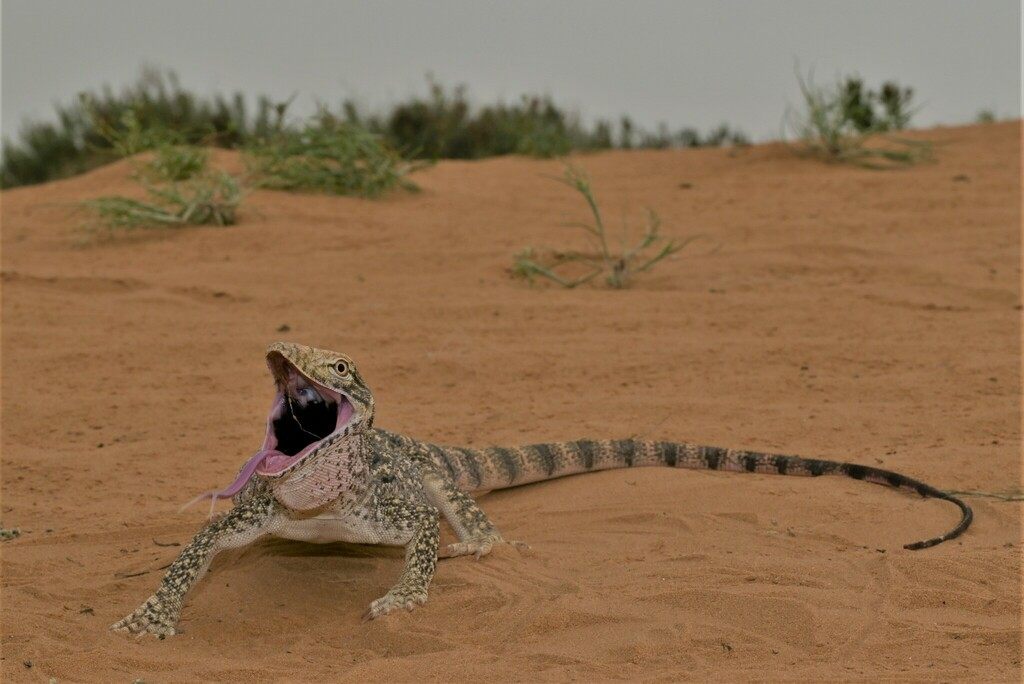
The desert monitor (Varanus griseus) is a legendary-tier lizard ranging from the Sahara through the Middle East to northwestern India. It hunts rodents, lizards and even venomous snakes from deep burrows, spends the cold months hibernating, and a confirmed sighting is genuinely rare even across its enormous range.
Most of the desert monitor's range is open, sun-blasted ground with almost nowhere to hide, and yet almost nobody who lives there has actually seen one up close. It spends the hottest hours of the day underground, moves fast and low across sand the same colour as its own skin, and vanishes into a burrow at the first sign of a footstep. In the Kaught catalog it sits at the Legendary tier, and once you understand how it actually lives, that rarity makes complete sense.
How to identify a desert monitor
It is one of the largest lizards across its entire range, and once you know the shape, it is hard to confuse with anything smaller:
- Snout: distinctly pointed and flattened, with nostrils set closer to the eyes than to the tip, unlike the rounder snout of many other monitor species.
- Colour: plain grey to sandy brown in barren desert, shifting to a banded pattern of orange-brown and cream in areas with more plant cover, an adaptation that tracks the background it needs to disappear into.
- Tail: long, muscular and whip-like, roughly as long as the head and body combined, used for balance, defence and a slap that can draw blood.
- Tongue: deep and forked like a snake's, flicked constantly to taste the air and ground for prey and rivals.
- Build: heavily muscled limbs with long claws built for fast digging, not climbing.
A fresh track in sand often gives it away before the animal itself does: four-toed footprints flanking a continuous tail-drag line down the centre.
Where the desert monitor lives
The species has an enormous range for a reptile, stretching from Morocco and the Sahara across the Middle East and the Arabian Peninsula, through Iran, Central Asia and Pakistan, into northwestern India. Within that range it keeps to sandy and rocky desert, semi-desert and dry scrub, generally below 800 m elevation.
It does not simply endure the desert, it engineers a way through it. A desert monitor digs its own burrow several feet long, or takes over one already dug by a rodent, and uses it as a refuge from both the midday heat and the winter cold. From around September to April it retreats into that burrow to hibernate, which is exactly the window when the odds of a sighting drop to near zero.
Three recognised subspecies split that range further: the nominate form across North Africa and the Middle East, a Caspian form in the sandy steppe around the Caspian Sea, and a smaller-bodied Indian form in the deserts of Pakistan and northwestern India. All three share the same basic biology, a solitary lizard that would rather dig away from a problem than confront it.
How it hunts, and the snakes it kills
The desert monitor is an opportunistic predator with an unusually broad diet: rodents such as gerbils, other lizards, ground-nesting birds and their eggs, tortoises, insects, scorpions and carrion. What sets it apart is a genuine willingness to take on venomous snakes as ordinary prey, overpowering them with speed and a bite before they can strike a fatal blow.
Like other monitor lizards, the desert monitor carries its own venom glands, located in the lower jaw. Research on the wider monitor family has shown these glands produce toxins capable of rapid effects on smaller prey, and a bite to a person can bring on swelling, nausea, dizziness and a racing heartbeat that lasts roughly a day. Its role is thought to be helping subdue a struggling meal rather than a primary weapon of self-defence, and the animal's first response to a threat is always to run or dig, not to bite.
How to improve your chances of seeing one
A confirmed sighting takes the right season and a lot of patience:
- Late spring through summer. This is when desert monitors are out of hibernation and most active, well before the punishing peak of midsummer heat forces a return to shelter.
- Dawn and dusk, not midday. Activity concentrates in the cooler hours either side of the hottest part of the day, when a monitor is more likely to be foraging above ground rather than retreated in a burrow.
- Watch burrow entrances. A wide, sloped opening near a rodent colony, in open sand or at the base of scrub, is a realistic place to wait quietly at a distance.
- Read the sand. A continuous drag mark between two rows of footprints is a giveaway even when the animal itself is long gone.
For more on how Kaught's rarity tiers compare across very different habitats, see the water monitor lizard's forked-tongue adaptation and the wider desert animals guide.
The desert monitor in the Kaught catalog
In Kaught, the desert monitor registers as a Legendary Reptile/Apex type, four filled diamonds out of four. The apex tag reflects its place at the top of its local food chain, a predator large and capable enough to kill venomous snakes and defend a burrow from most desert competitors. The Legendary tier itself is not a comment on conservation status, it is the catalog's record of how rarely the species is actually logged by real observers in the field, and for an animal this well camouflaged and this seasonal, that number stays low.
For a sense of how that compares to another apex predator on the opposite end of the climate spectrum, see the Eurasian lynx, also Legendary tier, also built around being nearly impossible to actually observe.
Three things that make the desert monitor remarkable
- Running speed scales directly with body temperature: roughly 1 metre per second at 21°C, rising to about 3 metres per second once its body warms to 37°C, a built-in speedometer for how much heat it is carrying.
- It becomes noticeably more aggressive and defensive below 21°C, the opposite of the sluggish, cold-slowed reptile people expect, likely because it cannot yet outrun a threat.
- Eggs are laid in early summer and take around 120 days to incubate, hatching just as the desert's brief cooler season begins, timing that gives hatchlings their best chance before the next extreme summer.
Desert monitor lizard: frequently asked questions
What does a desert monitor look like?
A large, powerfully built lizard with a long neck, a distinctly pointed and depressed snout, and a whip-like tail as long as its body. Colour ranges from plain grey in barren desert to a banded orange-brown pattern in vegetated areas, with a deeply forked, snake-like tongue.
Where does the desert monitor live?
Across North Africa, the Middle East and Central Asia to northwestern India, in sandy and rocky desert, semi-desert and dry scrub up to about 800 m elevation. It shelters in long burrows it digs itself or takes over from rodents.
Is the desert monitor venomous or dangerous to humans?
It carries venom glands in its lower jaw, like other monitor lizards, and a bite can cause swelling, nausea and a racing heartbeat lasting about a day. It is shy and avoids people, so bites are rare and almost always defensive, from handling.
What does a desert monitor eat?
Almost anything it can overpower: rodents, other lizards, snakes (including vipers), ground-nesting birds and their eggs, tortoises, insects, scorpions and carrion. Diet shifts with whatever prey the local desert offers.
Why is the desert monitor Legendary in Kaught?
Kaught's Legendary tier reflects how rarely a species is actually recorded in the wild, not any conservation status. The desert monitor is wary, well camouflaged and hibernates through the cooler months, so a confirmed sighting is genuinely uncommon even across its huge range.
How do you find a desert monitor in the wild?
Look at dawn or dusk from late spring to late summer, after it emerges from winter hibernation, scanning open sand and rock for its distinctive tail-drag trail alongside footprints. Burrow entrances near rodent colonies are a reliable place to wait quietly.
How big does a desert monitor get?
Most adults reach about 1 to 1.5 m in total length and weigh under a kilogram, though large individuals can approach 2 m and nearly 3 kg. It is among the largest lizards found anywhere in its North African and Middle Eastern range.
The next thing you see could be
your first catch.
Kaught is live on the App Store and Google Play. Free to start, and your first catch is one photo away.
Free to start · Live on the App Store and Google Play
Species data, type, rarity tier and measurements, is drawn from the Kaught catalog, built on open biodiversity records from GBIF and iNaturalist. Rarity reflects how often a species is observed in the wild, not its conservation status.