
Legendary spotlight
Mountain Lion: the most widespread wild cat on Earth, and the one almost nobody sees
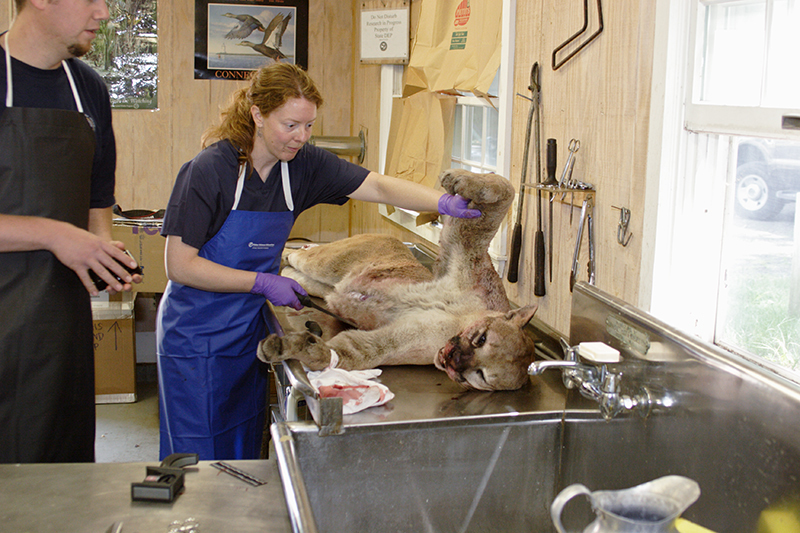
The mountain lion (Puma concolor) is the most widely distributed wild terrestrial mammal in the Americas. It lives from Canada to Patagonia in every habitat type. It holds the Guinness record for the most English names of any animal. Despite all this, most people who spend their lives in mountain lion country never knowingly see one.
A mountain lion moves through the land like a rumour. Trail cameras in the western United States document individuals crossing roads, skirting suburbs and following deer through familiar terrain. Hikers may follow the same trail for years without knowing that a mountain lion uses it nightly. The cat goes where it likes, on its own schedule, and it is very good at not being seen.
Forty names, one animal
Puma concolor holds the Guinness World Record for the animal with the most common names. Over 40 have been documented in English alone: mountain lion, cougar, puma, panther, catamount, painter, ghost cat, deer tiger, silver lion and many regional variants. In South America, the animal picks up more names in Spanish and Portuguese: puma, suçuarana, onça-parda. Each name reflects a different region's relationship with the animal, or simply the tendency of isolated populations of settlers to name what they encountered without knowledge of what other communities were calling the same beast.
The range explains the proliferation. Puma concolor lives in every major terrestrial habitat type in the Western Hemisphere: boreal forest in the Yukon, desert in the American Southwest, tropical rainforest in the Amazon basin, Andean mountain terrain above 4,500 metres, temperate forest in Patagonia. No other large terrestrial mammal covers this range.
How to identify a mountain lion
The animal itself is unmistakable if you are close enough to see it clearly. But most encounters are brief and partial, a shape in headlights, a shadow crossing the trail. Key features:
- Colour: uniform tawny to grayish-brown, paler on the chest and belly, with dark ear tips. No spots in adults. Kittens have spotted coats that fade within the first year.
- Build: long-bodied, with a small rounded head relative to body size, longer hind legs than front legs (producing a characteristic slight rump-high posture), and a very long tail with a dark tip.
- Size: males are significantly larger than females. A large male can exceed 90 kg and 2.4 m from nose to tail tip.
- Tracks: four toe pads arranged in a C shape around a large, three-lobed heel pad. No claw marks. The leading toe is offset, not centred, giving the print a clearly asymmetric shape.
The absence of claw marks is the single most reliable field mark when distinguishing mountain lion tracks from those of a large dog. Retractile claws are a felid trait; no domestic or wild canid shares it. Tracks average 8 to 10 cm wide in adults. Stride length on flat ground often exceeds a metre.
The territory and the hunt
Mountain lions are solitary. Adults, especially males, maintain large home ranges: 200 to 1,000 km² depending on prey density and terrain. A male's range typically overlaps the ranges of several females but not those of other males. Communication is through scent marking at scrapes: the cat rakes up a mound of debris with its hind feet, urinates and sometimes deposits scat on it. Scrapes on trails are spaced at intervals, marking a regular circuit.
The primary prey throughout most of the range is deer: white-tailed deer in the east and southeast, mule deer and elk in the west, various deer species in South America. A mountain lion kills roughly one deer per week and may return to a cached carcass for several days, covering it with debris between visits. Where deer are scarce it switches to smaller prey: rabbits, porcupines, smaller carnivores, livestock.
The hunting method is a stalk and short sprint, ending in a leap onto the prey's back and a bite to the nape or throat. The hind legs are longer than the front, giving extra propulsive power for the final leap. Mountain lions can jump 5.4 metres vertically and cover 9 metres horizontally from a standing start. They are not endurance runners: a chase that does not end quickly is usually abandoned.
The sound no one expects
Mountain lions cannot roar. The anatomy that produces the full roar of a lion or tiger requires a partially ossified, ligamentous hyoid bone. The puma's hyoid is fully ossified and rigid, the same configuration as domestic cats, which allows purring but not roaring. What the mountain lion produces instead is a range of chirps, whistles, bird-like calls and a high, wavering scream that carries through mountain terrain. The scream, most often made by females in oestrus, is frequently described by people who hear it for the first time as sounding human. It is not a sound anyone who has heard it once easily forgets.
The chances of a sighting
The Kaught catalog places the mountain lion at the Epic tier, three diamonds out of four. This reflects the actual record of documented wild sightings. Despite the enormous range, covering virtually all of the Americas, confirmed iNaturalist observations remain relatively rare. The animal's solitary nature, its large home range, its preference for movement at night or in low light, and its active avoidance of human presence all work against detection.
The best conditions for a chance encounter are: late afternoon or early morning in rocky canyon terrain, in areas with good deer populations, moving quietly. Trail cameras are the most reliable tool. A scratch mark on a tree (vertical claw raking up to 2 m above ground), a scrape mound on a trail, or a kill cache under debris are all signs of regular use.
For comparison: the Jaguar in South and Central America occupies largely overlapping terrain but is the heavier, stockier ambush specialist with rosette markings. The Leopard in Africa and Asia fills a similar ecological niche on the other side of the planet. Of the three, the mountain lion covers the most ground but produces the fewest confirmed sightings per square kilometre of range.
Three things worth knowing
- Mountain lions have been documented swimming across the San Francisco Bay and regularly navigate freeways in urban California, moving between habitat patches at night. Individuals have been recorded in New York City on more than one occasion.
- Young males disperse hundreds of kilometres from their birth range, a necessary behaviour to avoid inbreeding. Dispersers account for most of the unusual sightings in unexpected locations.
- The fastest animals list shows the mountain lion is not a record holder for speed: it reaches around 80 km/h in a sprint but cannot sustain it. Its real advantage is patience, concealment and explosive power at close range.
Mountain lion: frequently asked questions
What is a mountain lion?
The mountain lion (Puma concolor) is a large wild cat native to the Western Hemisphere. It is the most widely distributed wild terrestrial mammal in the Americas, ranging from the Yukon in Canada south to Patagonia in Argentina. It holds the Guinness World Record for the animal with the most English names: over 40, including cougar, puma, panther and catamount.
Is a mountain lion the same as a cougar or puma?
Yes. Mountain lion, cougar and puma are all common names for the same species, Puma concolor. Panther, catamount, painter and ghost cat are additional regional names. The Guinness World Record for the most common names for a single animal belongs to Puma concolor, with over 40 English names documented.
Are mountain lions dangerous to humans?
Attacks on humans are rare. The species is solitary and actively avoids people. Fewer than 20 fatal attacks have been confirmed across North America in the last 100 years. If encountered, stand tall, make yourself look large, back away slowly and never run.
Where do mountain lions live?
Every major habitat type in the Western Hemisphere: boreal forest, desert, grassland, tropical rainforest and high mountain terrain. The range spans from the Yukon in Canada south through Central and South America to Patagonia. In North America the highest densities are in the western mountain states and Pacific coast ranges.
Can mountain lions roar?
No. Mountain lions cannot roar. They lack the modified hyoid bone that allows lions, tigers and leopards to produce a full roar. Instead they communicate with chirps, whistles, purrs, growls and a screaming call that carries long distances in mountain terrain.
How do you tell mountain lion tracks from a large dog?
Mountain lion tracks have four toe pads arranged in a C-shape with a three-lobed heel pad and no claw marks, since the claws are fully retractable. A large dog shows claw marks in almost every print. Mountain lion prints are also asymmetric: the leading toe is offset, not central.
Why is the mountain lion Epic in Kaught?
Kaught's rarity tier reflects how often a species is recorded in the wild. Despite the mountain lion's enormous range, its solitary nature, large home range and avoidance of people means confirmed sightings are comparatively infrequent. It sits at the Epic tier: three diamonds out of four.
The next thing you see could be
your first catch.
Kaught is live on the App Store and Google Play. Free to start, and your first catch is one photo away.
Free to start · Live on the App Store and Google Play
Species data, type, rarity tier and measurements, is drawn from the Kaught catalog, built on open biodiversity records from GBIF and iNaturalist. Rarity reflects how often a species is observed in the wild, not its conservation status.