
Fun facts
7 of the weirdest animals in the world: creatures whose biology defies every rule
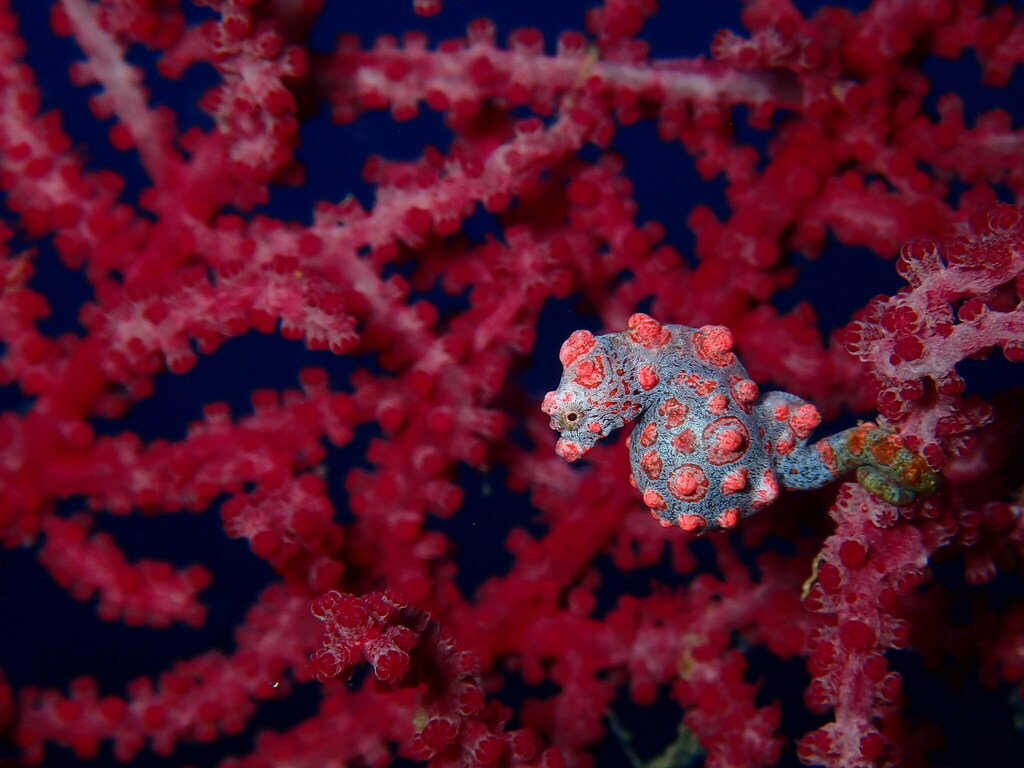
Seven species from the Kaught catalog that exist at the outer edge of biological possibility: a fish smaller than a thumbnail that hides in plain sight on coral, a two-tonne fish with no real tail, a monkey with a nose the size of a cucumber, and four others that each break a different fundamental rule of what animals are supposed to look like.
1. Pygmy Seahorse
At up to 2.7 cm, the pygmy seahorse is one of the smallest vertebrates in the ocean and one of the best camouflaged. It lives exclusively on a single genus of gorgonian sea fan (Muricella), and its body matches the fan's exact colour and the lumpy texture of its polyps so precisely that the species was not formally described until 1969, when a marine biologist found one still clinging to a sea fan already collected for study. No one had noticed it in the wild.
The camouflage is not passive. Pygmy seahorses that settle on red fans turn red. Those that settle on yellow fans turn yellow. The skin texture develops to match the host polyps. The mechanism appears to be a combination of background-matching cues and active pigment adjustment, though how completely this is under voluntary control is still being investigated.
Like all seahorses, the male carries the female's eggs in a brood pouch and gives birth to fully formed miniature young. For more on seahorse reproduction, see our guide to the Giant Seahorse.
2. Common Mola (Ocean Sunfish)
The ocean sunfish looks like something important is missing, specifically the back half. What appears to be its tail is actually a fused, rudder-like structure called a clavus, a modification unique to the mola family that replaced the conventional tail during the fish's evolution. The sunfish essentially left its tail behind tens of millions of years ago and never replaced it.
This is the heaviest bony fish on Earth, with confirmed individuals weighing over 2,300 kg. It spends its life drifting through open ocean, eating jellyfish, salps and other gelatinous prey, which are nutritionally dilute enough that the sunfish must eat almost constantly. After deep cold-water dives it surfaces and lies flat on its side, warming its body temperature in sunlight before diving again. It is also, unexpectedly, one of the most parasite-laden animals in the ocean, hosting over 40 species of parasite, which may explain why it surfaces near kelp beds where wrasse fish groom its skin.
3. Proboscis Monkey
The proboscis monkey is endemic to Borneo and is named, inevitably, for the male's enormous drooping nose, which can reach 7 cm and hangs below the mouth. When the male honks or is alarmed, the nose engorges with blood and acts as a resonating chamber, amplifying the call to carry through dense mangrove forest. Females have notably smaller, upturned noses.
The species is a strong swimmer, regularly crossing wide rivers and swimming between mangrove stands. When jumping into water it launches with its arms spread wide and lands feet-first in a belly-flop posture that generates much less splash than a headfirst dive. Males have a visible pot belly from the enlarged, multi-chambered stomach that digests their exclusive diet of unripe leaves and seeds, chosen specifically because ripe fruit would ferment dangerously in such a complex gut.
4. Giant Anteater
The giant anteater has no teeth. None at all. In their place, it uses a 60 cm tongue that flicks in and out up to 150 times per minute, coated in sticky saliva, to harvest ants and termites from torn-open mounds. It eats roughly 35,000 insects per day. To process them without chewing, it swallows small pebbles and grit along with its food; a muscular, gizzard-like region of its stomach grinds the insects mechanically.
The forelimbs are among the strongest in proportion to body size of any mammal. The animal walks on its knuckles to protect its claws, which can tear open concrete-hard termite mounds and, if cornered, are capable of killing a jaguar. Despite this, the giant anteater is not aggressive, and its first response to threat is to flee or to rise up on its hind legs and wave its forelegs in a display rather than attack.
The bushy tail is roughly as long as the body and serves as a blanket: the animal sleeps curled under it, conserving heat in cool grassland nights. A mother carries a single pup on her back for up to a year, the pup's stripe pattern aligning with the mother's so the two look like one animal to aerial predators.
5. Quokka
The quokka is a small wallaby, about the size of a domestic cat, found mainly on Rottnest Island off the coast of Perth, Western Australia. It has become famous globally for the "quokka selfie": the animal's round face and the upward curve of its mouth corners give it an expression that resembles a grin. This is anatomy, not emotion. The quokka is neither happy nor unhappy when photographed; it just looks that way.
What is genuinely remarkable about the quokka is its behaviour under pressure. In the 17th century, Dutch sailors landing on Rottnest reported seeing large rats, which is how the island got its name ("rats' nest"). What they were actually seeing were quokkas, which at the time were dense enough to be everywhere underfoot. The quokka population on the mainland has contracted severely due to predators, but on Rottnest the island's isolation still protects a population dense enough that the animals are genuinely unafraid of people.
Females can pause the development of an embryo (embryonic diapause) while nursing a joey, keeping the next offspring in reserve and able to deliver it rapidly if the joey in the pouch is lost to predation.
6. Capybara
The capybara is the world's largest rodent, weighing up to 66 kg, and is essentially a very large, very calm guinea pig that lives near water. It swims powerfully, can stay submerged for up to five minutes, and has slightly webbed toes. Socially it is gentle, forming groups of 10–20 individuals that move between grassland and water without apparent urgency.
What cemented the capybara's internet fame is not its size but its temperament. The species appears genuinely unbothered by other animals. Viral footage shows capybaras sharing thermal pools and mud wallows with jaguars, caimans, and monkeys, sitting completely still while other animals groom them, rest on them, or simply perch on their broad backs. In captivity they have been photographed in the same enclosure as domestic cats, dogs, rabbits and ducks, invariably appearing unmoved by the company.
The behaviour is not passivity from weakness. Capybaras are alert animals that flee predators effectively. What they appear to lack is territorial aggression toward other species. In places where they occur alongside the American Crocodile, they enter and exit the water calmly even when crocodiles are visible nearby, relying on numbers and vigilance rather than avoidance.
7. Aardvark
The aardvark is the only living member of the order Tubulidentata. This is not a family or genus distinction. It is alone in its entire taxonomic order, with no living relatives. Before molecular analysis became available, taxonomists debated whether it was related to insectivores, pigs, or armadillos. DNA eventually revealed its closest living relatives are elephants, hyraxes and tenrecs, a grouping nobody had predicted.
It is strictly nocturnal and almost never seen during the day, which explains its Rare tier in the Kaught catalog despite being widespread across sub-Saharan Africa. Each night it excavates ant and termite mounds with spade-like claws and harvests the insects with a long, sticky tongue. It can dig faster through hard soil than a person with a shovel, and a threatened aardvark will dig itself out of sight faster than a human can follow.
The burrows it abandons become essential habitat for dozens of other species, from warthogs and porcupines to owls, pythons, monitor lizards and wild cats. In this sense the aardvark is a keystone species: its digging creates infrastructure that sustains an entire savanna community, even when the aardvark itself is rarely seen.
For another remarkable animal whose biology places it alone in its taxonomic group, see our guide to the Vampire Squid, which belongs to its own separate order and is neither squid nor octopus.
Weirdest animals: frequently asked questions
What is the weirdest animal in the world?
Strong candidates include the pygmy seahorse (2.7 cm long, camouflaged to match one specific coral species), the aardvark (sole member of its entire taxonomic order, more closely related to elephants than to any other African mammal), and the ocean sunfish (the world's heaviest bony fish, with no true tail, that eats only jellyfish and basks on its side to rewarm after cold dives).
What is the world's largest rodent?
The capybara (Hydrochoerus hydrochaeris) of South America, weighing up to 66 kg. It is closely related to the guinea pig and lives semi-aquatically in groups near rivers and wetlands across most of tropical South America.
What is the world's heaviest bony fish?
The ocean sunfish (Mola mola), with confirmed individuals reaching 2,300 kg. It has no conventional tail, drifts through open ocean eating jellyfish, and basks flat on its side at the surface to warm up after deep cold-water dives.
Why does the proboscis monkey have such a big nose?
In males, the large pendulous nose amplifies calls in mangrove forest. Research also shows females prefer males with larger noses. The nose engorges with blood when the male calls or is alarmed, acting as a resonating chamber. Females have smaller upturned noses and the size difference between sexes is one of the most extreme in any primate.
What does an aardvark eat?
Almost exclusively ants and termites, roughly 50,000 insects per night. It tears open mounds with powerful claws and uses a long sticky tongue to harvest prey. Despite this volume, it has no teeth; a muscular stomach grinds the food with swallowed soil and grit.
The next thing you see could be
your first catch.
Kaught is live on the App Store and Google Play. Free to start, and your first catch is one photo away.
Free to start · Live on the App Store and Google Play
Species data, type, rarity tier and measurements, is drawn from the Kaught catalog, built on open biodiversity records from GBIF and iNaturalist. Rarity reflects how often a species is observed in the wild, not its conservation status.