
Field comparison
Dugong vs manatee: how to actually tell them apart
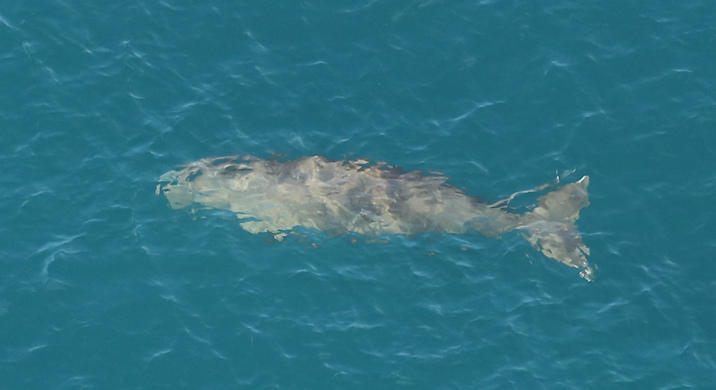
The clearest field mark is the tail: a dugong's is forked like a whale's, a manatee's is round and paddle-shaped like a beaver's. Dugongs live only in the Indo-Pacific; manatees live only in the Atlantic and Americas, so the two species never actually meet in the wild.
Round grey body, whiskered snout, a slow grazer on the seafloor: a dugong and a manatee look close enough to be the same animal, and for centuries sailors mistook both for mermaids. They are relatives, but not the same species, not even the same family, and they live on opposite sides of the planet. Three field marks settle it fast.
Dugong
The dugong is the only living member of its family, Dugongidae, found in warm coastal waters from East Africa and the Red Sea across South and Southeast Asia to northern Australia and Vanuatu. Adults run 2.5 to 3 m long and 230 to 420 kg. Its snout points sharply downward, built for grazing seagrass on the seafloor, and adult males (and some older females) grow short visible tusks, modified incisor teeth. It can live past 70 years but breeds slowly, a female typically raising one calf every 3 to 7 years.
Manatee
The West Indian manatee is one of three manatee species (alongside the Amazonian and African manatees), ranging from Florida and the Gulf of Mexico south through the Caribbean to Brazil. Adults run 2.7 to 3.5 m long and 400 to 550 kg. Its upper lip is split into two independently moving pads that pull in plants from any angle, at the surface or the bottom, and it has no visible tusks: instead, its molars shed at the front and are replaced by new teeth migrating in from the back, a system shared with elephants, its closest living land relative.
The tail: the fastest field mark
From a boat, a plane or an app photo, the tail alone settles most sightings. A dugong's tail is fluked, two pointed lobes meeting at a central notch, built exactly like a dolphin's or a whale's for steady, powerful strokes low over the seagrass. A manatee's tail is a single broad, round paddle with no notch at all, more like the flat tail of a beaver. Seen from above or below, in clear water or murky, this is the one mark that almost never fails.
The snout and the tusks
Look closer and the face confirms it. A dugong's snout is long and turns sharply down, ending in a narrow, bristled, horizontal mouth built for one job: grazing seagrass off the bottom. A manatee's snout is shorter and blunter, with a split upper lip whose two halves move independently, almost like small grasping hands, letting it feed at the surface as easily as on the bottom. Tusks settle any remaining doubt: visible tusks mean dugong, no tusks mean manatee.
Fresh water vs salt water
This is the difference with the clearest biology behind it, and it runs the opposite way from most marine comparisons. The dugong is strictly marine; its body has no tolerance for fresh water, and it never enters a river. The manatee does the reverse: it moves freely between salt water, brackish estuaries and pure fresh water, and in winter the West Indian manatee relies on warm freshwater springs and power-plant outflows to survive the cold, something a dugong could never do.
One order, two branches: the taxonomy behind the split
Dugongs and manatees share the order Sirenia, the only group of fully aquatic, plant-eating mammals, named directly after the Sirens of Greek myth. But they diverged into separate families. The dugong sits alone in Dugongidae; its only other known relative, Steller's sea cow, a giant Arctic sirenian, was hunted to extinction within 27 years of its discovery in 1741. Manatees sit in Trichechidae, a family of three living species spread across the Americas and West Africa. Both families trace back to a shared land-dwelling ancestor closer to today's elephants than to any other living marine mammal, a lineage switch echoed elsewhere in the ocean by animals like the giant seahorse, a fish that gave up its ancestral shape entirely.
Why they have never met in the wild
Unlike predators that overlap at a coastline, dugongs and manatees occupy entirely separate oceans. Dugongs are confined to the Indian and western Pacific Oceans; manatees are confined to the Atlantic, the Caribbean, the Amazon basin and the West African coast. There is no sea route connecting the two ranges warm enough for either animal to survive the crossing, so despite their near-identical lifestyle, grazing seagrass in warm shallow water, a wild dugong and a wild manatee have never shared the same patch of ocean. Other seagrass grazers do turn up alongside dugongs, including the green sea turtle, which crops the same meadows from the opposite side of the food chain.
How rare is each one to actually spot?
In the Kaught catalog both the dugong and the West Indian manatee sit at the Common tier, one diamond out of four. That is not a measure of how many exist worldwide, Kaught's rarity is purely about how often a species is actually confirmed in real sightings. Both animals are large, slow and surface regularly to breathe in places people already watch for wildlife, Florida's spring-fed rivers for the manatee, sheltered seagrass bays for the dugong, which makes a confirmed sighting more achievable than for a typical open-ocean marine mammal like the narwhal, whose tusk is in fact a different structure entirely: an elongated canine tooth, not a modified incisor like the dugong's.
Dugong vs manatee: frequently asked questions
What is the easiest way to tell a dugong from a manatee?
Look at the tail. A dugong's tail is forked and notched like a whale's or dolphin's. A manatee's tail is a single round, flat paddle, closer to a beaver's. It is the one field mark that works from any angle, even underwater.
Why does a dugong have a forked tail and a manatee a round one?
They evolved the shapes independently for different feeding styles. A dugong feeds only on the seafloor, so a fluked tail gives it the steady, dolphin-like propulsion it needs to cruise low over seagrass. A manatee grazes at the surface and the bottom, and a broad paddle tail suits that slower, more vertical movement.
Do dugongs and manatees ever live in the same place?
No. Dugongs live only in the Indian and western Pacific Oceans, from East Africa to northern Australia. Manatees live only in the Atlantic, the Caribbean, the Amazon basin and West Africa. Their ranges never overlap, so the two species have never met in the wild.
Do dugongs have tusks?
Adult male dugongs (and some older females) grow short visible tusks, which are modified incisor teeth. Manatees do not have visible tusks; their molars instead move forward and are replaced continuously throughout life as older teeth wear down at the front.
Can manatees live in salt water like dugongs?
Yes, and manatees go further: they move freely between salt water, brackish estuaries and pure fresh water, including rivers and warm springs. The dugong is the opposite case, it is strictly marine and its body cannot tolerate fresh water at all.
Are dugongs and manatees closely related?
Yes, both belong to the order Sirenia, the only fully aquatic plant-eating mammals, but they split into separate families. The dugong is the sole living member of Dugongidae; manatees belong to Trichechidae, a family of three species. Their closest shared relative on land is the elephant.
The next thing you see could be
your first catch.
Kaught is live on the App Store and Google Play. Free to start, and your first catch is one photo away.
Free to start · Live on the App Store and Google Play
Species data, type, rarity tier and measurements, is drawn from the Kaught catalog, built on open biodiversity records from GBIF and iNaturalist. Rarity reflects how often a species is observed in the wild, not its conservation status.