
Legendary spotlight
Jaguar: the Americas' apex cat that kills with a bite to the skull
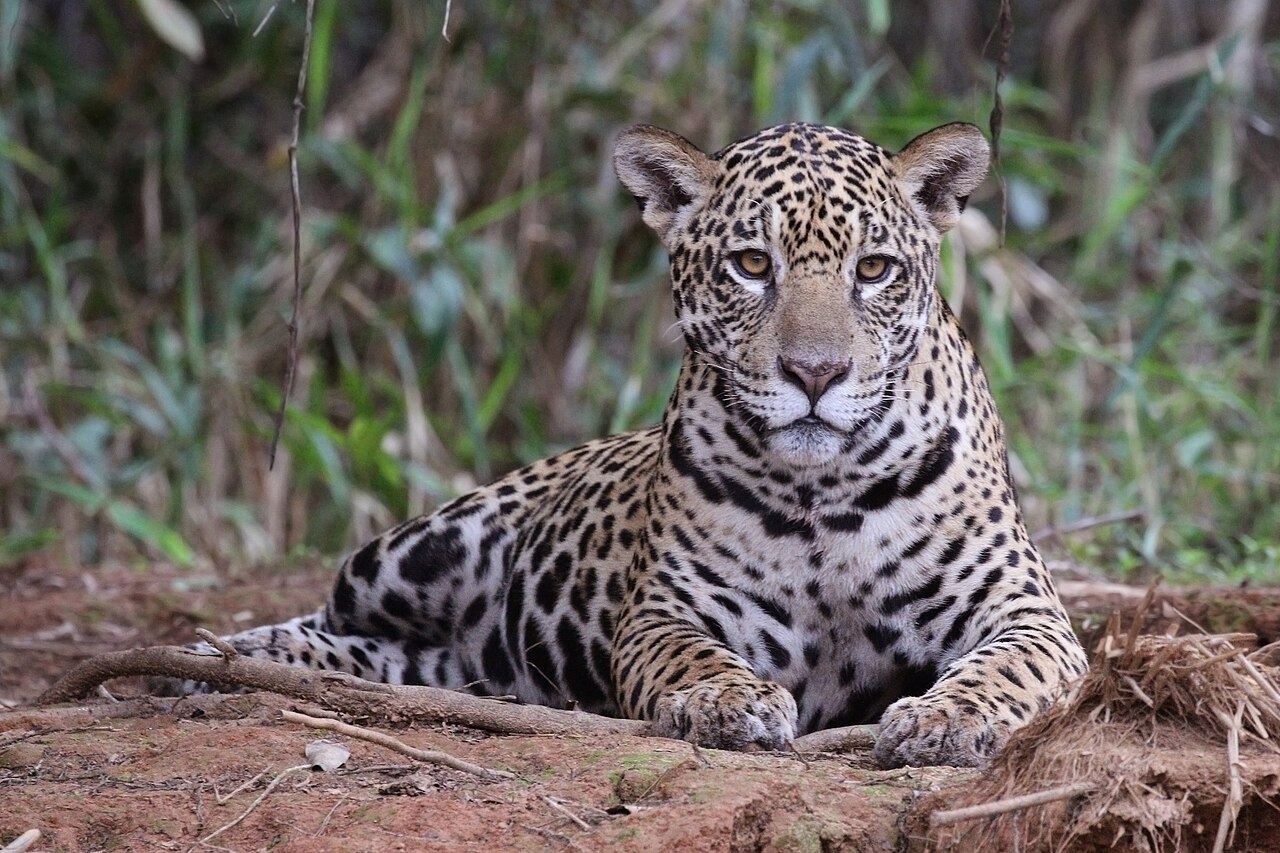
The jaguar (Panthera onca) is the largest wild cat in the Americas: a heavily built, rosette-patterned predator that hunts in dense rainforest, swims rivers readily, and kills with a direct crushing bite through the skull rather than a throat hold. Found from Mexico to Argentina, it is rated Legendary in the Kaught catalog due to extreme sighting scarcity.
At first glance, a jaguar looks like a leopard with an American passport. Look harder. The jaguar is heavier, broader across the shoulders, more powerful through the chest. Its rosettes usually contain interior spots. Its head is massive, with jaw muscles that do something no other big cat bothers with: drive canine teeth directly through the skull of its prey.
How to identify a jaguar
The jaguar's coat ranges from pale gold to deep orange-yellow, covered in black rosettes on the back and sides that usually contain one or more smaller black spots inside the ring. The belly and inner legs are white with black spots. Key field marks:
- Build: compact and low-slung, heavily muscled, with stocky limbs and huge paws. Noticeably heavier than a leopard of similar length.
- Head: very broad and round, with a prominent jaw and short muzzle. The head looks disproportionately large compared to the body.
- Rosettes: larger than a leopard's, and almost always with at least one dark central spot inside the ring. Leopard rosettes are plain open circles.
- Range: if you are in the Americas, it can only be a jaguar. The two species do not overlap geographically.
Black individuals occur: the dark coat is caused by melanism and the rosettes are still visible in the right light. These "black panthers" are jaguars (or sometimes leopards in Asia), not a separate species.
Where do jaguars live?
The jaguar's range runs from the southwestern United States and Mexico through Central America to northern Argentina. The Amazon Basin is its stronghold, but it occupies a remarkable range of habitats: dense tropical rainforest, seasonally flooded grassland (the Pantanal), dry scrubland (the Chaco) and mangrove swamps along the coast.
Unlike most cats, jaguars actively seek out water. They swim strongly, hunt caimans and large river turtles, and have been recorded crossing wide rivers between territories. In the Pantanal, the world's largest tropical wetland, the highest densities of wild jaguars can be found, making it the best place on Earth to see one from a boat.
The skull-crushing bite
Every other big cat kills by throat bite, suffocating prey that can take several minutes to die. The jaguar kills differently. It bites directly through the skull of its prey, piercing the brain. This requires extraordinary jaw strength, and the jaguar's skull is proportionally the most robust of any felid relative to its body size.
The same bite cracks open a river turtle's shell and punches through the bony armour of a caiman. When a jaguar takes a fish, it bats it from the water with a paw, then bites through the head. The method is faster and arguably more efficient than suffocation, and it allows the jaguar to take prey that other cats cannot.
The name gives the game away: "jaguar" comes from the Tupi-Guarani word yaguara, meaning "he who kills with one leap." Indigenous people across Amazonia built entire cosmologies around its power.
What jaguars eat
With 87 recorded prey species, the jaguar is the most catholic feeder of any large cat. The main items are deer, capybara, peccary and tapir. Where rivers are near, caimans, turtles and large fish round out the menu. Jaguars are also the only big cat documented to hunt aquatic prey deliberately rather than opportunistically.
Unlike leopards, jaguars rarely cache prey in trees. They drag large kills into cover and eat on the ground, sometimes returning to the same carcass over several days.
Jaguar vs leopard: the four field marks
The two cats are not closely related, but share a spotted coat and a similar hunting style. Here is how to tell them apart:
- Range: jaguars are New World only; leopards are Old World (Africa and Asia). No overlap.
- Rosettes: jaguar rosettes contain interior spots; leopard rosettes are plain rings.
- Build: jaguars are stockier, heavier and broader-headed than leopards of similar length.
- Kill method: jaguars bite through the skull; leopards bite the throat. Field-distinguishable on prey remains.
For a fuller comparison, see the leopard spotlight and the tiger guide.
Why Legendary?
In the Kaught catalog, rarity reflects how often a species is actually observed in the wild, not whether it is threatened. Jaguars are solitary, largely nocturnal and live in dense forest where visibility is measured in metres. The Pantanal boat trips that reliably produce daytime sightings are unusual; across most of the jaguar's range, even field biologists with camera traps go weeks without a confirmed image. Four diamonds.
Compare the strongest animals ranking to see how jaguar jaw force compares to saltwater crocodile and brown bear.
Jaguar: frequently asked questions
What does a jaguar look like?
A large, heavily built wild cat with a pale gold to orange-yellow coat covered in black rosettes that typically contain interior spots. The head is very broad and round, the legs stocky, and the body compact and muscular. Adult males reach up to 1.85 m body length and 120 kg.
Where do jaguars live?
From the southwestern United States and Mexico through Central America to northern Argentina, with the stronghold in the Amazon Basin and Pantanal. They prefer dense tropical rainforest near rivers but live in dry scrubland, flooded grassland and mangrove swamps too.
How is a jaguar different from a leopard?
Jaguars are larger and more heavily built, found only in the Americas; leopards are slimmer and found in Africa and Asia. Jaguar rosettes usually contain interior spots; leopard rosettes are plain rings. Jaguars kill prey with a skull-crushing bite; leopards use a throat hold.
Are jaguars dangerous to humans?
Very rarely. Jaguars are apex predators that typically avoid human contact, and unprovoked attacks are uncommon. They should always be observed from a safe distance and treated with respect.
What do jaguars eat?
A wide range of prey: deer, capybara, peccary, tapir, caimans, river turtles and large fish. Their powerful bite lets them pierce turtle shells and caiman skulls. They will also take livestock in areas where natural prey is scarce.
Why is the jaguar Legendary in Kaught?
Kaught's rarity tier reflects how often a species is actually recorded in the wild, not whether it is threatened. Jaguars are solitary, largely nocturnal and live in dense forest. Confirmed wild sightings are extremely rare outside a handful of specialist locations, putting them at the Legendary tier, four diamonds out of four.
How fast can a jaguar run?
Around 80 km/h over short distances. Jaguars do not rely on sustained speed: they are ambush hunters that close the final gap in a short burst from cover, then dispatch prey with a bite to the skull rather than a chase.
The next thing you see could be
your first catch.
Kaught is live on the App Store and Google Play. Free to start, and your first catch is one photo away.
Free to start · Live on the App Store and Google Play
Species data, type, rarity tier and measurements, is drawn from the Kaught catalog, built on open biodiversity records from GBIF and iNaturalist. Rarity reflects how often a species is observed in the wild, not its conservation status.