Habitat guide
Amazon rainforest animals: the 10 species that define the world's greatest jungle
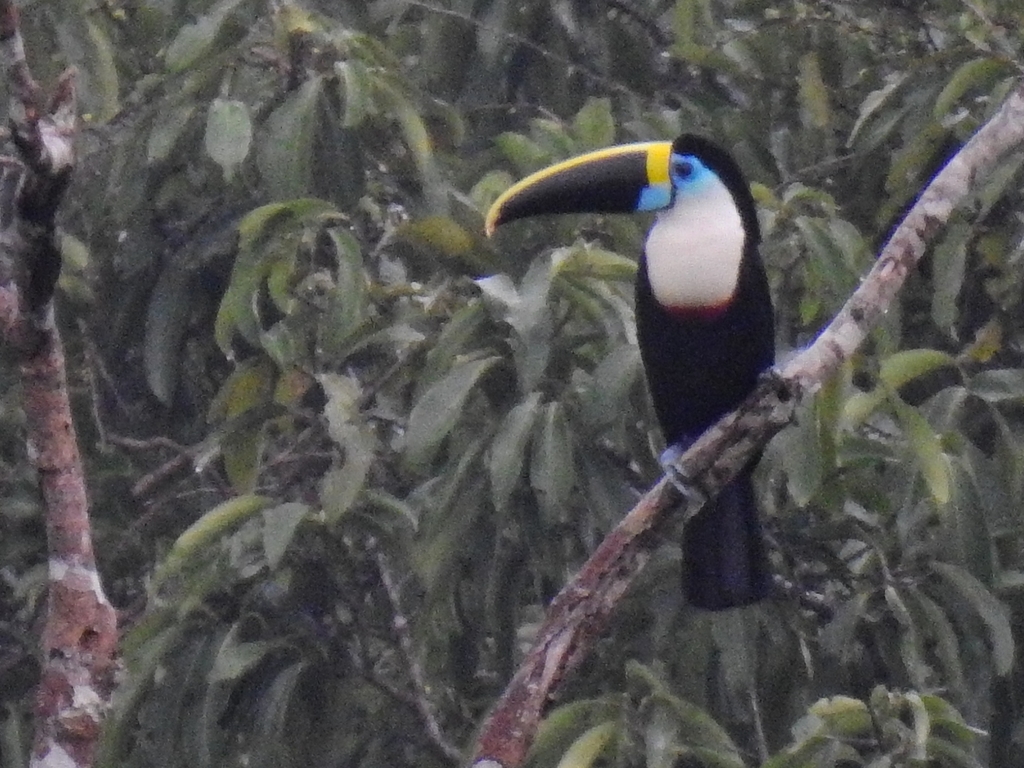
The Amazon basin holds roughly 10% of all species on Earth, packed into a system of flooded forest, blackwater rivers and canopy that runs from the Andes to the Atlantic. This guide covers ten of its most distinctive animals: the species that, between them, explain what makes Amazonian wildlife unlike anywhere else on the planet.
1. White-throated Toucan
The toucan is the Amazon's most recognisable silhouette. The white-throated toucan (Ramphastos tucanus) reaches 60 cm in length, most of that apparently bill, and its far-carrying yelp echoes through the canopy like a squeaky toy. That enormous bill, though, is not what it looks like: the structure is hollow, braced internally by a mesh of bony rods, and weighs a fraction of what solid bone would. It functions partly as a radiator, allowing the bird to dump body heat through the surface, and partly as a reach tool, plucking fruit from branches too thin to support the bird's weight.
2. Jaguar
The jaguar (Panthera onca) is the largest cat in the Americas and the only one that kills with a skull bite rather than a throat clamp, driving the canine teeth through bone to reach the brain. It is an obligate swimmer and regularly crosses major Amazonian rivers. Its rosette pattern is unique to each individual, allowing researchers to identify animals from camera-trap images. In the Amazon it hunts tapir, capybara, caiman and fish with equal readiness.
3. Green Anaconda
The green anaconda (Eunectes murinus) is not the world's longest snake (the reticulated python holds that record) but it is almost certainly the heaviest, with large females exceeding 200 kg and 8 metres. It is semi-aquatic, spending most of its life at the waterline of Amazonian backwaters, ambushing prey as large as capybara, caiman and deer. After constriction, swallowing a large caiman can take several hours.
4. Giant Otter
The giant otter (Pteronura brasiliensis) is the world's largest otter by length, reaching 1.8 metres, and among the noisiest animals in South America. Family groups of up to 20 individuals hold territories along river systems, marking them with communal latrines and maintaining them against rival groups with deafening group choruses. They hunt cooperatively, driving fish into shallows, and each individual can eat up to 4 kg of fish per day.
5. Amazon River Dolphin (Pink Dolphin)
The Amazon river dolphin (Inia geoffrensis), also called the boto, is a real freshwater dolphin with a flexible neck (unfused vertebrae allow it to turn its head 90 degrees) and an elongated, beaked snout. Adults are pink: males especially so, the colour building over decades as skin abrasions from territorial fights heal as pink scar tissue. The boto navigates flooded forest by echolocation, squeezing between tree trunks in the wet season to reach fish that take refuge among the roots.
6. Ocelot
The ocelot (Leopardus pardalis) is a medium-sized spotted cat found throughout Amazonian forest, scrubland and mangrove, hunting at night for small rodents, birds, reptiles and fish. Unusually for a cat, it is a capable swimmer. Each individual's spot pattern is unique, and researchers use photo-ID to census populations. The ocelot's spots are actually rosettes AND stripes combined, a pattern shared by no other cat.
7. Harpy Eagle
The harpy eagle (Harpia harpyja) is the most powerful bird of prey in the Americas, with talons the size of a grizzly bear's claws. It hunts in the upper and mid canopy, specialising in monkeys and sloths, and is fast enough to take prey directly off branches. The facial disc of feathers, like an owl's, channels sound to its ears for hunting in the forest interior where visibility is limited.
8. Capybara
The capybara (Hydrochoerus hydrochaeris) is the world's largest rodent, reaching 65 kg, and a defining animal of Amazonian and South American wetlands. It grazes in groups on riverbank vegetation and enters the water readily to escape predators, holding its breath for several minutes. Jaguars, anacondas and giant otters all count the capybara as a significant prey item.
9. Poison Dart Frog
The Amazon hosts dozens of species of poison dart frogs (family Dendrobatidae), ranging from a few centimetres to less than a centimetre in length, all advertising their toxicity through vivid colours. The toxins are dietary in origin, accumulated from insects and arthropods the frogs eat in the wild; captive-bred individuals raised on commercial diets are non-toxic. Their coloration is honest advertising: the brighter the frog, the more reliably poisonous.
10. Giant Anteater
The giant anteater (Myrmecophaga tridactyla) is one of the most visually improbable mammals in South America: a long-snouted, bushy-tailed animal that uses no teeth at all, relying entirely on a tongue that can flick 150 times per minute into termite mounds and ant nests. It claws open hard clay mounds with forearms powerful enough to deter a puma. Its tongue can be 60 cm long when extended.
The Amazon in numbers
- ~40,000 plant species
- ~1,300 bird species (about 14% of all known bird species)
- ~430 mammal species
- ~1,000 amphibian species
- ~3,000 freshwater fish species (more than the entire Atlantic Ocean)
No other ecosystem on land comes close to this density of vertebrate diversity, which is why the Amazon is the single most productive wildlife-watching destination on Earth.
Amazon rainforest animals: frequently asked questions
What is the most dangerous animal in the Amazon rainforest?
The jaguar is the apex mammalian predator and capable of killing large prey with a skull bite; the green anaconda can constrict prey over 50 kg. For sheer frequency of harm to people, mosquitoes and parasites cause far more injury than any large animal.
Are there pink dolphins in the Amazon?
Yes. The Amazon river dolphin (Inia geoffrensis), also called the boto, is a real freshwater dolphin native to the Amazon and Orinoco systems. Adults, especially males, are genuinely pink, the colour building over a lifetime of healed skin abrasions.
How big do giant otters get?
Up to 1.8 metres in total length and 34 kg in weight, making them the world's largest otter by length. They live in family groups of up to 20 and hunt cooperatively.
What does a toucan use its beak for?
Reaching fruit on thin branches, regulating body heat (the bill surface dissipates warmth), and display. The bill is largely hollow and weighs far less than it appears. It is not used as a weapon.
What animals live in the Amazon rainforest?
Roughly 10% of all Earth's species, including 430 mammal species, 1,300 bird species, 1,000 amphibian species and 3,000 freshwater fish species. Key animals include the jaguar, giant otter, Amazon river dolphin, green anaconda, ocelot, harpy eagle, tapir and capybara.
The next thing you see could be
your first catch.
Kaught launches soon. Join the waitlist and be first to start a collection of the living world, one photo at a time.
Free at launch · No spam, just one email on launch day
Species data, type, rarity tier and measurements, is drawn from the Kaught catalog, built on open biodiversity records from GBIF and iNaturalist. Rarity reflects how often a species is observed in the wild, not its conservation status.