
Fun facts
7 animal abilities that sound impossible but are thoroughly real
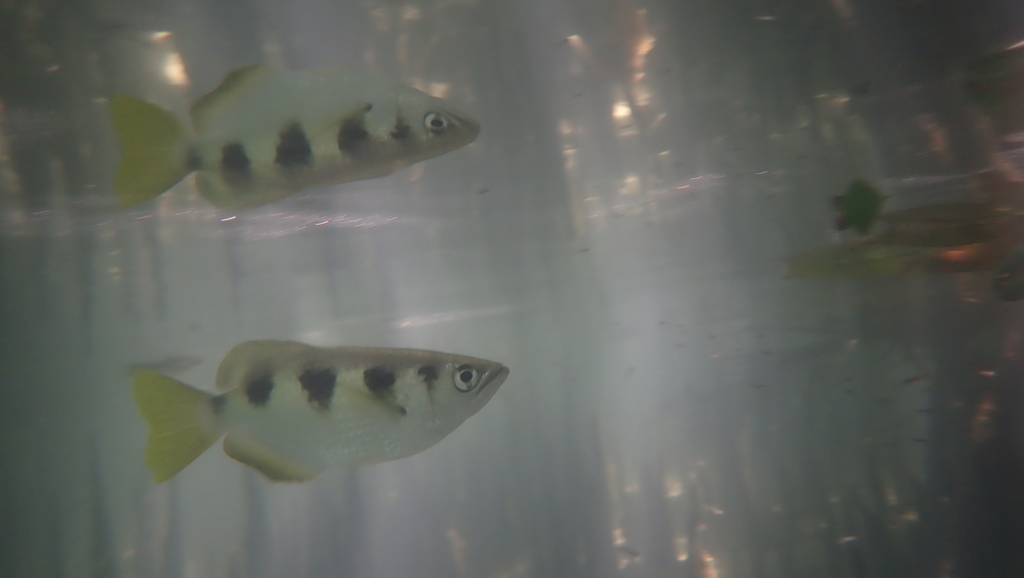
Seven catalog species with documented abilities that defy easy belief: a frog that freezes solid every winter and thaws alive, a shrimp that produces a cavitation flash briefly hotter than the sun, a salamander embryo with photosynthetic cells, a fish that shoots water like a rifle, and three more. All verified. All in the Kaught catalog.
The animal kingdom has a habit of producing capabilities that feel made up. The seven below are real, documented in peer-reviewed research, and each belongs to a species in the Kaught catalog with a card to prove it. None of them are metaphors or exaggerations.
1. The archerfish that corrects for physics
The banded archerfish lives in brackish mangrove creeks across Southeast Asia and northern Australia. It eats insects. The insects it wants are perched on vegetation hanging up to 3 m above the waterline. The archerfish's solution is to compress its gill covers, press its tongue against a groove in the roof of its mouth to form a tube, and fire a precisely aimed jet of water at the target.
The remarkable part is the physics correction. Light bends when it moves between water and air (refraction), which means the insect appears to be in a different position than it actually is. A brain calculating the shot naively would miss every time. Archerfish learn, through practice, to compensate for the angle. Their accuracy and range improve over a lifetime, and juveniles improve faster by watching experienced individuals shoot, one of a very short list of animals known to learn hunting technique by social observation.
The jet itself is not a single pulse: it accelerates as it leaves the mouth, with the rear of the jet travelling faster than the front, so by the time it reaches the insect it hits as a concentrated travelling pulse rather than a dispersed spray. The insect falls. The archerfish is already moving to intercept.
2. The frog that freezes solid every winter
Every autumn across northern North America, wood frogs bury themselves in leaf litter and freeze. Not "enter a torpor" or "slow their metabolism." Freeze. Heart stops. Breathing stops. Blood partially crystallises. Ice forms between cells, and the frog becomes, for months, a rigid brown object that you could pick up and knock against a rock.
In spring it thaws and hops away.
This is not a trick. It is a documented physiological process studied at length in cold biology research. The mechanism: as temperatures fall, the wood frog floods its cells with glucose and urea, acting as antifreeze compounds that prevent ice forming inside cells while allowing it to form in the spaces between them. The intracellular fluid remains liquid even as the extracellular fluid crystallises. Organs are protected from ice damage. When temperatures rise, the process reverses: ice melts, blood resumes flowing, heart restarts, frog hops off to breed.
The wood frog can survive this process repeatedly within a single winter. Some Alaskan populations survive temperatures below minus 16 Celsius in the frozen state.
3. The lizard that shoots blood from its eyes
The Texas horned lizard, the "horny toad" of the American Southwest, is a slow-moving, ant-eating reptile that looks like a small thorny pancake. When threatened by a canid predator (a coyote, a wolf, a domestic dog), it may deploy one of the strangest defences in vertebrate biology: it squirts a pressurised stream of blood from its eyes.
The mechanism is autohaemorrhaging. The lizard constricts blood vessels leaving the head, causing pressure to build rapidly in the ocular sinuses. When the pressure exceeds a threshold, small vessels near the eyelids rupture and blood is expelled with enough force to travel up to 1.5 m. The blood contains chemicals called Varanopsin compounds that are strongly aversive to canid predators, which shake their heads and retreat. Non-canid predators (hawks, snakes) seem largely indifferent.
The lizard can do this multiple times and loses up to a third of its total blood volume in a single event, replenished over subsequent days. It does not squirt at every threat: the response is reserved for the specific predators that the blood chemistry actually deters.
Australia produced an almost identical-looking animal from a completely separate lineage. The thorny devil is also flat, spiny, slow and ant-eating, and it solved the desert water problem with a trick just as unlikely: microscopic channels in its skin that wick dew to its mouth from anywhere on its body, uphill against gravity.
4. The shrimp that briefly reaches 8,000 degrees
The snapping shrimp has a problem: it is 3 cm long and needs to stun or kill prey. Its solution is physics. One claw is enlarged to nearly half the shrimp's body length, and when the claw snaps shut, it accelerates so fast (roughly 30 m/s in under a millisecond) that the water beside it cannot fill the vacuum fast enough. A cavitation bubble forms.
The bubble is what matters. As it collapses inward a fraction of a millisecond later, it compresses and heats the gas inside to approximately 8,000 degrees Celsius, briefly, hotter than the surface of the sun. The collapse produces a shockwave that stuns or kills nearby prey, a sharp cracking sound audible above the waterline, and a flash of light: sonoluminescence, the conversion of mechanical energy into light via cavitation.
The entire event lasts microseconds. The shrimp does it repeatedly, and some species form colonies so dense that their collective snapping creates a continuous noise that submarine sonar operators find disruptive. For a related crustacean with extraordinary physical abilities, see the mantis shrimp, which delivers a strike with similar cavitation effects but at ten times the impact force.
5. The salamander embryo that photosynthesises
The spotted salamander is a secretive, yellow-spotted amphibian of eastern North American forest. Its eggs are green. The green comes from algae (Oophila amblystomatis) that live inside the eggs, which is not unusual. What is unusual, and what makes this the only known case of its kind in vertebrate biology, is where the algae live: inside the cells of the embryo itself.
A 2011 study confirmed that green algae live within the cells of spotted salamander embryos, not just in the surrounding egg jelly. This is the only documented example of a photosynthetic organism living inside the cells of a vertebrate. The algae appear to supply oxygen and possibly organic carbon to the developing embryo directly, from within the cell. The embryo, in exchange, provides carbon dioxide and nutrients the algae need.
Why the embryo's immune system tolerates the algae rather than destroying them, as it would any other foreign cell, is still not fully understood. The relationship dissolves after hatching: adult spotted salamanders carry no algae. It exists only in the egg.
6. The beetle whose light wastes nothing
The European glow-worm is not a worm. It is a beetle, and specifically the wingless female of the species, who climbs a grass stem on warm summer nights and switches on a steady green glow to attract a flying male. The light comes from a chemical reaction in a specialised organ on the underside of the abdomen.
What makes this light extraordinary is its efficiency. A standard incandescent lightbulb converts roughly 5% of its electrical energy into visible light; the rest leaves as heat. The glow-worm's bioluminescence converts chemical energy into visible light at close to 100% efficiency. No heat is produced. The light is "cold light," which is why the organ producing it does not warm the surrounding tissue.
The chemical mechanism, the reaction between luciferin and luciferase in the presence of oxygen, produces photons directly without the intermediate heat step that conventional light sources require. Engineers trying to build more efficient lighting have studied this reaction for decades.
7. The animal with a 500-million-year-old design and a pinhole eye
The emperor nautilus has been solving the same problems, finding food, avoiding predators, finding mates, for over 500 million years without significantly changing its basic body plan. It is one of the few animals alive today that would be recognisable to a Cambrian observer. All other cephalopods (squid, octopus, cuttlefish) lost their external shells over evolutionary time and became faster, more muscular and more cognitively complex. The nautilus did not. It kept the shell and the slow life, and it is still here.
Its eye is the strangest part. The emperor nautilus is the only animal known to use a genuine pinhole camera eye with no lens at all. Light enters through a small aperture (the "pinhole") directly onto the retina, forming an image by geometry alone rather than by focusing. This is the simplest possible eye design: a pinhole camera is the first thing you build when you are learning about optics, before you introduce a lens.
The pinhole eye provides poor resolution in dim light (small aperture, few photons) but works over a wide range of depths and distances without any need for a flexible lens or focusing mechanism. It is not a primitive eye that evolution has not yet "finished." It is a working solution that has persisted unchanged because it works well enough for an animal that has had 500 million years to prove it.
For more on extraordinary cephalopod biology, see the vampire squid and wonderpus octopus spotlights.
Weird animal abilities: frequently asked questions
What animal can freeze solid and survive?
The wood frog (Lithobates sylvaticus) of North America freezes completely solid every winter: heart stops, breathing stops, blood partially crystallises. It survives by flooding cells with glucose and urea antifreeze. It thaws fully alive in spring. The only vertebrate confirmed to survive complete body freezing.
What animal shoots blood from its eyes?
The Texas horned lizard (Phrynosoma cornutum) squirts blood from its eyes up to 1.5 m by restricting blood leaving the head until pressure builds and ruptures eyelid vessels. The blood contains chemicals strongly repellent to canid predators like coyotes and domestic dogs.
What animal ability is hotter than the sun?
The snapping shrimp (Alpheus species) snaps a specialised claw so fast it creates a cavitation bubble. As the bubble collapses, it briefly reaches around 8,000 degrees Celsius, hotter than the sun's surface, producing a shockwave, a crack and a flash of light (sonoluminescence). This stuns or kills prey.
Which animal can shoot water to catch prey?
The banded archerfish (Toxotes jaculatrix) fires precisely aimed jets of water at insects up to 3 m above the waterline. It compensates for light refraction at the water surface, correcting its aim through learned experience. Accuracy improves over its lifetime and younger fish improve faster by watching experienced individuals shoot.
Which vertebrate has photosynthetic cells?
The spotted salamander (Ambystoma maculatum) is the only vertebrate confirmed to host photosynthetic cells. Green algae live inside the cells of the salamander's embryos, apparently supplying oxygen directly from within. The relationship dissolves after hatching: adult salamanders carry no algae.
What animal has survived unchanged for 500 million years?
The emperor nautilus (Nautilus pompilius) has a body plan essentially unchanged for over 500 million years. It is also the only living animal known to use a true pinhole camera eye with no lens, the simplest possible eye design, a working solution that has persisted because it is good enough.
The next thing you see could be
your first catch.
Kaught is live on the App Store and Google Play. Free to start, and your first catch is one photo away.
Free to start · Live on the App Store and Google Play
Species data, type, rarity tier and measurements, is drawn from the Kaught catalog, built on open biodiversity records from GBIF and iNaturalist. Rarity reflects how often a species is observed in the wild, not its conservation status.