Adaptation explainer
Thorny Devil: how a desert lizard drinks water through its skin
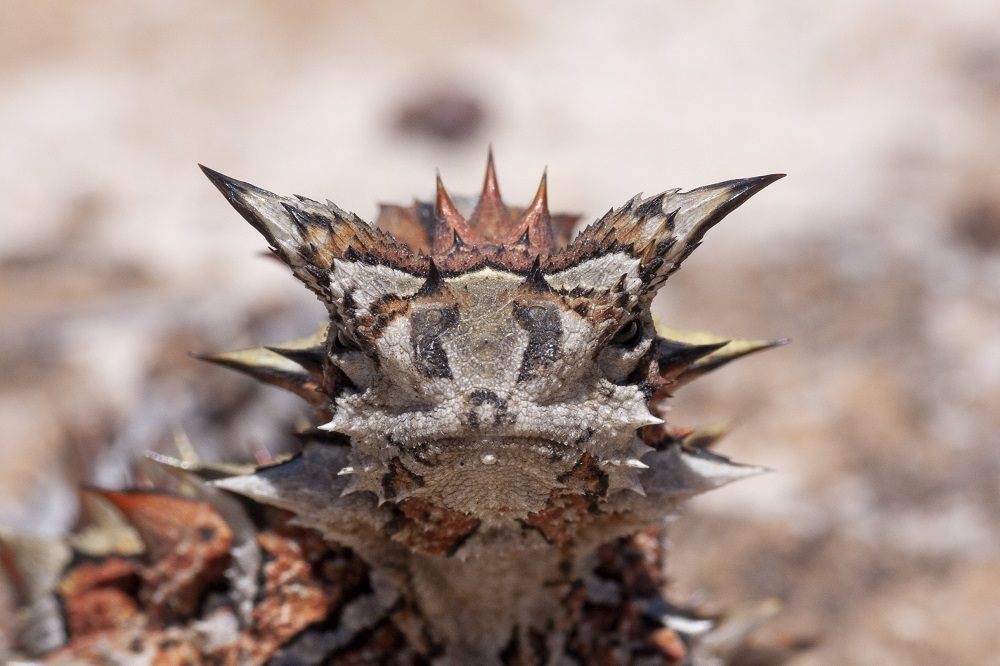
The thorny devil (Moloch horridus) is a small, spiny Australian desert lizard that drinks without ever finding a pool. Its skin is grooved with microscopic channels that pull water from dew or damp sand along its whole body to its mouth by capillary action, even uphill. It eats only ants, thousands a day, and sits at Rare tier in the Kaught catalog.
Water is the hardest thing to find in the Australian desert, and the thorny devil has solved the problem more strangely than almost any other animal. It does not need a puddle, a stream or even rain falling on it. Brush one part of its body against damp sand and water climbs across its entire skin to its mouth on its own. This is a lizard that drinks with its feet, its back and its belly. Here is how the plumbing works, and what else makes this ant-eating desert specialist so unusual.
How the thorny devil drinks water through its skin
The secret is in the skin itself. Between the thorny devil's overlapping scales runs a network of tiny open channels, a set of grooves so fine they behave like the gaps in a paper towel. When water touches any point on the body, surface tension pulls it into these channels and it wicks along them by capillary action, the same force that lifts liquid up a narrow tube. The channels all lead toward the corners of the mouth.
The remarkable part is the direction. The water does not just run downhill; the channel geometry moves it toward the head from anywhere on the body, including uphill against gravity. Microscopic hexagonal structures on the scale surface make the skin superhydrophilic once it is slightly wet, so the first drops prime the system and the rest flow faster. To swallow, the lizard opens and closes its jaws in a rhythmic pumping motion that draws the collected water in from the channels around its mouth.
In practice this means a thorny devil can rehydrate in three ways with no open water at all: standing on dew-soaked sand at dawn, letting overnight condensation collect on its spines, or shovelling damp sand onto its own back so the moisture is squeezed out and wicked up. It is one of the purest examples of a structural adaptation, a survival trick built into the shape of the body rather than into behaviour or chemistry.
Built like a pincushion: the spines and the false head
The thorny devil is covered, head to tail, in hard conical spines. They are not weapons. A predator that tries to swallow the lizard finds a rigid, awkward, spiky mouthful, so most give up. The spines also do double duty in the water system: they give condensation more surface to collect on and more edges to channel it down.
Its cleverest defence is a decoy. On the back of its neck sits a spiny knob of soft tissue, a false head. When a thorny devil feels threatened it tucks its real head down between its front legs and lifts the false one into view. A bird or goanna striking at the "head" hits a hard, spined lump, while the real head, and the brain and eyes inside it, stay protected below. Combined with a slow, jerky, rocking walk that mimics a leaf or seed head shifting in the breeze, the lizard is easy to miss and hard to catch.
A lizard that eats nothing but ants
The thorny devil is one of the most specialised eaters in the reptile world. Its entire diet is ants, mainly small species from genera such as Iridomyrmex and Ochetellus. It positions itself beside an ant trail and licks the insects up one at a time with a short, sticky tongue, and it can work through thousands of ants in a single day.
Eating that many tiny prey needs a slow metabolism and a patient temperament, which is exactly what the thorny devil has. It does not chase, wrestle or ambush. It sits, licks, and lets the colony come to it, a feeding style completely unlike an active hunter such as the water monitor, which runs prey down and swallows it whole.
Camouflage and colour change
Most thorny devils wear desert browns, tans and rusty reds that match the sand and gravel they live on. They also shift shade with conditions, turning paler in the heat of the day and darker when it is cold, which helps with both camouflage and temperature control. A darker body warms faster in the cool of the morning; a paler one reflects the midday sun.
This is a slower, simpler kind of colour change than the dramatic, mood-driven displays of a chameleon, but it works on the same principle: pigment cells in the skin expanding and contracting to change how much light the surface absorbs. In an animal this exposed, blending into the ground is the first line of defence, long before the spines or the false head are ever needed.
Where the thorny devil lives
The thorny devil is found only in Australia, and only in its dry interior. It lives across the sandplains and sand ridges of the central deserts and much of Western Australia, through spinifex grassland and mallee scrub, favouring areas with sandy loam soils where its ant prey thrives. Females dig a burrow around 30 cm deep to lay a clutch of roughly 3 to 10 eggs between spring and early summer, and the young hatch after three to four months.
It is a long-lived little animal, surviving 15 to 20 years in the wild, remarkable for a lizard barely the length of a hand. That slow, careful life, low energy, few enemies that can handle the spines, water on tap from the ground itself, is what the whole body is built for.
A case of convergent evolution
If the thorny devil looks familiar, it is because a completely unrelated lizard on the other side of the world looks almost identical. The horned lizards of North American deserts (genus Phrynosoma) are also flat, spiny, ant-eating and slow. Yet the thorny devil belongs to the Old World dragon family, Agamidae, alongside relatives like the gliding flying dragon, while horned lizards sit in a separate American family entirely.
Neither copied the other. Both were shaped independently by the same problem: how to survive as a small, slow reptile eating ants in an open desert full of sharp-eyed predators. When two distant lineages arrive at the same answer, biologists call it convergent evolution, and few examples are as neat as this one. For more feats of animal engineering that sound invented but are not, see our roundup of animal abilities that sound impossible.
How rare is the thorny devil?
In the Kaught catalog the thorny devil sits at the Rare tier, two diamonds out of four. That is a statement about sightings, not about survival. Kaught's rarity reflects how often a species actually turns up in real-world records. The thorny devil lives only in remote arid Australia, is small and slow, and is camouflaged so well against sand and gravel that people walk within a metre of one and never notice it. Locally present, genuinely hard to spot: that combination is exactly what the Rare tier describes.
Thorny devil: frequently asked questions
What is a thorny devil?
The thorny devil (Moloch horridus) is a small Australian desert lizard in the dragon family, Agamidae, and the only species in its genus. It grows to about 21 cm, is covered entirely in conical spines, eats only ants, and collects water through channels in its skin. It sits at Rare tier in the Kaught catalog.
How does the thorny devil drink water through its skin?
Its skin is grooved with microscopic capillary channels that run between the scales toward the mouth. When any part of the body touches dew, rain or damp sand, water is drawn along these channels by capillary action, even uphill against gravity, and the lizard pumps it in with rhythmic jaw movements. It never lowers its head to a puddle.
What do thorny devils eat?
Almost nothing but ants. The thorny devil is a specialist ant-eater, taking small ants from genera such as Iridomyrmex and Ochetellus one at a time with a sticky tongue. It can eat thousands of ants in a single day, often licking up a steady stream beside an ant trail.
Is the thorny devil dangerous or venomous?
No. The thorny devil is completely harmless to people. It has no venom and does not bite defensively. Its spines are a passive defence that make it hard to swallow, and its threat display is to lower its head and present a spiny false head, not to attack.
Where do thorny devils live?
Only in the arid interior of Australia. They occupy sandplain and sandridge desert, spinifex grassland and mallee scrub across central Australia and much of Western Australia, favouring areas with sandy loam soils where their ant prey is abundant.
How rare is the thorny devil in Kaught?
Rare: two diamonds out of four. It lives only in remote arid Australia and is small, slow and superbly camouflaged, so it is recorded far less often than common animals. Kaught's rarity reflects how often a species is observed in the wild, not its conservation status.
The next thing you see could be
your first catch.
Kaught is live on Google Play. Get it on Android now, or leave your email and we’ll send the iPhone link the day it lands.
Free to start · No spam, just one email when iPhone goes live
Species data, type, rarity tier and measurements, is drawn from the Kaught catalog, built on open biodiversity records from GBIF and iNaturalist. Rarity reflects how often a species is observed in the wild, not its conservation status.