
Adaptation explainer
How do polar bears survive in the Arctic? Five adaptations, explained
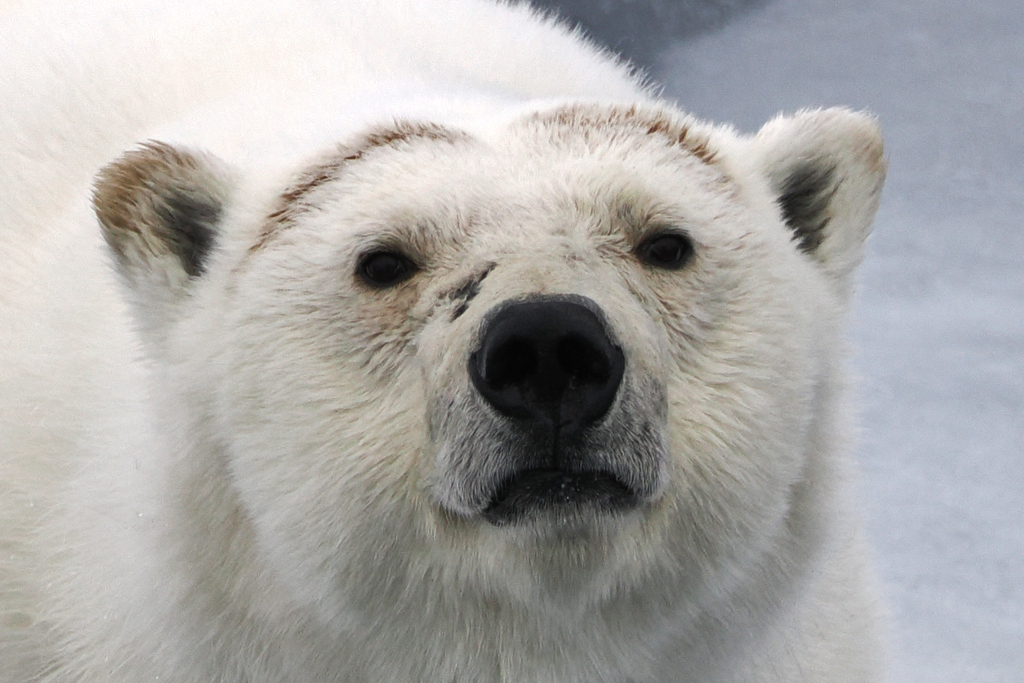
The polar bear (Ursus maritimus) survives the Arctic through five key adaptations: transparent hollow fur that appears white, black skin beneath that absorbs solar heat, a fat layer up to 10 cm thick, enormous paws that serve as paddles and snowshoes, and a hunting strategy built around patient stillness at seal breathing holes in the ice. It is the world's largest land predator and one of the hardest wild mammals to observe.
The Arctic is not a place most mammals can survive. Temperatures fall below minus 40 Celsius. The sea ice offers no shelter, no freshwater and nothing to eat except what you can catch through the ice. The polar bear has been solving this problem for roughly 150,000 years, and the solutions it evolved are more specific and more extreme than most people realise.
Adaptation 1: fur that is not what it looks like
Polar bear fur appears white. It is not. Each individual hair is transparent, colourless and hollow. The outer guard hairs scatter visible light in every direction, giving the coat a white appearance in the same way that snow looks white rather than transparent. The hollow core provides additional insulation by trapping air.
Beneath the guard hairs sits a dense underfur that forms a second insulating layer. Below that, the skin itself is black. Black absorbs more solar radiation than any other colour, and on a cold but sunny Arctic day the skin soaks up as much warmth from the sun as the coat will allow through. The combination, transparent scattering fibres over a black absorber, is a biological heat-capture system of considerable efficiency.
The fur also repels water. After a swim, a polar bear shakes off most of the water with a single shake, and the coat dries rapidly rather than remaining wet against the skin.
Adaptation 2: fat as engineering
Adult polar bears carry a layer of fat up to 10 cm thick beneath the skin. This serves three separate functions simultaneously.
First, insulation: fat conducts heat roughly twenty times less efficiently than muscle or organ tissue, so a thick fat layer dramatically reduces heat loss to the environment. Second, buoyancy: fat is less dense than water, making the bear more buoyant and reducing the energy cost of swimming between ice floes. Third, energy storage: in lean periods between hunts, and during the winter denning fast for pregnant females, the fat is metabolised to power the body.
Adaptation 3: paws built for two environments
Polar bear paws are proportionally enormous, up to 30 cm across. The size distributes the bear's weight across soft snow and young ice, reducing the risk of breaking through. Between the toe pads, the paws are partially webbed, and the sole is covered in small papillae (bumps) that grip ice the way a tyre tread grips a wet road.
In water, those same large paws become paddles. Polar bears swim with the front feet, holding the hind feet flat as a rudder, and are capable of covering long distances in open water. Recorded swims of over 300 km have been logged from tagged individuals, though these are exceptional and costly in energy.
Adaptation 4: still-hunting
The polar bear's primary hunting technique is called still-hunting, and it requires something unusual for an apex predator: patience measured in hours. A bear locates a ringed seal's breathing hole in the ice (using its sense of smell, which can detect a seal through a metre of snow and ice), then waits. Motionless. Sometimes for three hours or more. The moment the seal surfaces to breathe, the bear strikes with explosive speed, hooks it with a paw and hauls it through the hole.
The strategy works because ringed seals must surface to breathe roughly every five to fifteen minutes regardless of danger, so the wait always ends. The energy return from a single seal is enormous, enough to sustain the bear for days. A large bear can consume 45 kg of seal fat in a single sitting.
For comparison with another patient apex hunter, see why herons stand still when hunting.
Adaptation 5: physiological fasting
Pregnant females do something remarkable: they go without food for up to eight months. They enter a den in late autumn and remain inside through winter, not eating or drinking, while pregnant, giving birth and nursing. Unlike true hibernation, their body temperature stays close to normal throughout. They survive by metabolising fat, shifting metabolism to a state that recycled nitrogen from muscle protein breakdown back into useful proteins rather than excreting it as waste, a process sometimes called "walking hibernation."
Cubs are born in December or January, weighing roughly 600 g each. By spring, fed entirely on their mother's increasingly depleted fat reserves, they emerge at 10 to 15 kg. The mother, having lost up to a third of her body weight, needs to find a seal within days.
Why Legendary?
In Kaught, rarity reflects how often a species is actually observed in the wild. Polar bears live on remote Arctic sea ice, accessible only by specialist expedition in specific seasons. Outside Churchill, Manitoba (where bears congregate near Hudson Bay in autumn), or purpose-built Arctic ship voyages, wild sightings are genuinely exceptional. Four diamonds. Compare the narwhal for another Legendary Arctic species that requires the same expedition to encounter.
Polar bear: frequently asked questions
How do polar bears survive in the Arctic?
Through five key adaptations: transparent hollow fur that scatters light to appear white, black skin beneath that absorbs solar heat, a fat layer up to 10 cm thick for insulation and energy, enormous partly-webbed paws that work as snowshoes and paddles, and still-hunting at seal breathing holes in the ice to extract maximum energy from minimal prey.
Is polar bear fur really hollow?
Yes. Each hair is transparent and hollow, scattering light to appear white. The hollow core traps warm air. The skin beneath the fur is black, absorbing solar radiation directly. The combination works as an efficient heat-capture system in cold but sunny Arctic conditions.
What do polar bears eat?
Primarily ringed seals and bearded seals, hunted at breathing holes or in subnivean birth lairs. They are the most carnivorous of all bears. In summer, when ice retreats, they may eat seabirds, eggs, seaweed and carrion, but these provide insufficient energy to maintain condition.
How long can a polar bear survive without food?
Healthy adults can survive several months on fat reserves. Pregnant females go without eating for up to eight months during winter denning, surviving while pregnant, giving birth and nursing. Body temperature stays near normal throughout, so this is not true hibernation.
How do polar bears hunt seals?
Primarily by still-hunting: locating a breathing hole by smell and waiting motionless beside it, sometimes for hours, until the seal surfaces. The bear then strikes with explosive speed and hauls the seal through the hole. It also stalks seals on open ice and digs into subnivean birth lairs in spring.
Why is the polar bear Legendary in Kaught?
Kaught rarity reflects how often a species is actually observed in the wild. Polar bears live on remote Arctic sea ice accessible only via specialist expeditions. Wild sightings outside a handful of specific locations and seasons are genuinely exceptional. Four diamonds, Legendary.
The next thing you see could be
your first catch.
Kaught is live on the App Store and Google Play. Free to start, and your first catch is one photo away.
Free to start · Live on the App Store and Google Play
Species data, type, rarity tier and measurements, is drawn from the Kaught catalog, built on open biodiversity records from GBIF and iNaturalist. Rarity reflects how often a species is observed in the wild, not its conservation status.