
Adaptation explainer
Mantis Shrimp: 16-colour vision and a punch faster than a bullet
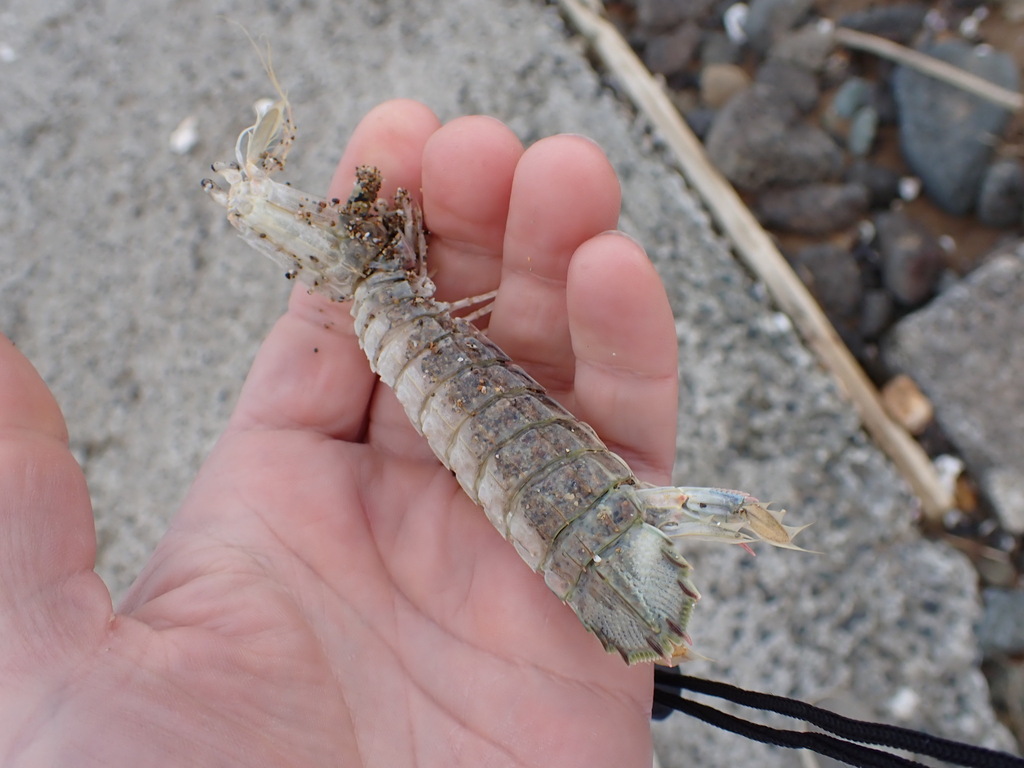
The mantis shrimp is a predatory crustacean with two adaptations that stand above almost anything else in the animal kingdom: eyes with up to 16 colour-receptor types (humans have 3) that also detect UV light and the polarisation of light; and a striking appendage that accelerates at 10,000 g and delivers 1,500 Newtons of force, enough to crack aquarium glass. It is not a shrimp and it is not a mantis. It is its own ancient order: Stomatopoda.
There is a small crustacean living in burrows on tropical and subtropical seafloors whose two main adaptations, eyes and striking appendages, are so extreme that biologists have spent decades trying to understand what it actually perceives and how the physics of its punch are even possible. It is the mantis shrimp, and it is neither a mantis nor a shrimp.
What is a mantis shrimp?
Mantis shrimps are members of the order Stomatopoda, an ancient crustacean lineage that split from its relatives approximately 400 million years ago. There are roughly 550 known species, ranging from 2 cm to 38 cm in length, found across the tropical and subtropical Indo-Pacific, Atlantic and Caribbean. They live in burrows dug into sandy or rocky seafloor in shallow water, typically from the intertidal zone to about 50 metres depth.
The Shako Mantis Shrimp (Oratosquilla oratoria) is the hero species of this article. It lives in sandy and muddy seafloor of the western Pacific, from Japan through Korea and China, and is a spearer-type: its striking appendage is barbed rather than club-shaped, used to impale fish and soft-bodied shrimp rather than to hammer shells. In the Kaught catalog, it sits at Legendary, four diamonds, a reflection of its very low open observation count. It spends most of its time inside a U-shaped burrow, leaving only to ambush prey within reach of the entrance.
Adaptation 1: the eyes
Human eyes have three types of colour receptor (red, green, blue). Most other mammals have two. Mantis shrimps have up to 16, covering a spectrum from deep ultraviolet to far-red, well beyond the range of human vision in both directions.
They also detect the polarisation of light, something no vertebrate can do. Polarised light is light whose electromagnetic waves vibrate in a single plane rather than at random. The surface of the sea, scales on fish, and the shells of many invertebrates all reflect polarised light in distinctive patterns. To a mantis shrimp, these patterns are visible information: a camouflaged fish that is invisible to a predator looking at colour alone becomes detectable by the pattern of polarised light it reflects.
Here is the counterintuitive finding from research, though: despite this extraordinary receptor count, mantis shrimps appear to be poor at distinguishing colours that are similar to each other. They do not work the way human vision does, layering signals from all 16 receptor types to build a fine colour image. Instead, each receptor type acts more like a narrow-band filter: the shrimp identifies what it sees by which filter fires, not by comparing signals across filters. This makes the system extraordinarily fast, but less suited to fine hue discrimination than human colour vision.
The practical output is a visual system that can simultaneously extract colour, UV reflectance, and polarisation information in real time, without the processing overhead of a brain that has to compare overlapping signals. It is a different engineering solution to the problem of seeing, not a superior one.
Adaptation 2: the strike
The striking appendage of a mantis shrimp is called a raptorial appendage or dactyl. In smashers, it is a heavily calcified club. In spearers like the Shako, it is a barbed spear. Both are cocked by flexing a spring-like saddle structure in the appendage, then released by a latch mechanism, exactly like a loaded crossbow.
The result is one of the fastest movements in the animal kingdom. Smasher-type mantis shrimps accelerate their dactyl at up to 10,000 g, reaching approximately 23 metres per second (83 km/h) within a few milliseconds. The blow delivers around 1,500 Newtons of force on impact. One species, the peacock mantis shrimp, can strike with enough force to crack the glass wall of an aquarium from inside.
But there is a secondary effect. A strike through water at 23 m/s creates a cavitation bubble: a localised vacuum in the water behind the dactyl that collapses with a shockwave. Even if the first physical impact misses, the cavitation shockwave can stun or kill prey. The mantis shrimp effectively punches twice, once with the dactyl and once with the collapsing bubble, on every strike.
How does the dactyl survive the repeated impacts? The club of smasher species is made of a helicoidal composite of mineralised chitin fibres, arranged in a structure that dissipates crack propagation rather than letting a single fracture line run through the material. Material scientists have studied this structure as a model for impact-resistant composites in engineering.
Two other things worth knowing
Mantis shrimps have complex social behaviour unusual for crustaceans. Many species form monogamous pairs that share a burrow and cooperate in defending it, sometimes for many years. The female broods eggs in the burrow, and both parents have been observed caring for the young.
The Shako Mantis Shrimp is an important commercial fishery species in Japan and China, where it is eaten boiled or raw as sashimi. Its flavour is described as richer than a prawn with a texture closer to lobster. The commercial catch is significant enough that population observation data in the open record is lower than the actual abundance of the animal: most Shako end up in a market rather than on iNaturalist.
For the full picture of how animals use force records, the strongest animals ranking covers the bite-force and raw-power records across the catalog. And for another Indo-Pacific animal with a biology designed to surprise, see the Ribbon Eel and its sequential sex change.
Mantis Shrimp: frequently asked questions
How many colours can a mantis shrimp see?
Up to 16 types of colour-receptor cell, versus three in humans. They also detect ultraviolet light and the polarisation of light. Research suggests they use these receptors as fast parallel filters rather than combining signals for fine colour discrimination.
How fast does a mantis shrimp punch?
The dactyl accelerates at up to 10,000 g, reaching about 23 m/s (83 km/h), delivering roughly 1,500 Newtons on impact. A secondary shockwave from cavitation bubbles can stun or injure prey even on a near-miss.
What is the difference between smasher and spearer mantis shrimp?
Smashers have a club-shaped dactyl that hammers hard-shelled prey like crabs and mollusks. Spearers have a barbed appendage that impales soft-bodied fish and shrimp. The Shako Mantis Shrimp is a spearer.
Is the mantis shrimp dangerous to humans?
Smasher types can break a finger bone if handled bare-handed. Neither type is venomous. They are not aggressive in the wild and pose no threat to swimmers, but should not be picked up without protection.
Where do mantis shrimp live?
Tropical and subtropical shallow seas worldwide, typically in burrows in sandy or rocky seafloor down to about 50 metres. The Shako Mantis Shrimp is found in the western Pacific, from Japan through Korea and China.
Why is the Shako Mantis Shrimp Legendary in Kaught?
The Kaught rarity tier reflects how often a species is actually observed and recorded in the wild. The Shako has fewer than 100 open iNaturalist records globally: it spends nearly all its time in burrows, and much of the commercial catch goes directly to markets rather than appearing in observation databases.
The next thing you see could be
your first catch.
Kaught is live on the App Store and Google Play. Free to start, and your first catch is one photo away.
Free to start · Live on the App Store and Google Play
Species data, type, rarity tier and measurements, is drawn from the Kaught catalog, built on open biodiversity records from GBIF and iNaturalist. Rarity reflects how often a species is observed in the wild, not its conservation status.