
Exotic spotlight
Firefly Squid: the bioluminescent squid that lights up an entire bay
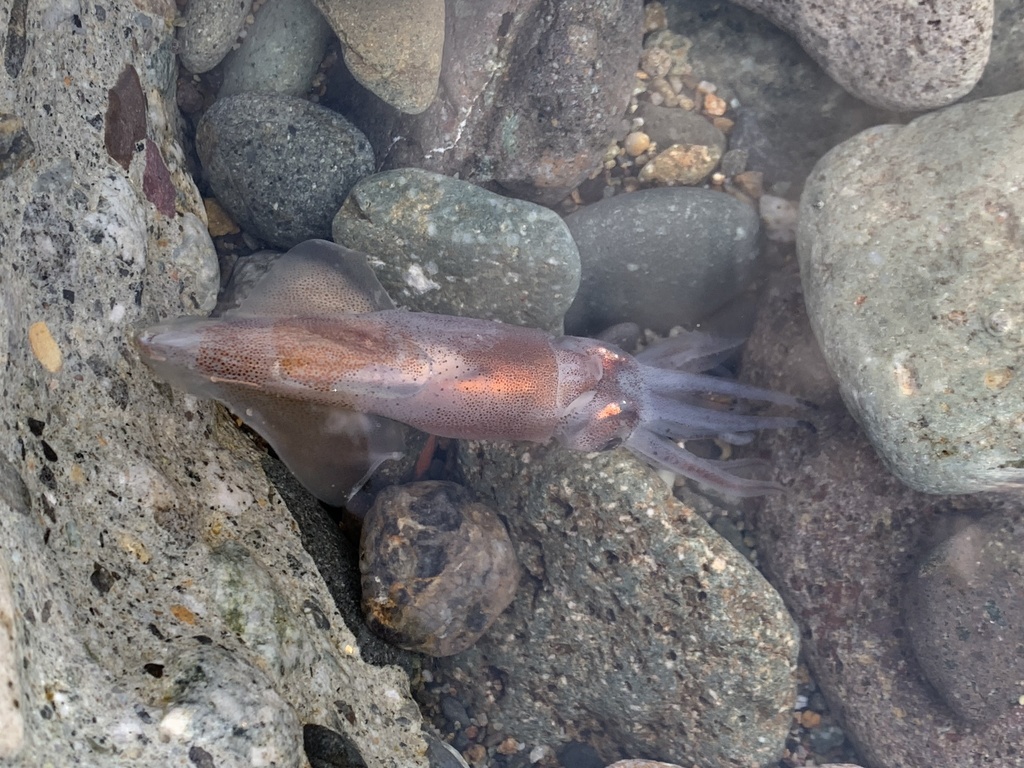
The firefly squid (Watasenia scintillans) is a palm-sized deep-sea cephalopod covered in hundreds of light-producing cells. It lives at 200 to 700 m depth in the Western Pacific, and each spring millions surface in Toyama Bay, Japan, turning the water electric blue-white in one of the most vivid natural bioluminescent displays on Earth. Legendary tier, four diamonds.
The firefly squid spends most of its life in the dark. Between 200 and 700 m down in the Western Pacific, it hunts small crustaceans and fish in water where sunlight never reaches, navigating and signalling by light it generates itself. For most of the year, almost no one sees one. Then spring arrives in Toyama Prefecture.
The Toyama Bay phenomenon
Every year from March through June, tidal currents in Toyama Bay on Japan's Honshu coast push massive quantities of cold, deep water upward. Millions of firefly squid, drawn to the surface to spawn, arrive in the shallows carried by that same upwelling. Boats leave Namerikawa port before dawn to find them: the water turns blue-white from horizon to horizon as millions of squid flash simultaneously. The squid wash onto beaches in such numbers that fishing crews can fill boats in a single pass of a dip net.
The event is so reliable and so dramatic that Toyama Prefecture has designated it a Special Natural Monument, and the squid appears on everything from local restaurant menus to souvenir tins.
How the bioluminescence works
The firefly squid carries roughly 800 photophores, light-producing organs, distributed across its mantle, arms, around its eyes and in rows along the underside of each arm. The light is blue, the colour that travels farthest in deep water, and is produced by a chemical reaction between luciferin and luciferase, the same basic mechanism used by fireflies on land.
The three photophores at the tip of each arm are structurally different from the rest. They produce polarised light, a property researchers believe may allow firefly squid to communicate with each other in a channel invisible to most predators, which cannot detect polarisation.
The underside photophores serve a different purpose: counter-illumination. By matching the faint ambient light coming from above, the squid erases its silhouette when viewed from below, making it much harder for predators deeper in the water column to spot it against the sky.
Life in the deep
Outside the spring migration, firefly squid live a vertical life. By day they sit in deeper water, 400 to 700 m; at night they rise toward 200 m to feed. Their diet includes small fish, shrimp and copepods. Like most squid, they are short-lived, usually dying after their single spawning season. The eggs they release in Toyama Bay settle to the seafloor and hatch into larvae that descend to the depths to begin the cycle again.
Their eyes are unusual among squid in being asymmetrical: the left eye points upward and is structurally adapted to detect dim downwelling light, while the right eye is more conventionally oriented. The asymmetry is thought to help them detect silhouettes of predators above while scanning for prey laterally.
Firefly squid vs vampire squid
Both are deep-water, both glow, and both appear in the Kaught catalog. They are not closely related. The firefly squid is a true squid (order Oegopsida) with ten arms and a streamlined, muscular body built for active hunting. The vampire squid belongs to its own separate order, Vampyromorpha, drifts slowly through the oxygen minimum zone and eats marine snow rather than prey. Convergent evolution produced similar body colours and bioluminescent equipment in two very different animals.
For another cephalopod with spectacular visual adaptation, see the wonderpus octopus and its unique fixed spot pattern.
How rare is it?
In Kaught terms: four diamonds, Legendary. Despite the spectacle in Toyama Bay, confirmed individual sightings in the wild are almost zero outside that annual window. The squid live in deep water that is impractical to observe directly, surface for a matter of weeks, and are identified by fleeting flashes in the dark. The Legendary tier reflects how genuinely inaccessible a clear encounter is for almost everyone on Earth.
Firefly squid: frequently asked questions
What is a firefly squid?
A small bioluminescent squid (Watasenia scintillans) found in the deep Western Pacific, particularly off Japan. It grows to about 7.5 cm mantle length and is covered in hundreds of light-producing photophores. Legendary tier in the Kaught catalog due to extreme observation scarcity.
Why does the firefly squid glow?
It uses its photophores for counter-illumination (hiding its silhouette from predators below), for communicating with other individuals using polarised light, and possibly for luring prey. The blue glow travels farthest in deep water, making it the optimal signal frequency for this environment.
Where do firefly squid live?
At depths of 200 to 700 m in the Western Pacific, mainly in seas around Japan. Each spring, millions migrate to shallow water in Toyama Bay, Japan, to spawn, creating one of the world's most vivid natural bioluminescent displays.
When can you see the firefly squid in Toyama Bay?
The mass spawning in Toyama Bay runs from March through June, peaking in April and May. Boats leave from Namerikawa port before dawn; the squid flash in the water around the hull and sometimes wash onto the beach in large numbers on calm nights.
How is the firefly squid different from the vampire squid?
Despite both living deep and glowing, they are unrelated. The firefly squid is a true squid that actively hunts prey and surfaces to spawn. The vampire squid belongs to its own ancient order, drifts slowly collecting marine snow, and never surfaces. Convergent evolution, not common ancestry.
Is the firefly squid edible?
Yes. They are commercially fished in Japan and are a local delicacy in Toyama Prefecture, eaten boiled, pickled in soy sauce or raw. The fishing season coincides with the spring spawning migration.
The next thing you see could be
your first catch.
Kaught is live on the App Store and Google Play. Free to start, and your first catch is one photo away.
Free to start · Live on the App Store and Google Play
Species data, type, rarity tier and measurements, is drawn from the Kaught catalog, built on open biodiversity records from GBIF and iNaturalist. Rarity reflects how often a species is observed in the wild, not its conservation status.