
Species spotlight
The Bald Eagle: North America's apex bird of prey, identified at every age
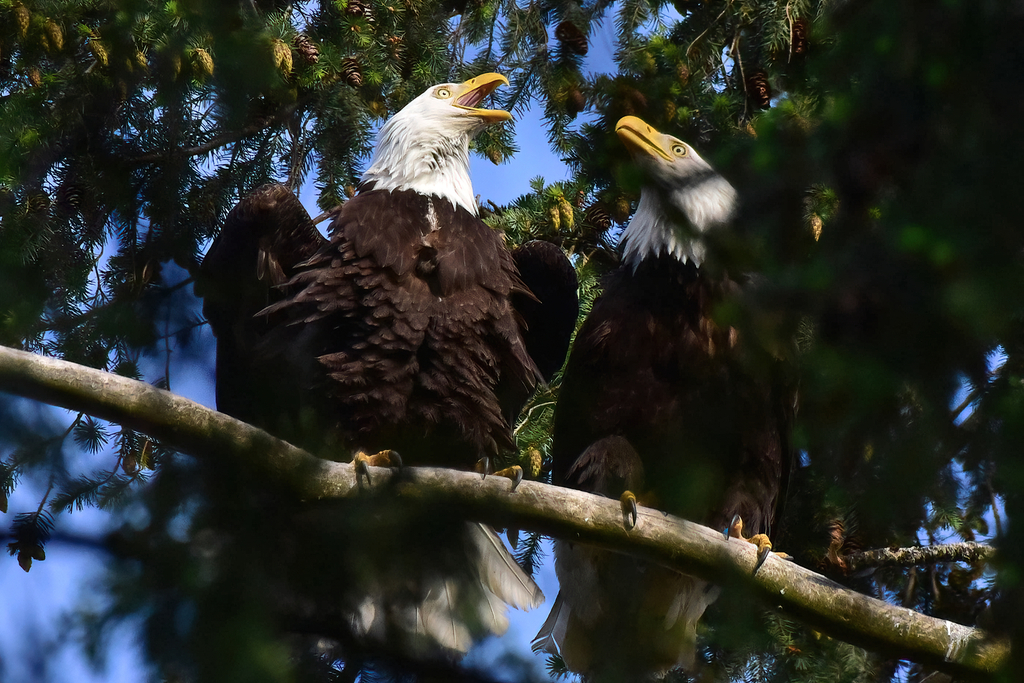
The bald eagle (Haliaeetus leucocephalus) is North America's largest bird of prey: a dark brown raptor with a white head and tail, a wingspan up to 2.3 m and a large yellow hooked bill. It hunts fish from the surface of lakes and rivers, nests in the tallest trees near water, and does not develop its famous white plumage until age 4 or 5. Epic tier in Kaught, three diamonds.
The bald eagle is one of the most recognisable birds on Earth. It is also one of the most frequently misidentified, because for the first four years of its life it looks nothing like the symbol on the dollar bill. Here is how to identify one at any age, where to find it, and what it is actually doing when it soars over a river.
How to identify a bald eagle
Adults are unmistakable: a dark chocolate-brown body and wings, a brilliant white head and neck, a white tail, and a large bright yellow hooked bill. The eyes are pale yellow. In flight the wings are flat and very broad, held horizontal rather than angled upward, and the head projects forward on a thick neck. The white head makes it look front-heavy.
Juveniles and immatures (ages 1 to 4) are a problem. They are entirely mottled brown with variable pale streaking across the belly and wing linings, and no white on the head or tail at all. They are large, with the same characteristic flat-winged silhouette and protruding head, but a birder who only knows the adult will walk straight past them.
Key separation from the golden eagle, the most likely confusion species:
- Wing shape: bald eagles hold wings dead flat; golden eagles tilt them upward in a slight dihedral.
- Head: bald eagles have a proportionally larger, more protruding head and bill; golden eagles have a smaller, more rounded head.
- Nape: adult golden eagles have a golden-washed nape, the closest thing to the bald eagle's white head but restricted to the back of the neck only.
- Feet: golden eagle feet are feathered to the base of the toes; bald eagle lower legs and feet are bare yellow.
For size context, compare the eagle owl, Europe's largest owl, and the Andean condor, which beats the bald eagle on wingspan but not on typical body mass.
Where bald eagles live
Bald eagles are found near large open water across North America: coastal areas, large rivers, lakes and reservoirs from Alaska and Canada south through the lower 48 United States. They need three things: water with abundant fish, tall trees nearby for nesting (often conifers), and a degree of seclusion for the nest itself.
The great concentrations are in coastal Alaska, the Pacific Northwest and the Great Lakes states. In winter, bald eagles from northern populations move south and can congregate in hundreds along large rivers, particularly where open water remains for fishing. The best winter counts come from along the Mississippi, Missouri and Susquehanna rivers.
In recent decades they have recovered strongly in many areas of the continental United States and are now regularly seen in suburbs near reservoirs and large rivers, including over some major cities.
What bald eagles eat, and the art of theft
Fish make up most of the diet. The hunting technique is direct: the eagle soars over or perches near the water, spots a fish near the surface, and drops into a feet-first plunge, snatching the fish with its talons. The feet lock on impact, the curved talons driven deep into the fish by the momentum of the stoop. It does not dive below the surface: fish must be visible within roughly 30 cm of the top.
Bald eagles also eat waterfowl, small mammals, carrion and offal from salmon runs. And they steal. A bald eagle harassing an osprey that has just caught a fish is a classic scene across North American waterways: the osprey is chased until it drops the fish, which the eagle catches or retrieves from the water. Benjamin Franklin famously objected to the bald eagle as a national symbol partly for this reason, preferring the turkey as "a more respectable bird."
Nests and breeding
Bald eagle nests are among the largest structures built by any bird. Pairs return to the same nest each year and add material, so old nests can reach 2.5 m across and weigh over a tonne. The record nest, in Florida, was measured at 2.9 m wide and 6 m deep. A single pair may use the same nest for decades.
Eggs are laid in late winter to early spring. The incubation period is about 35 days. The chicks fledge at 10 to 12 weeks, but will remain dependent on their parents for several more weeks. They will not breed themselves until they develop adult plumage, at 4 or 5 years old.
The name "bald"
The bald eagle is not bald. The name comes from the Old English word "balde," meaning white, referring to the white head and tail of the adult bird. The head is fully feathered. The confusion arose because early American English speakers used "bald" to mean "having a white mark" in the same way they spoke of a "bald-faced" horse with a blaze on its face.
How rare is the bald eagle?
In the Kaught catalog: Epic tier, three diamonds. Bald eagle populations have recovered strongly in North America, but clear close sightings of adult birds still require visiting the right water bodies at the right time of year. Outside North America, the species is simply absent. For scale, compare the fastest animals ranking where the golden eagle stoops at around 240 km/h, and imagine that speed applied to a bird twice as heavy.
Bald eagle: frequently asked questions
What does a bald eagle look like?
Adults have a dark brown body and wings, a bright white head and tail, and a large yellow hooked bill. Wingspan 1.8 to 2.3 m, weight 3 to 6.3 kg. Juveniles under 4-5 years are fully mottled brown with no white on the head, causing frequent misidentification.
Where do bald eagles live?
Near large open water across North America, from Alaska and Canada south through the continental United States. They need water with abundant fish and tall trees for nesting. Greatest concentrations are in coastal Alaska, the Pacific Northwest and the Great Lakes.
What do bald eagles eat?
Primarily fish, snatched from near the water surface with their talons in a feet-first plunge. Also waterfowl, small mammals and carrion. They are well-known kleptoparasites, stealing prey from osprey by chasing them until they drop the fish.
How do you identify a juvenile bald eagle?
Juveniles are fully mottled brown with pale streaking on the belly. The key is the large flat-winged silhouette with a big protruding head. Separate from golden eagles by the flat (not tilted) wing hold, larger bill and bare yellow feet. White head and tail only develop fully at 4-5 years.
Is the bald eagle actually bald?
No. "Bald" comes from the Old English word for white, referring to the adult's white head and tail. The head is fully feathered; the white is a plumage colour, not bare skin.
Why is the bald eagle Epic in Kaught?
Kaught rarity reflects how often a species is actually observed in the wild. While populations have recovered, clear and close sightings of adult birds require visiting the right North American water bodies. Outside North America, the species is simply absent. Three diamonds, Epic tier.
How big is a bald eagle?
Wingspan 1.8 to 2.3 m, weight 3 to 6.3 kg. Females are noticeably larger than males. In flight, the broad wings and large projecting head distinguish them from other large raptors.
The next thing you see could be
your first catch.
Kaught is live on the App Store and Google Play. Free to start, and your first catch is one photo away.
Free to start · Live on the App Store and Google Play
Species data, type, rarity tier and measurements, is drawn from the Kaught catalog, built on open biodiversity records from GBIF and iNaturalist. Rarity reflects how often a species is observed in the wild, not its conservation status.