
Exotic spotlight
Wonderpus Octopus: the Indo-Pacific cephalopod that wears its identity on its skin
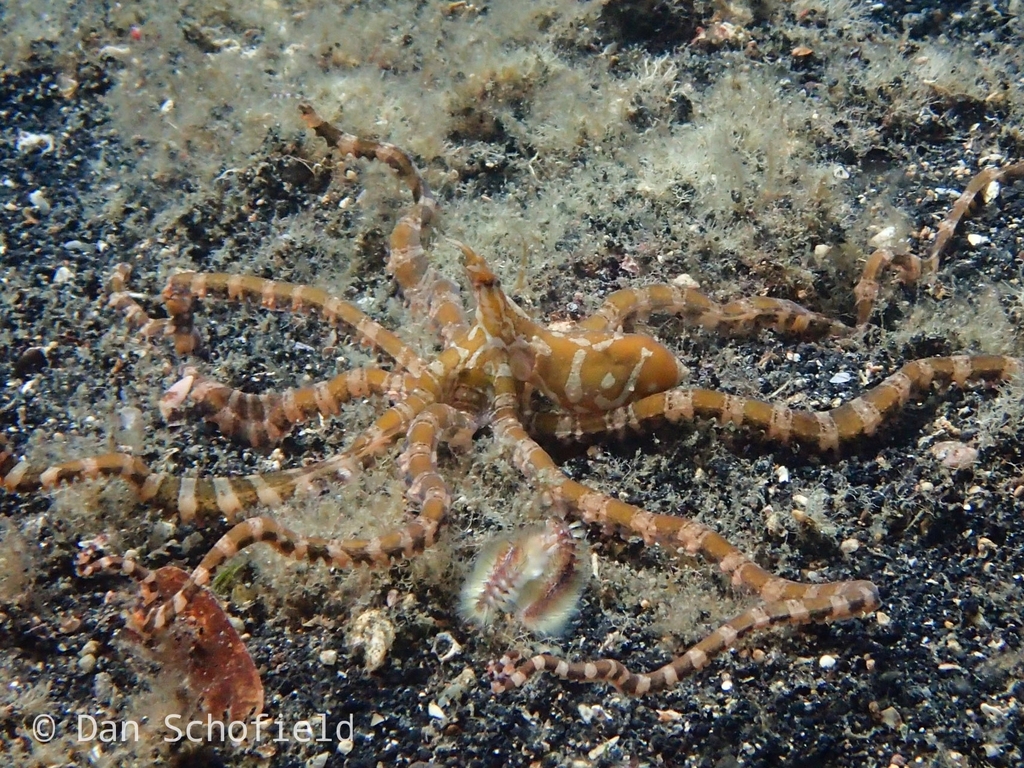
The wonderpus (Wunderpus photogenicus) is a small tropical octopus with a permanent rust-brown and white spot pattern unique to each individual, like a fingerprint. It hunts shrimp and small fish from shallow sandy bays across the Indo-Pacific, and uses mimicry to impersonate venomous animals when threatened. Fewer than 400 confirmed iNaturalist observations exist worldwide.
Most octopuses are famous for what they can hide. The wonderpus is famous for what it displays: a bold, permanent pattern of rust-brown skin against bright white spots and rings that remains consistent across its lifetime. That consistency makes it one of the very few octopus species where individual animals can be identified by photograph alone.
The fingerprint pattern
Octopuses typically change colour and texture in fractions of a second. The wonderpus does too, but its underlying white markings, produced by fixed white chromatophores in the skin, do not change. The positions of the spots and rings are set at hatching and stay constant for life.
Researchers photographing the same bays in Indonesia's Banda Sea over multiple years have been able to reidentify specific individuals by pattern alone, the same way researchers ID great white sharks by dorsal fin notches or humpback whales by fluke markings. The species name photogenicus was given partly in recognition of this: it photographs beautifully, and photography is how it gets identified.
Where it lives
The wonderpus is an animal of shallow, sheltered tropical bays with silty or sandy substrate. Core range: Indonesia (particularly Sulawesi, the Banda Sea and the Lembeh Strait), the Philippines, and Papua New Guinea. Most sightings come from depths of 3 to 30 m in bays protected from strong currents, where the fine sediment provides both cover and the invertebrate prey it hunts.
It is primarily nocturnal. During the day it retreats into small holes in the sediment or under rubble, closing the entrance with gravel or shell fragments. Dusk brings it out to forage.
How it hunts
The wonderpus hunts shrimp and small fish using a technique shared with some close relatives: it spreads its arms wide to form a canopy over an area of sand or rubble, then drives prey out from cover using a pulsing motion. Any animal that darts into the space under the web of arms meets the beak at the centre. The hunting posture, arms spread flat like a sunburst, is one of the most reliable visual cues for identifying the species in murky water.
The mimicry
The wonderpus is a confirmed mimic, though less versatile than its close relative the mimic octopus. Observed mimicry includes:
- Flatfish: by flattening the body and rippling the arm edges, it takes on the silhouette and movement of a sole or flounder gliding across the seafloor.
- Lionfish: by raising the arms in a radial fan and holding them stiffly, it mimics the venomous fin array of a lionfish, a shape most reef predators learn to avoid.
- Sea anemone: by extending all eight arms vertically with subtle undulation, it can hold the posture of a large anemone attached to rubble.
The common thread is aposematism: all the models are either venomous or unpalatable. The wonderpus itself is believed to be mildly venomous (its saliva can immobilise shrimp), but the mimicry suggests it relies on resembling something more dangerous when a predator approaches.
How rare is a sighting?
The wonderpus sits at the Epic tier in the Kaught catalog, three diamonds. That tier is earned: the global iNaturalist record holds fewer than 400 confirmed sightings, and the species is restricted to a specific habitat type in a relatively small part of the tropical Indo-Pacific. Even experienced divers in the Lembeh Strait, one of the world's most-dived muck-diving destinations and the best place to look, may spend multiple trips without finding one.
The species is most often found during night dives, when it is actively foraging and its contrasting brown-and-white pattern becomes visible in torch light against dark sediment.
Wonderpus vs mimic octopus
These two species are often confused in photographs. The key differences:
- Wonderpus: defined white spots and irregular blotches on a rust-brown base; pattern is fixed and consistent.
- Mimic octopus: more uniform dark brown base; white markings are bands and stripes rather than distinct spots; overall pattern varies more with behaviour.
- Arms: the wonderpus has proportionally longer, thinner arms relative to body size.
Both species appear in the same bays and are sometimes photographed within metres of each other in the Lembeh Strait. Both carry a Kaught card. Only the wonderpus is photogenicus by name, and the photographs confirm why.
Wonderpus Octopus: frequently asked questions
What is the wonderpus octopus?
A small tropical octopus of the Indo-Pacific with a rust-brown and white spot pattern unique to each individual, like a fingerprint. It mimics venomous animals and hunts shrimp in shallow sandy bays. Arm span up to ~50 cm.
Is the wonderpus the same as the mimic octopus?
No. Both are brown-and-white Indo-Pacific octopuses and both mimic other animals, but they are distinct species. The wonderpus has fixed white spots; the mimic octopus has bands and stripes and is a more versatile mimic overall.
Where does the wonderpus live?
Shallow silty bays across the tropical Indo-Pacific, mainly Indonesia (Sulawesi, Lembeh Strait, Banda Sea), the Philippines and Papua New Guinea, typically 3 to 30 m depth.
What does the wonderpus mimic?
Flatfish (by flattening the body and rippling arm edges), lionfish (by spreading arms in a fan to mimic venomous spines), and sea anemones. Mimicry is used primarily as a defensive strategy.
Why is the wonderpus Epic in Kaught?
Fewer than 400 global iNaturalist observations exist. A confirmed sighting requires the right bay, usually a night dive, in a small part of the Indo-Pacific. That genuine rarity places it at the Epic tier, three diamonds.
The next thing you see could be
your first catch.
Kaught is live on the App Store and Google Play. Free to start, and your first catch is one photo away.
Free to start · Live on the App Store and Google Play
Species data, type, rarity tier and measurements, is drawn from the Kaught catalog, built on open biodiversity records from GBIF and iNaturalist. Rarity reflects how often a species is observed in the wild, not its conservation status.