Behaviour explainer
Why do gorillas beat their chests?
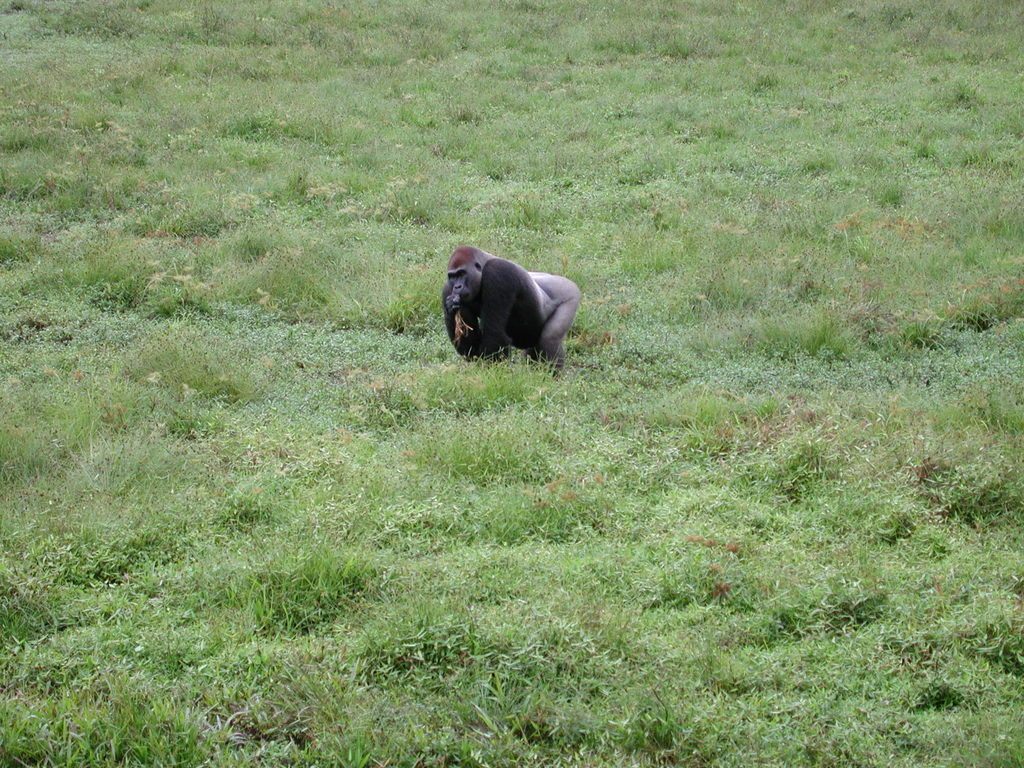
Gorillas beat their chests to broadcast their size across dense forest. Each silverback's beat is acoustically unique: a deeper pitch signals a larger, dominant male, advertising to rivals and attracting females. It is not a charge. It is communication, and the display almost always ends with the gorilla walking away.
Somewhere in the forest of Gabon or the Congo Basin, a silverback gorilla rears upright, tears a branch from a nearby tree, and then strikes his chest with a rapid series of cupped-palm blows. The sound carries. Rivals hear it. Females hear it. Even humans, hundreds of metres away, feel the low frequency before they fully register the noise.
That sound is one of the most recognisable animal displays on Earth. But what is it actually saying? And why do gorillas do it at all?
The full display sequence
The chest-beat is the climax of a longer sequence, not a standalone action. Researchers observing wild groups have documented up to eight distinct stages in a full display:
- Hooting. The silverback begins with a series of soft, slow hoots that increase in pace and volume over several seconds.
- Rising. He stands up on two legs, often to his full height.
- Vegetation toss. He picks up or tears at nearby plants and throws them into the air or to the side.
- Lateral run. He runs sideways through the undergrowth, sometimes crashing through vegetation.
- Chest-beating. He strikes the chest rapidly with both hands, alternating palms. The beat lasts 0.5 to 2 seconds and involves 6 to 20 individual strikes.
- Ground slap. He slaps the ground with one or both hands to punctuate the display.
Not every display goes through all six stages. A mild social reminder might be a quick three or four beats and nothing else. A serious challenge from a rival triggers the full sequence, sometimes more than once.
Cupped palms, not fists
One of the most persistent myths about gorilla chest-beating is that it is done with clenched fists. It is not. Gorillas use cupped, open palms, and the distinction matters.
Cupping the hands creates a hollow air pocket between the palm and the chest. When that pocket collapses on impact, it produces a resonant boom rather than a dull, flat thud. The technique amplifies the sound far more efficiently than a closed fist would, and that amplification is the point. The display needs to carry.
The chest itself also helps. Gorillas have large laryngeal air sacs, pockets of tissue connected to the larynx that inflate during vocalisations and displays. These air sacs add resonance, making the chest act partly like a drum, and their size varies between individuals.
Each silverback sounds different
A 2021 study from the Max Planck Institute for Evolutionary Anthropology (Fischer et al.) analysed chest-beat recordings from multiple male gorillas and found that each individual's beat has a consistent acoustic signature. The peak frequency, the dominant pitch of the sound, correlates with the male's body size: a larger male with a bigger chest and larger air sacs produces a lower-pitched beat.
This matters enormously in a habitat where visual contact through dense rainforest is often impossible. A rival male, half a kilometre away, can hear the beat, identify the caller, and assess his size without ever seeing him. That is an efficient system: competition resolved at range, without physical risk.
Females appear to prefer lower-pitched beats, which makes evolutionary sense. A deeper beat signals a larger, higher-ranking male.
What the beat is actually communicating
The chest-beat carries at least three distinct messages depending on context.
To rival males: "I am this big. Assess whether you want to challenge me before you cross into my range." In practice, many potential conflicts between silverbacks never escalate to physical contact because the acoustic advertisement is enough to establish a hierarchy.
To the family group: A silverback within his own group uses chest-beats as location signals and to restore social order after a disturbance. The family hears him and knows where he is and that he is attending to a situation.
To females: The deeper the beat, the larger the male, and size correlates with dominance. Females within a group and those in neighbouring groups appear to respond to beat frequency when assessing potential mates.
What the chest-beat almost never is, at least in a field context, is a commitment to violence. Gorillas are highly intelligent social animals that have evolved elaborate ways to resolve conflict without injury. The display is one of those ways. See also the full ranking of the world's smartest animals, which covers the cognitive abilities of great apes in more depth.
Do female gorillas beat their chests?
Yes. All gorillas can chest-beat and all of them do at some point, but frequency and context differ sharply by age and sex.
Juveniles beat their chests during social play, treating the action more like a game than a statement. Subadult males practice the display as they approach maturity, refining timing and technique by watching the silverback in their group. Females beat their chests in minor social disputes or moments of high excitement.
The full elaborate sequence, rising on two legs, tearing vegetation, the lateral run, the sustained rapid beat, belongs almost exclusively to adult silverbacks. It develops gradually as males mature, and the acoustic signature deepens as their bodies grow.
What to do if a gorilla beats its chest near you
If you encounter a wild gorilla or observe one in a sanctuary and it begins a display, the biology is on your side: this is almost always a warning, not an attack.
Field researchers advise four things:
- Stop moving. Running triggers a pursuit response in most large animals.
- Make yourself small. Crouch low or sit down. Height is read as a challenge.
- Avert your eyes. Direct eye contact is a dominance signal. Look slightly to the side.
- Stay calm. Gorillas track body language closely. Sudden movements after a chest-beat can restart the display sequence.
Field accounts of gorilla charges, including from researchers who have spent years with wild groups, consistently report that the charge stops short. The chest-beat is the forest equivalent of a raised voice: unmistakable, intentional, and usually the end of the incident rather than its beginning.
Gorilla behaviour is shaped by the same pressures as any large, powerful animal: energy is finite, injury is costly, and non-contact resolution is almost always the better option.
The gorilla in the Kaught catalog
The Lowland Gorilla (Gorilla gorilla) sits at the Epic tier in the Kaught catalog: three diamonds out of four. That tier reflects how often the species is recorded in the wild by observers.
Wild gorillas live in remote, dense rainforest across central and western Africa, a range that includes southern Cameroon, Gabon, Equatorial Guinea and the Congo Basin. They are not easy to encounter even within their range, and the full chest-beat display of a silverback in the wild is genuinely rare to witness.
Rarity in the catalog is a measure of that observation frequency, nothing more. It is not a conservation assessment. See the meerkat sentinel article for another look at how social animals use displays to manage group dynamics, and the spotted hyena behaviour piece for a parallel case study in intelligence and cooperative social structure across an African species.
Gorilla chest-beating: frequently asked questions
Why do gorillas beat their chests?
Gorillas beat their chests to broadcast their size and location across dense forest where visual contact is impossible. The beat carries up to 800 metres and serves as a message to rivals, a signal to females, and a way to re-establish order within the group. It is communication, not aggression.
Do gorillas beat their chests with fists or open palms?
Open, cupped palms. The common image of a gorilla pounding with clenched fists is a myth. Cupping the hands creates an air pocket that amplifies the strike into a resonant boom. Closed fists produce a flat thud that carries far less well through dense vegetation.
How far does the sound carry?
Research suggests up to 800 metres through closed-canopy rainforest. The peak frequency of around 1 kHz travels well through vegetation, so rivals and family members can identify the caller and gauge his size without ever seeing him.
What does it mean if a gorilla beats its chest at you?
Almost always: I see you, and I want you to leave. Stop, crouch low, avert your eyes, and stay still. Running triggers a pursuit response. Field researchers report that gorilla charges almost always stop short. The display is a warning, not a commitment to attack.
Do female gorillas beat their chests?
Yes, all gorillas can and do. Females beat their chests during social disputes and moments of excitement. Juveniles do it in play. The full elaborate display with vegetation-tossing, the lateral run and sustained rapid beating is almost exclusively performed by adult male silverbacks.
What is a silverback gorilla?
A mature male gorilla aged 12 or older. As males mature, the hair on their back and saddle turns silver-grey. The dominant silverback leads a family group of 5 to 30 individuals, protects them from rivals and predators, and is typically the only breeding male in the group.
Why is the Lowland Gorilla rated Epic in Kaught?
Kaught's rarity tier reflects how often a species is recorded in the wild, not its conservation status. Wild gorillas live in remote, dense rainforest across central Africa and are seldom recorded by casual observers. That observation scarcity places the species at the Epic tier: three diamonds out of four.
The next thing you see could be
your first catch.
Kaught is live on Google Play. Get it on Android now, or leave your email and we’ll send the iPhone link the day it lands.
Free to start · No spam, just one email when iPhone goes live
Species data, type, rarity tier and measurements, is drawn from the Kaught catalog, built on open biodiversity records from GBIF and iNaturalist. Rarity reflects how often a species is observed in the wild, not its conservation status.