
Behaviour explainer
Why do meerkats stand up? The science behind the sentinel
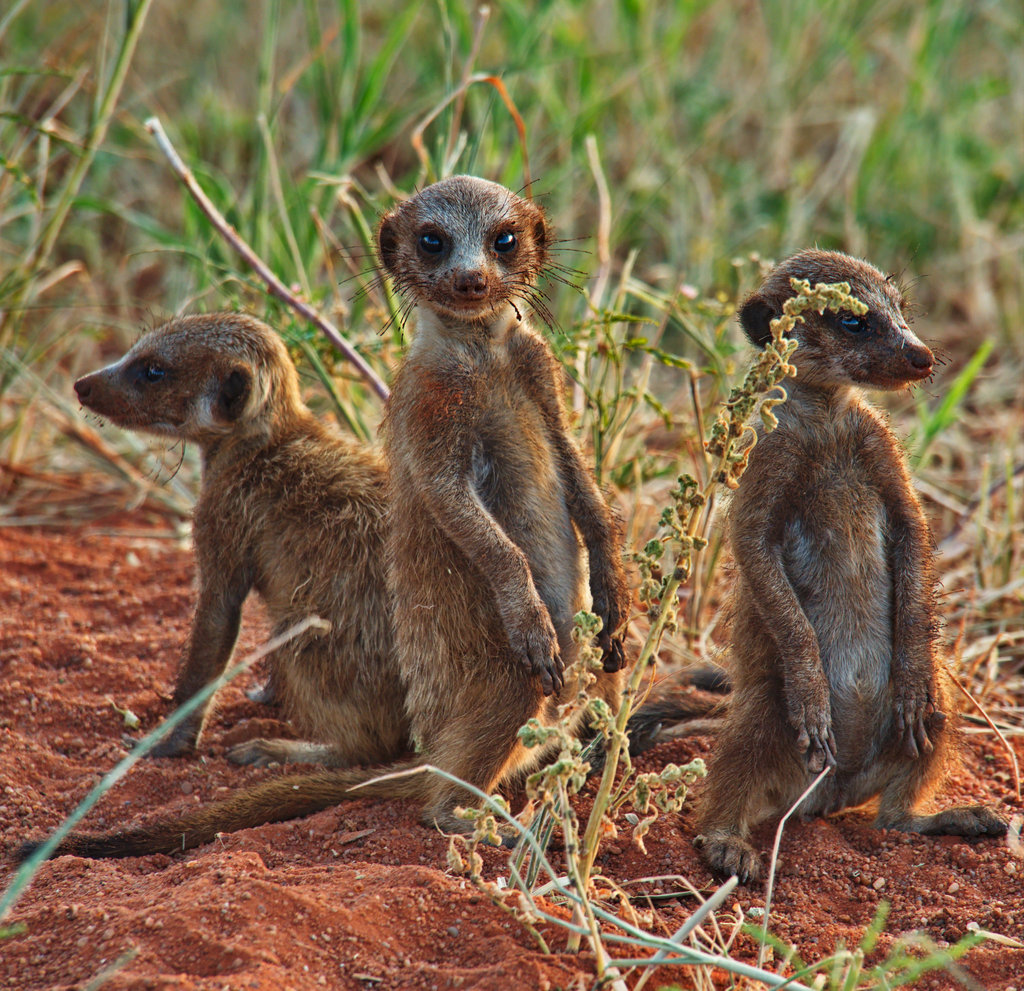
Meerkats stand upright to act as sentinels for their group. The raised posture gives them an elevated vantage point across flat scrubland, letting them spot aerial and ground predators while the rest of the mob keeps its head down and forages. The sentinel calls out a coded alarm when a threat appears, giving the group a few seconds of warning before impact.
The image of a meerkat standing perfectly upright, chin raised, eyes fixed on the horizon, is one of the most replicated photographs in wildlife. It appears on mugs and posters and phone cases, sometimes with a caption about attitude. What it actually depicts is one of the most studied examples of cooperative vigilance in any mammal: a small carnivore taking a personal risk so that the rest of the group does not have to.
What the sentinel actually does
When a meerkat mob emerges from its burrow at dawn and begins foraging, individuals take turns acting as sentinel. The sentinel climbs to an elevated position, typically a termite mound, a low shrub, or occasionally a fence post, and scans systematically for threats. While on duty the sentinel maintains near-constant vigilance and issues a continuous watchman's song, a soft, repetitive call that tells the foraging mob: I am watching, keep eating.
The moment the sentinel detects something, the call changes. The specific call encodes information about both the type and the urgency of the threat:
- A low, urgent chatter signals a ground predator (jackal, snake, honey badger). The mob typically watches the threat together and retreats slowly.
- A sharp, high-pitched bark signals an aerial predator (martial eagle, hawk). The mob sprints for the nearest bolt-hole immediately, no watching required.
- Repetition rate and call duration encode distance. A distant threat generates fewer, slower calls; an immediate overhead threat generates rapid, urgent calls.
This multi-dimensional alarm call system gives the group a few additional seconds of warning, which, against an aerial predator diving at speed, can be the difference between reaching the burrow and not reaching it.
Why stand upright in the first place?
The Kalahari and surrounding semi-arid scrubland that meerkats inhabit is predominantly flat. Predators can approach from any direction. A meerkat foraging with its nose to the ground has a line-of-sight of less than a metre in dense vegetation. A meerkat balanced on a termite mound can see hundreds of metres in any direction. The bipedal upright posture maximises height efficiently: the meerkat is only 25–35 cm long at the body, but standing upright on a raised mound can put its eyes 60 cm or more above the surrounding ground level. In flat terrain, every additional centimetre of height adds several metres to the visual horizon.
The posture also frees the forepaws and keeps the head perfectly mobile, allowing the sentinel to turn and track a moving object without repositioning. A meerkat can rotate its head across a wide arc while standing and maintaining balance in a way it cannot while crouched and foraging.
Does the sentinel sacrifice its meal?
Early accounts of sentinel behaviour framed it as an altruistic sacrifice: the sentinel stands guard while everyone else eats, going hungry for the good of the group. Field research by Tim Clutton-Brock and colleagues at the Kalahari Meerkat Project overturned this assumption significantly.
The key finding was that well-fed meerkats are more likely to take sentinel shifts than hungry ones. An individual that has eaten well has lower immediate food motivation and higher energy reserves to sustain the costs of vigilance. A hungry individual prioritises foraging. This means sentinel duty is largely undertaken by individuals who can most afford it at that moment, rather than individuals making a costly sacrifice.
The cost of standing guard, in caloric terms, is also relatively low. The sentinel is not exerting itself. It is standing still and watching. The energetic cost of maintaining the upright posture is modest, and the sentinel can eat small invertebrates within reach of its position between scanning passes. The main personal cost is the heightened exposure to the predators the sentinel is watching for: a lone upright meerkat is far more visible than a crouched forager in low scrub.
The structure of a meerkat mob
Meerkats live in groups called mobs, typically numbering 5 to 30 individuals, with a mean around 20 for an established group in good habitat. The mob is structured around a single dominant breeding pair, the alpha male and alpha female, who produce nearly all the pups in the group. All other adults are subordinates, usually offspring from previous litters, who function as non-breeding helpers.
These helpers do not merely stand guard. They:
- babysit pups at the burrow while the mob forages
- feed pups once they are old enough to follow the mob
- teach pups how to handle dangerous prey, particularly scorpions and snakes, by progressively presenting them with less dangerous versions of live prey and watching them learn
- pup-sit and pup-guard in the weeks before the pups are mobile
The sentinel system is one part of a broader cooperative framework. It is not an isolated altruistic behaviour but one component in a network of cooperative tasks distributed across the mob. The African Wild Dog shows a similar cooperative structure around a dominant breeding pair, though with a very different hunting specialisation.
What meerkats watch for
The main aerial threat in meerkat habitat is the martial eagle, a large eagle capable of striking at high speed and taking prey up to the size of a small antelope. Meerkats produce their most urgent alarm calls in response to a martial eagle silhouette overhead, and the flight-to-burrow response is essentially reflexive after hearing this call.
Ground threats include:
- Black-backed jackal and cape fox, which can outrun individual meerkats
- Cape cobra and puff adder, which can take meerkats in and around burrow entrances
- Honey badger, which can dig open burrow systems and is capable of killing multiple meerkats
The distinction between aerial and ground alarm calls is not innate. Young meerkats are born with the predisposition to respond to alarm calls but learn which call pattern means which threat type through observation and experience in their first year. Animals with greater experience tend to produce more accurate and informative calls. For more on how animals learn to use environmental cues, see our article on animals with extreme senses.
The thermoregulation bonus
Meerkats also use the upright posture outside of guard duty. In the early morning, after emerging from the burrow, the mob sunbathes. Individuals stand facing the sun, exposing the dark skin and thin fur of the belly and inner arms to direct sunlight. This is solar thermoregulation: the unpigmented belly skin absorbs solar radiation efficiently, warming the animal's core faster than it would warm passively. After a cold Kalahari night, this morning sunbathing session can raise core temperature by several degrees in under 15 minutes, allowing the mob to begin foraging earlier than if it had to generate all its heat metabolically.
The posture used for thermoregulation is essentially identical to the sentinel posture, which may be why an upright meerkat outside of a clear guard context is sometimes misidentified as sunbathing when it is actually watching for predators, and vice versa. Both uses of the posture are real and widespread; they share the same physical form but serve different functions.
What you see in the wild
In meerkat habitat, the sentinel is the most reliably visible individual in any mob. By definition it has chosen an exposed, elevated position and is holding still in full sunlight. If you spot a lone meerkat standing upright on a mound or stump, look for the foraging mob nearby, within 20 to 50 metres. The mob foragers are typically spread across a loose area, all moving with heads down, digging for beetles, scorpions, millipedes and roots.
If the sentinel's call shifts from the slow watchman's song to a repeated sharp bark, the mob's response is worth watching: an almost instantaneous scatter to the nearest bolt-hole, a movement that takes only two or three seconds from call to disappearance. The speed of the learned response to alarm calls is striking. For more on social hunter behaviour, see our profile of the smartest animals in the world.
Meerkat sentinel behaviour: frequently asked questions
Why do meerkats stand up on their hind legs?
To act as sentinel for the group. The upright posture on an elevated mound gives the meerkat a longer line-of-sight across flat scrubland, letting it spot aerial and ground predators while the foraging mob keeps its head down. The sentinel calls a watchman's song to signal safety and switches to a specific alarm call when a threat appears.
How do meerkat alarm calls work?
Meerkats produce distinct calls for aerial versus ground predators, and vary call rate and urgency to encode proximity. A sharp, rapid high-pitched bark signals an aerial threat overhead, triggering sprint-to-burrow. A lower chatter signals a ground predator, triggering a group-watch-and-retreat. Young meerkats learn the call-to-meaning associations through observation in their first year.
Does the sentinel get to eat less than the rest of the mob?
Research from the Kalahari Meerkat Project showed that well-fed individuals are more likely to volunteer as sentinel. The guard shift is typically taken by the individual least in need of immediate food, making it a relatively low-cost contribution rather than the self-sacrifice it was initially assumed to be. The sentinel also eats small invertebrates within reach while on post.
What predators do meerkats watch for?
The main aerial threat is the martial eagle. Ground threats include black-backed jackals, cape foxes, cape cobras, puff adders and honey badgers. The distinction between aerial and ground alarm calls is learnt from observation, not innate. Each call type triggers a different mob response calibrated to the threat profile.
How big is a meerkat mob?
Typically 5 to 30 individuals, with around 20 as a common size. A dominant alpha pair does nearly all the breeding. All other adults are non-breeding helpers, usually offspring from previous litters, who assist with babysitting, pup-feeding, guard duty and prey-handling tuition for the alpha pair's new litters.
Why is the meerkat Common in Kaught if it is so famous?
Kaught rarity reflects how often a species is observed in the wild, not its cultural fame. Meerkats live in large active mobs in open scrubland and are diurnal and highly visible. In their range they are genuinely easy to spot, which puts them at the Common tier. Fame and rarity are independent. A sparrow is common. A meerkat in the Kalahari is common. Both are fascinating.
The next thing you see could be
your first catch.
Kaught is live on the App Store and Google Play. Free to start, and your first catch is one photo away.
Free to start · Live on the App Store and Google Play
Species data, type, rarity tier and measurements, is drawn from the Kaught catalog, built on open biodiversity records from GBIF and iNaturalist. Rarity reflects how often a species is observed in the wild, not its conservation status.