Taxon guide
Jumping spiders: the 8-eyed hunters that look back
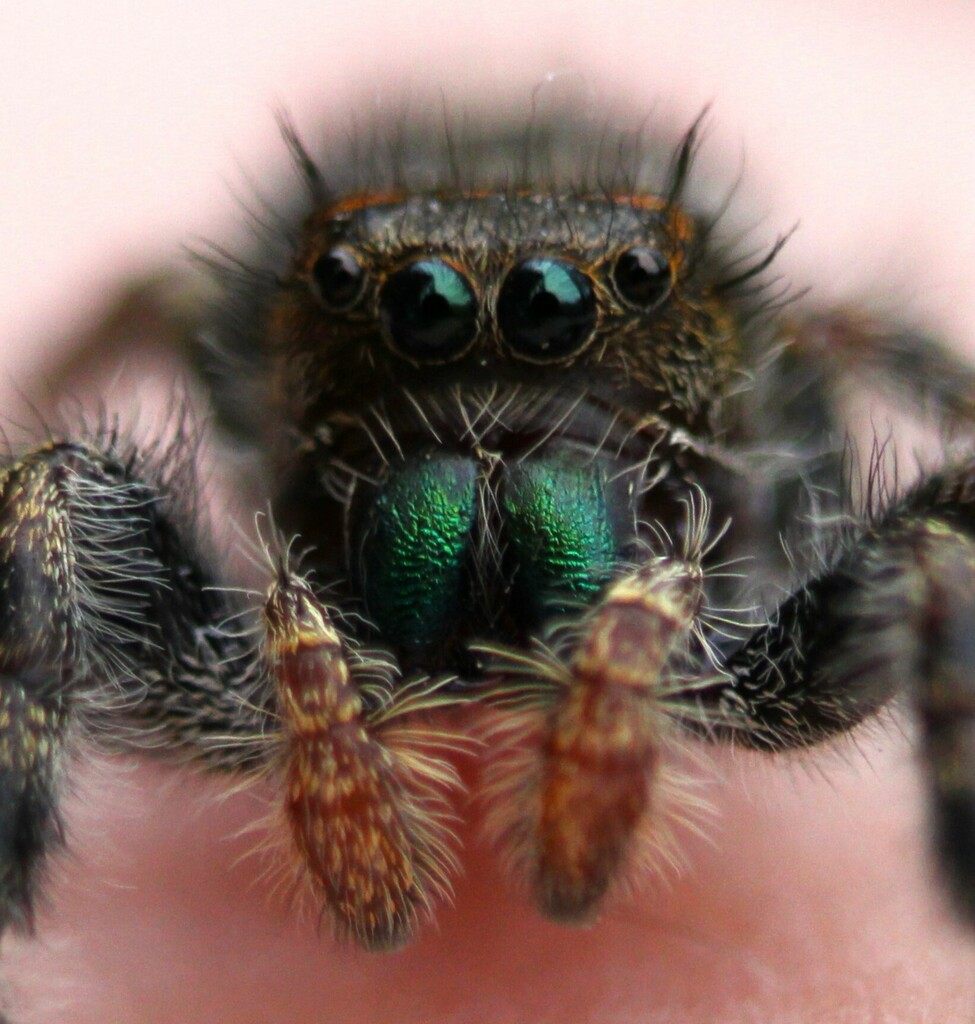
Jumping spiders (family Salticidae) are the most species-rich spider family on Earth, with around 6,000 described species. They hunt by sight using eight eyes, four of which give sharp forward-facing depth perception. They are harmless to people, found on every continent except Antarctica, and the most curious spiders you are likely to encounter.
Something catches your eye on the fence. A small spider, compact and hairy, sitting very still. Then it turns. Not to escape, but to face you directly, front eyes locked on. It pivots as you move. It looks, genuinely, as if it is watching you back.
That is the jumping spider effect, and it is not accidental. These are active, visually-driven predators with some of the most sophisticated eyes in the arthropod world. Unlike web-building spiders that sit and wait, jumping spiders stalk, assess, and pounce. The visual system that makes them so effective also makes them seem oddly alert and watchful.
How jumping spiders see
Eight eyes, in two rows, covering almost every angle. The dominant pair at the front (the anterior median eyes) are large, forward-facing, and fixed in the head capsule. Inside those fixed lenses, though, are moveable retinal tubes, narrow telescopes that the spider steers with muscles, scanning a small sharp-focus field across a wider scene. When a jumping spider appears to look at you, it is doing exactly that: tracking your face with those internal tubes.
The result is binocular depth perception in the forward arc, good enough to judge a leap accurately at ranges up to 30 times their body length. The six secondary eyes, arranged around the sides and rear of the head, detect motion across a near-360-degree field, feeding information to the brain whenever anything moves at the periphery.
The system is well-suited to an ambush lifestyle: the secondary eyes notice the target, the primary eyes assess it, and the spider pivots its body to bring the full forward-facing resolution to bear before deciding to hunt or flee.
The full comparison of extreme animal senses covers how jumping spider vision compares to mantis shrimp and other outliers. For spiders specifically, the web-builder's approach is covered in how spiders spin silk, a completely different strategy from the same order.
Bold Jumping Spider
The bold jumping spider is the most frequently observed jumping spider on iNaturalist, with over 115,000 records. It is North America's most recognisable species: a stout black body, 10-22 mm long, with white spots on the abdomen, white banding on the legs, and iridescent green or blue chelicerae (the fangs) that catch the light as it approaches prey. Females are noticeably larger than males.
It lives across the full breadth of North America, from southern Canada to Mexico, in gardens, forest edges, fields and increasingly in suburban environments where prey is abundant. It is bold in the literal sense: rather than retreating when you approach, it pivots to face you and watches. Spend a moment staying still and it will often take a step or two closer.
Before any jump, the spider attaches a silk dragline to its current surface. If the leap misses, the line stops it mid-air. This silk safety line is one of the few uses jumping spiders make of silk: they do not build capture webs.
Zebra Jumping Spider
The zebra jumping spider is the wall spider of Europe and North America. Its bold black-and-white banded abdomen is the source of the common name, and the pattern is one of the clearest field marks of any small spider. Body length is 5-9 mm, making it noticeably smaller than the bold jumper.
It favours sun-warmed vertical surfaces: garden walls, window frames, fence posts and house facades, anywhere that gets full sun and supports a population of small flies and midges. It can be found from sea level to over 2,000 m in mountain areas. In the right garden, zebra jumping spiders are present on warm days from spring through to early autumn.
The species is one of the most studied jumping spiders in the world. Its court display is elaborate: males wave their pedipalps (the small feeler-like appendages at the front) and perform a lateral zigzag dance in front of females, sometimes for several minutes. Females are choosy: unremarkable displays produce no response.
Pantropical Jumping Spider
If you have spent time in a tropical country, you have almost certainly seen this spider. The pantropical jumping spider is the most globally distributed species in the family, present across Africa, Asia, Australia, the Pacific Islands and the Americas wherever the climate stays warm. Its spread has been partly assisted by human trade and transport over centuries.
Males are black with a bold white central stripe running the length of the abdomen and a white band at the front of the head; females are grey-brown with similar patterning but more subdued. Body length is 9-12 mm. It lives on the walls of buildings, in gardens and under roof eaves, hunting flies, mosquitoes and small moths: essentially the same prey as the bold jumper but in a tropical context.
It is, proportionally, the species most likely to make direct eye contact with a visitor in a hotel room or field station in Asia or Africa. It is completely harmless and a notably effective control on mosquito populations in inhabited buildings.
Red-bellied Jumping Spider
The red-bellied jumping spider is the standout European species for colour. Males carry a vivid crimson abdomen contrasted against a black head and legs, making them look entirely unlike the muted spiders most people expect to find on a sunny wall in southern France or Italy. Females are cryptically marked in grey and buff.
It is a Mediterranean and warm-temperate species, ranging from Iberia east through Turkey, the Caucasus and into Central Asia, favouring dry, open habitats: stone walls, rocky outcrops, cliff faces and sun-baked scrubland. Body length is 6-14 mm, with a noticeable size difference between the sexes.
The male's colouration functions in courtship: rival males assess each other by colour intensity before engaging in the extended waving displays common to the family. The abdomen colour fades after death, so specimens in old collections often look nothing like a live male seen in the field.
How jumping spiders hunt
The hunting sequence is one of the most deliberate and watchable behaviours in the arachnid world. From a distance, the spider spots a target: a fly on a leaf, a moth resting on a stem. It begins to move, slowly and low, keeping its primary eyes fixed forward. When the prey looks toward it, the spider freezes mid-step. When the prey looks away, it advances.
At the right range, 3-8 cm for most species, the spider anchors its dragline and launches. The leap is powered not by muscle bulk but by hydraulic pressure: a sudden surge of haemolymph (spider blood) into the legs extends them rapidly, catapulting the spider forward. The bite follows immediately, delivering venom that immobilises prey within seconds.
Jumping spiders routinely take prey larger than themselves, including grasshoppers, large flies and other spiders. The decision to attack or retreat is made deliberately: they assess size and distance and sometimes approach from an angle the prey cannot see, routing around objects to come at the target from the side.
Are jumping spiders dangerous?
No. Jumping spiders are not dangerous to people. They will occasionally bite if pressed against skin, a rolled-up sleeve, a tight-fitting glove, but the bite causes nothing beyond mild redness that fades within an hour. Their venom is calibrated for prey in the 5-20 mg range. A 70 kg person presents no threat scenario that triggers venom delivery. No jumping spider species anywhere in the world is considered medically significant.
The instinct to handle them gently if you pick them up is the right one. Not because they are dangerous, but because they are small. A spider that feels trapped will use its only defence. Move slowly and let it walk onto your hand rather than grabbing it, and most will simply investigate the new surface.
The species in the Kaught catalog sit at the Common tier, one diamond out of four. That reflects observation frequency: jumping spiders are present in suitable habitat worldwide and widely recorded. The Common tier is purely a measure of how often they turn up in field records, not a judgement on how interesting they are to find.
How to spot one
Start on any warm, sunny vertical surface: garden walls, brick fences, window frames, wooden fence posts. Jumping spiders need warmth to be active and they need altitude to spot and pursue aerial prey like flies. On a clear day from April through September in temperate regions, one good inspection of a south-facing wall often produces several individuals.
The giveaway is movement: a small, compact shape that stops when you stop, pivots to face you, and then sits very still. Unlike other spiders, it does not run for cover. It watches. Move your finger slowly in an arc and the spider will track it.
In tropical regions, start at building walls and eaves after dark, when the pantropical jumping spider is most active. In North American woodland edges, look low on fence posts and tree trunks in morning sun. For the red-bellied jumping spider in southern Europe, check stone walls and cliff faces in mid-morning heat between April and July.
Jumping spiders: frequently asked questions
Are jumping spiders dangerous to humans?
Jumping spiders are not dangerous. They rarely bite, and when they do it causes only minor redness. Their venom is designed for insect-sized prey, not people. No jumping spider species poses a medical risk.
How many eyes do jumping spiders have?
Eight eyes in two rows. The large front-facing pair gives binocular depth perception and actively tracks moving objects. Six secondary eyes detect motion at the sides and rear, giving nearly 360-degree awareness of the surroundings.
Why do jumping spiders look at you?
The large primary eyes have moveable retinal tubes inside a fixed lens. The spider steers these tubes toward whatever interests it, which is why it appears to track your face. It is actively assessing you as a potential threat or something worth investigating.
How far can a jumping spider jump?
Up to 50 times their own body length. The jump is powered by hydraulic pressure in the legs, not enlarged muscles. Before leaping, they always anchor a silk dragline behind them as a safety line in case they miss.
What do jumping spiders eat?
Insects and other small arthropods: flies, moths, beetles, small crickets and sometimes other spiders. They stalk prey actively rather than trapping it in a web, and will tackle prey larger than themselves.
How do I identify a jumping spider?
Look for a compact, hairy spider with two large forward-facing eyes at the front of the head. It moves in short, jerky bursts and pivots to face you. Most are under 2 cm long and found on walls, fences and sunny vegetation.
Where do jumping spiders live?
On every continent except Antarctica. They favour sunny surfaces: garden walls, window frames, fence posts, tree bark and rocky outcrops. Different species cover the tropics, temperate zones, and even high-altitude meadows.
The next thing you see could be
your first catch.
Kaught launches soon. Join the waitlist and be first to start a collection of the living world, one photo at a time.
Free at launch · No spam, just one email on launch day
Species data, type, rarity tier and measurements, is drawn from the Kaught catalog, built on open biodiversity records from GBIF and iNaturalist. Rarity reflects how often a species is observed in the wild, not its conservation status.