
Superlative ranking
Smartest animals in the world: 6 ranked by brain power
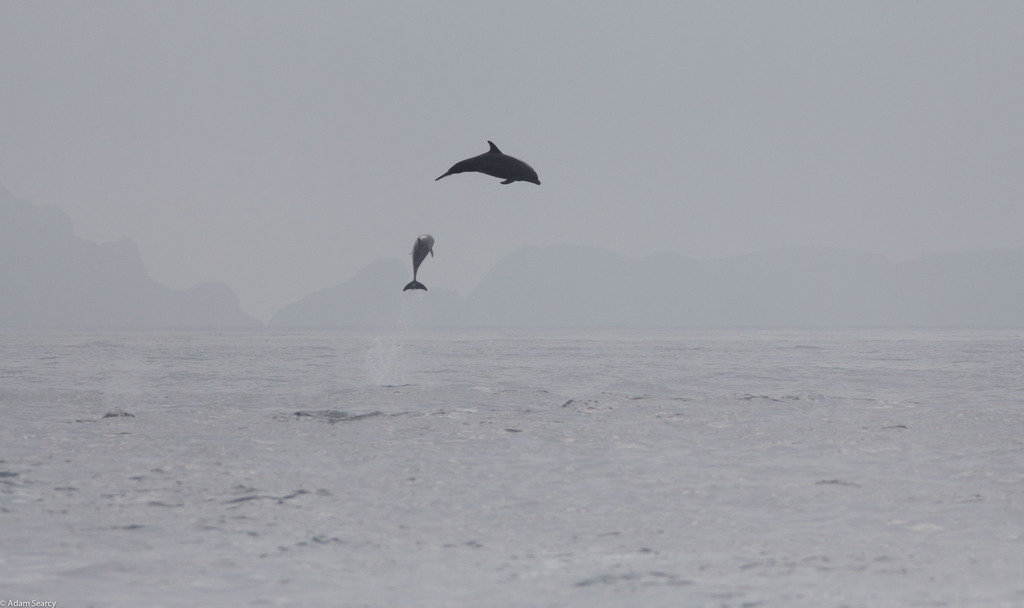
By the benchmarks researchers actually use (tool use, mirror self-recognition, social learning, problem-solving), the top tier is chimpanzees, bottlenose dolphins, elephants, ravens, orangutans, and octopuses. The last entry is an invertebrate with its neurons distributed across eight arms.
"Smartest animal" is a question researchers now treat with care: a chimpanzee and a raven evolved intelligence for completely different ecological problems, and the benchmarks we use reflect what we think intelligence is. The fairest measure is a cluster of abilities: can the animal use tools, recognise itself, learn socially, solve problems it has never encountered, and communicate with others about things that are not immediately present?
Every species below is in the Kaught catalog. Every claim is grounded in peer-reviewed research. The ranking is honest about what each animal excels at and where the evidence is thinner.
1. Chimpanzee
The animal with the best-documented intelligence across the most dimensions. Chimpanzees use at minimum ten distinct tool types in the wild: sticks to fish termites from mounds, stones to crack open hard nuts, leaves compressed into a sponge to drink water from hollows, and sharp stones knapped to a working edge. This last behaviour, stone knapping, was until recently considered exclusively human.
They pass the mirror test. They teach: a novel nut-cracking technique discovered in one community spreads to others through observation and practice. They communicate with over 66 distinct gestures that carry specific meanings and are understood across communities that have never met. They plan ahead: given a choice between an immediate small reward and a larger reward available later, they wait.
Genetically, chimpanzees share approximately 98.7% of their DNA with humans. The cognitive similarity is not a coincidence: both lineages diverged from a common ancestor around 6 million years ago, and much of the neural architecture is shared.
2. Bornean Orangutan
Orangutans are the most solitary of the great apes, which makes their cultural transmission of tool use particularly striking: without constant social contact, innovations spread slowly, but they do spread.
Wild Bornean orangutans use leaves as gloves when handling spiny or irritating fruit. They build a fresh sleeping nest each night, and some populations build a separate roof structure over the nest on rainy nights. They have been observed using leaves to amplify vocalisations (a kissing sound used to deter predators), holding them against the lips like a megaphone. In captivity, orangutans have learned to use saws, hammers, and hand drills by watching humans, then demonstrated the skill unprompted to another individual.
They also plan for the future in a concrete way: wild orangutans have been observed vocalising about a direction of travel before moving, allowing others in earshot to anticipate and follow.
3. Common Bottlenose Dolphin
Dolphin intelligence evolved independently from primate intelligence but arrived at the same general destination. The bottlenose dolphin has the largest brain relative to body size of any non-human animal, and the neocortex (the region associated with higher cognition) has more surface folds than a human brain.
Each dolphin develops a unique signature whistle in its first year. Other dolphins use this whistle to address an individual by "name", calling it when separated from the group, a form of individual naming found nowhere else outside of humans. Dolphins also pass the mirror test, cooperate on coordinated hunts with tactical role differentiation, and have been documented using sponges as tools: holding them against the snout while foraging over rough seafloor to protect the beak from abrasion.
In one documented case in Australia's Shark Bay, this sponge-carrying behaviour spread through a matrilineal line over multiple generations, a clear demonstration of cultural transmission in a non-primate.
4. African Savanna Elephant
The elephant's brain is the largest of any land animal by absolute mass, around 5 kg. The temporal lobe (memory and social processing) is proportionally larger than in most other mammals. This reflects a life history that demands exceptional memory: matriarchal groups must remember water sources, migration routes, and individual identities across decades in landscapes that shift with drought.
Elephants pass the mirror test. They use branches as fly-whisks and scratch the areas of their back they cannot reach with the trunk. They have been observed covering dead group members with vegetation, returning to the same carcass site over years, and responding to the bones of strangers with extended investigation. Researchers describe this as mourning, though the subjective experience remains contested.
Elephants also cooperate on problems neither could solve alone. In one landmark experiment, two elephants on either side of a partition had to pull two ends of a rope simultaneously to receive food. Both learned rapidly that the task required coordination, and would wait for their partner to arrive before pulling.
5. Common Raven
The raven is the benchmark for avian intelligence, and for some tasks it has outperformed primates. Ravens solve multi-step mechanical puzzles involving locks, levers, and pulleys. They demonstrate deferred gratification: offered a choice between an immediate mediocre reward and a tool they can exchange later for a better one, they take the tool and wait.
They cache food in hundreds of locations and remember them accurately months later. They are also aware that other ravens may be watching and use this to their advantage: a raven that suspects it has been observed will return to a cache and re-hide the food in a new location, but only if the observer was a conspecific (another raven) with eyes that worked, not a blind bird or a stone.
In a 2020 study comparing ravens and great apes on a battery of future-planning tasks, ravens scored comparably to orangutans and chimpanzees, a result that was unexpected given that birds and mammals diverged roughly 320 million years ago. The neural architecture is entirely different: ravens have no neocortex. The same cognitive result emerged from a different structural solution.
See also: fastest animals for how the raven's cousin, the peregrine falcon, dominates a different kind of performance table.
6. Common Octopus
The octopus makes this list partly as a corrective. The cephalopod brain plan diverged from vertebrate intelligence over 600 million years ago, and the octopus evolved it from scratch without any shared evolutionary history with the other animals above. That it arrived at many of the same capabilities is one of the most striking facts in comparative cognition.
Octopuses open screw-top jars, navigate mazes with spatial memory, learn through observation (watching a demonstrator octopus choose a specific coloured ball produces a statistically significant bias toward the same ball in the observer), and recognise individual humans. They play: given objects with no food value, they will push them around in patterns that researchers describe as non-instrumental, i.e., not directed at any obvious goal.
The unusual thing about octopus intelligence is where it lives. Of the roughly 500 million neurons in a common octopus, about two-thirds are distributed across the eight arms rather than the central brain. Each arm has its own nerve ganglion that can process sensory input and initiate movement semi-independently. An arm removed from the body continues to respond to stimuli and attempt to pass food toward where the mouth used to be for up to an hour. The octopus is, in a meaningful sense, nine loosely coordinated problem-solvers sharing one body.
Compare with the mantis shrimp, another marine invertebrate with extraordinary sensory processing, or the vampire squid, the octopus's ancient deep-sea relative.
Smartest animals: frequently asked questions
What is the smartest animal in the world?
By the broadest measures (tool use, self-recognition, social learning, problem-solving, communication), chimpanzees rank consistently at the top among non-human animals. Bottlenose dolphins and elephants also score across all major intelligence benchmarks.
What is the smartest non-mammal?
The common raven is widely regarded as the most cognitively advanced non-mammal. Ravens solve multi-step puzzles, demonstrate deferred gratification, and have matched great apes on some future-planning tasks. The common octopus is the most cognitively advanced invertebrate.
Can animals recognise themselves in a mirror?
Species that reliably pass the mirror test include chimpanzees, bonobos, orangutans, elephants, bottlenose dolphins, orcas, and magpies. Most animals treat the reflection as another individual and do not pass.
Do octopuses really have arms that think independently?
Yes. About two-thirds of an octopus's roughly 500 million neurons are in its eight arms rather than its central brain. Each arm has a local nerve ganglion that can process information and initiate movement semi-independently, and a severed arm continues to respond to stimuli for around an hour.
Which is smarter, a chimpanzee or a dolphin?
Both score at the same top tier across the main benchmarks. Chimpanzees have closer genetic proximity to humans and a larger absolute brain; dolphins have a proportionally larger brain relative to body size and more complex social communication. Direct ranking is difficult because their intelligences evolved for different environments.
Are elephants actually intelligent?
African elephants have the largest absolute brain of any land mammal (around 5 kg) and pass all major intelligence benchmarks: mirror test, tool use, cooperative problem-solving, and long-term memory of individuals and locations across decades.
The next thing you see could be
your first catch.
Kaught is live on the App Store and Google Play. Free to start, and your first catch is one photo away.
Free to start · Live on the App Store and Google Play
Species data, type, rarity tier and measurements, is drawn from the Kaught catalog, built on open biodiversity records from GBIF and iNaturalist. Rarity reflects how often a species is observed in the wild, not its conservation status.