Species spotlight
Spotted Drum: the most visually distinctive fish on a Caribbean reef
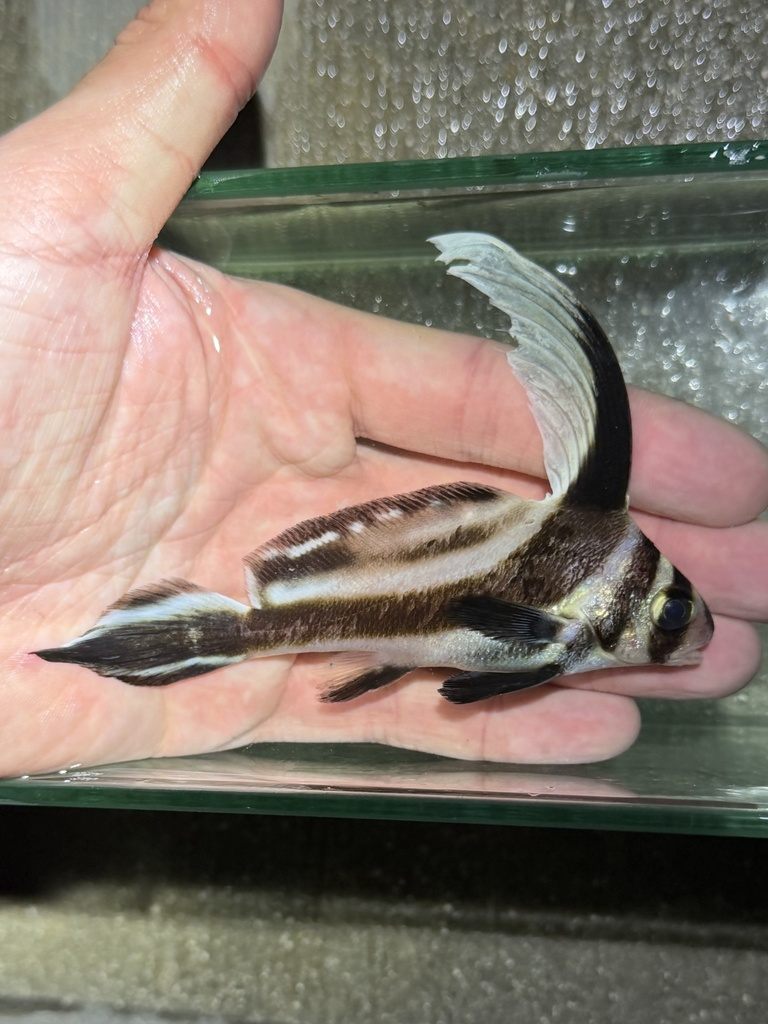
The spotted drum (Eques punctatus) is a 27 cm Caribbean reef fish instantly identified by bold black and white spots, a broad black dorsal stripe and a habit of hovering motionless under coral overhangs. Juveniles are even more dramatic: a ribbon dorsal fin three times the body length. It produces a resonant drumming sound from its swim bladder and sits at Epic tier in the Kaught catalog.
A Caribbean reef holds hundreds of species, but one stands out on sight every time. The spotted drum stops divers and snorkellers mid-fin-stroke. It is the reef's most recognisable fish: stationary under a ledge, bold as a graphic design, tipped at a slight angle as it faces the current. Once you know it, you will never mistake it for anything else.
How to identify a spotted drum
Adults are black and white in a pattern unlike any other Caribbean reef fish:
- Body: white, densely covered in black spots, smaller on the head and larger toward the tail.
- Dorsal stripe: a broad, solid black band runs from the top of the first dorsal fin along the back to the upper tail lobe.
- Fins: the trailing edge of the dorsal and anal fins are black-edged. The tail fin is rounded.
- Posture: adult spotted drums hover almost motionless, head slightly down and often angled into the current, under ledges, in cave mouths or tucked beneath coral formations.
If you see something spotted and black-and-white motionless under a ledge on a Caribbean reef, it is almost certainly this species. The only common lookalike, the jackknife fish (Eques lanceolatus), has fewer spots and a single high black dorsal stripe without the spotted body coverage.
The juvenile: a different creature entirely
Finding a juvenile spotted drum is one of the memorable experiences of Caribbean diving. The small fish, often just 2 to 5 cm long, is all-black with a single elongated first dorsal fin that streams upward in the water column at three to four times the fish's body length. This ribbon of fin waves in the current above a tiny body covered in the same spotted pattern, still small and high-contrast.
The function of the elongated juvenile fin is debated. The most plausible hypothesis is mimicry: the black, ribbon-like shape and waving motion closely resembles the swimming polyclad flatworms that are toxic or unpalatable to most reef predators. As the fish grows, the fin's proportional length decreases and the adult pattern emerges. Juveniles are often spotted in shallower water than adults, among rubble zones and around reef bases.
The drum sound
The spotted drum is in the family Sciaenidae, the drumfishes, named for a sound production mechanism that evolved across all 286 species: specialised drumming muscles contract rapidly against the walls of the swim bladder, causing it to vibrate and amplify a low-frequency resonant call. The spotted drum's call is a deep, knocking sound audible to divers as a soft reverberant knock or thump emanating from under the ledge where the fish shelters.
Sciaenidae produce these sounds primarily for mate attraction and territorial communication. They are most vocal at dusk and night, which coincides with the spotted drum's shift from daytime rest to nocturnal active foraging. In well-studied fish communities like the coral reef, sound is a significant part of the acoustic landscape that reef fish use to navigate and communicate in conditions of low visibility.
Behaviour and feeding
During the day the spotted drum is a solitary, cryptic species: almost always alone under a specific ledge, often returning to the same site over consecutive days. At night it becomes a roaming predator of small shrimp, crabs and worms on and around the reef surface. It locates prey through a combination of vision (adapted to low-light conditions) and sensory pores along the lateral line that detect the pressure waves of moving invertebrates.
Compare it to other dramatic Caribbean reef residents like the spotted garden eel and the ribbon eel of the Indo-Pacific, both fish with unmistakable visual identities that use unusual body shapes for distinct ecological purposes. The spotted drum's cryptic daytime rest strategy and nocturnal hunting pattern are the fish equivalent of the tawny owl: highly visible by distinctive appearance but genuinely elusive by behaviour.
Range and where to find one
The spotted drum ranges from Bermuda and southern Florida through the entire Caribbean, Gulf of Mexico and along the Atlantic coast of Central and South America to southern Brazil. It is common in the Cayman Islands, Belize Barrier Reef, Bonaire, Curacao and throughout the reef systems of Mexico's Yucatan coast.
The most reliable way to see one: at any Caribbean dive site with established coral ledges at 5 to 20 m, look slowly under every overhang from the waterline side. Spotted drums are site-attached: divers familiar with a reef know exactly which ledge each individual fish uses.
Epic tier: how rare is the spotted drum?
The spotted drum sits at Epic in the Kaught catalog, three diamonds out of four. Despite occupying a large range on accessible Caribbean reefs, it is cryptic, nocturnal in its active phase, and almost entirely hidden under ledges during daylight hours. A diver who does not know where to look may spend an entire dive on a reef where spotted drums are resident without noticing one. That behavioural invisibility, combined with its low total observation frequency relative to common Caribbean reef fish, places it firmly in the Epic tier.
Spotted drum: frequently asked questions
What is a spotted drum fish?
The spotted drum (Eques punctatus) is a Caribbean reef fish in the family Sciaenidae. Immediately identified by bold black and white spots and a solid black dorsal stripe, it hovers under coral ledges by day and hunts invertebrates at night. Adults reach 27 cm. It is Epic tier in the Kaught catalog.
Where do spotted drums live?
On shallow coral reefs, rocky outcrops and cave overhangs throughout the Caribbean and western Atlantic, from Bermuda and Florida south to Brazil. Usually found at 1 to 30 m depth, almost always in or under a shaded ledge by day.
Why do juvenile spotted drums look so different?
Juveniles have a dramatically elongated first dorsal fin, three to four times the body length, waving in the current. This is thought to mimic toxic polyclad flatworms, deterring predators. The fin shrinks proportionally as the fish grows into its adult spotted pattern.
Why is it called a drum?
Members of the family Sciaenidae produce a deep resonant drumming sound by vibrating the swim bladder with specialised muscles. The spotted drum's call is audible to divers as a soft knocking sound from under the ledge where it shelters. The sound is used for communication and mate attraction.
Is the spotted drum safe to approach?
Entirely harmless. The spotted drum has no venom, no dangerous spines and no aggressive behaviour toward divers. It may retreat further under the ledge if approached too closely but will usually resume its stationary hovering position once the diver moves on.
How rare is the spotted drum in Kaught?
Epic: three diamonds out of four. Cryptic daytime behaviour under reef ledges and nocturnal active habits mean it is genuinely uncommon even on reefs where it is resident. Kaught's rarity reflects observation frequency in the wild, not conservation status.
The next thing you see could be
your first catch.
Kaught launches soon. Join the waitlist and be first to start a collection of the living world, one photo at a time.
Free at launch · No spam, just one email on launch day
Species data, type, rarity tier and measurements, is drawn from the Kaught catalog, built on open biodiversity records from GBIF and iNaturalist. Rarity reflects how often a species is observed in the wild, not its conservation status.