
Exotic spotlight
White-tailed Eagle: Europe's largest eagle and how to identify one
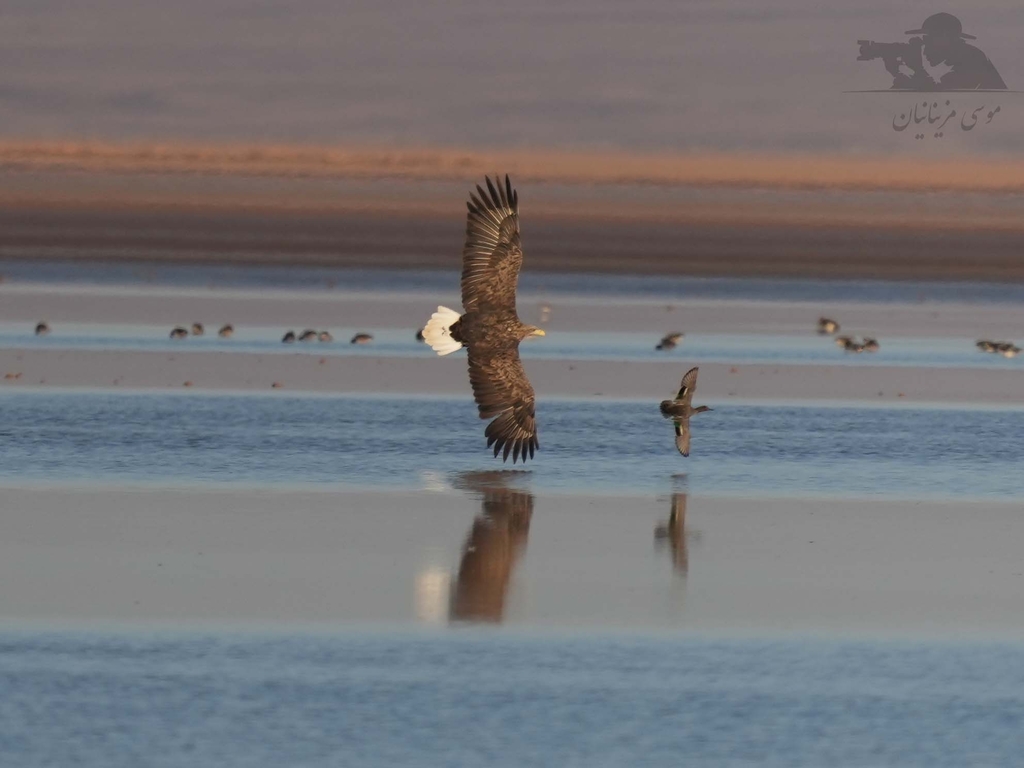
The white-tailed eagle (Haliaeetus albicilla) is Europe's largest eagle, with a wingspan up to 245 cm. In flight it is unmistakable: rectangular wings held flat, a short white wedge of a tail in adults, and a massive pale head projecting forward like a flying plank.
If you see a raptor soaring on wings so long they look almost absurd, with the front end projecting like a plank and a squared-off tail, you are probably looking at Europe's top bird of prey. The white-tailed eagle demands attention. Here is everything you need to identify one and understand what you are seeing.
How to identify a white-tailed eagle
Four field marks, in order of usefulness:
- Wing shape: the wings are long, very broad, and rectangular, like two planks attached at a pivot. In soaring flight they are held flat, not angled up in a V. This is the single best long-range mark.
- The head: large and pale, projecting far forward of the wing leading edge. From the side the bird looks all neck and bill.
- The tail: short, wedge-shaped, and white in adults. The white only develops fully after five years of age; immature birds have a dark, mottled tail and can confuse beginners.
- The bill: enormous, hook-tipped and yellow; visible at considerable distance when perched.
In bright conditions the body appears chocolate-brown, the head noticeably paler. Size is hard to judge alone but a white-tailed eagle alongside a common buzzard looks like a different class of animal: the eagle's wingspan can exceed 2.4 metres.
White-tailed eagle vs golden eagle: the key differences
Both are large, brown and powerful. The distinction matters.
Wings: the white-tail holds its wings flat, like a stretched-out rectangle. The golden eagle holds its in a shallow upward angle (dihedral), giving a more tapered look. At distance, "flat plank" versus "shallow V" separates them cleanly.
Tail: golden eagle tail is longer, rounded and dark, with a whitish base in young birds, but never the clean wedge-white of an adult white-tail.
Head: golden eagle has a golden nape and a smaller, darker bill. The white-tail's pale head and heavy yellow bill are obvious when perched.
The closest relative the white-tailed eagle has is the bald eagle of North America: both belong to the genus Haliaeetus and share the same basic design, a large, fish-eating sea-eagle with a pale head. The bald eagle's white head covers the entire crown and face; the white-tail's pale head is more cream-brown and the white is confined to the tail.
Where does the white-tailed eagle live?
Across a vast Eurasian range, from Iceland and Ireland east through Norway, Russia and Central Asia to the Pacific coast of Russia and China. The species has a strong preference for large, open water: broad lakes, major rivers, fjords, sea coasts and estuaries. It nests in tall trees or on cliff ledges with a clear approach and good views of the surrounding water.
In Britain the white-tailed eagle was hunted to extinction in the early twentieth century. Reintroduction to Scotland began in the 1970s, and birds now breed regularly on the west coast and the Isle of Skye. More recently they have been reintroduced to the Isle of Wight and Cambridgeshire. Numbers in Britain are still low; a sighting remains genuinely rare.
What does the white-tailed eagle eat?
Fish are the foundation, snatched by a low gliding approach and grabbed from just below the surface with the talons. It does not plunge-dive like an osprey; it skims low over the water, then reaches. Large waterbirds, rabbits and hares feature in the diet where fish are less accessible. In winter, when rivers ice over, carrion including deer carcasses becomes important.
The white-tailed eagle is also a deliberate kleptoparasite: it will pursue large soaring birds and other raptors carrying prey and harry them until they drop it. Ospreys are frequent targets. The eagle owl, by contrast, is a direct competitor at night; the two rarely overlap in habits but can share large European river systems.
The white-tailed eagle in the Kaught catalog
In the Kaught catalog the white-tailed eagle is Epic tier, three diamonds out of four. The tier reflects observation frequency in the wild, not any conservation classification. Despite a recovering European population, this is a low-density apex raptor with enormous territories: a pair in Norway may hold a river valley of 50 km² or more. The realistic chance of a clear, unambiguous sighting on any given day in most of its range is low, and Epic is accurate.
Contrast with the golden eagle (also Epic) and the closely related bald eagle (also Epic), and the pattern holds: large raptors, apex roles, wide territories, genuinely uncommon sightings.
Nesting and behaviour
White-tailed eagles pair for life and return to the same nest year after year, adding material each season. An old nest can reach 1 m deep and weigh hundreds of kilograms. Eggs are laid in February or March, incubated for about 38 days, and chicks fledge at around 10 weeks. Young birds are independent by late autumn but spend several years wandering before settling to breed.
Their soaring flight covers enormous distances daily, often riding thermals to survey territory from altitude before dropping to the water to hunt. They are not fast in a stoop, nothing like a peregrine, but their size means they can take prey that almost no other European bird could handle.
White-tailed eagle: frequently asked questions
What does a white-tailed eagle look like?
A very large, broad-winged raptor with a uniform chocolate-brown body, a pale yellowish head in adults, a short wedge-shaped white tail (in birds five years and older), and a massive hooked yellow bill. The wingspan reaches up to 245 cm, wider than any other European eagle. In flight the rectangular wings held flat give it a silhouette often compared to a flying barn door.
How do you tell a white-tailed eagle from a golden eagle?
White-tailed eagle: wings long and rectangular, held flat; tail short, wedge-shaped and white in adults; head pale and protruding. Golden eagle: wings slightly narrower and tapered, held in a shallow V; tail longer, rounded, no white; head golden-nape, smaller bill. The flat-winged 'plank' silhouette is the clearest field mark at distance.
Where does the white-tailed eagle live?
Across northern Eurasia from Iceland and Ireland east to the Pacific coast of Russia and China. It favours large lakes, wide rivers, fjords and sea coasts with good fish stocks. In Britain it was reintroduced to Scotland in the 1970s and has since returned to parts of England.
How big is a white-tailed eagle?
Body 70 to 90 cm, weight 3.1 to 6.9 kg (females larger), wingspan 178 to 245 cm. That maximum wingspan is broader than any other eagle in Europe and wider than a typical golden eagle.
What does a white-tailed eagle eat?
Mainly fish, snatched from near the surface in a low gliding approach. Also large waterbirds, hares, rabbits and carrion in winter. It will steal prey from ospreys and other raptors, pursing them until they drop their catch.
Why is the white-tailed eagle Epic tier in Kaught?
Kaught's rarity tier reflects how often a species is actually observed in the wild, not conservation status. Despite a recovering population, this apex raptor lives at low densities across a wide range; a clear sighting on any given day remains genuinely uncommon across most of Eurasia. Epic: three diamonds.
The next thing you see could be
your first catch.
Kaught is live on the App Store and Google Play. Free to start, and your first catch is one photo away.
Free to start · Live on the App Store and Google Play
Species data, type, rarity tier and measurements, is drawn from the Kaught catalog, built on open biodiversity records from GBIF and iNaturalist. Rarity reflects how often a species is observed in the wild, not its conservation status.