
Species spotlight
Canada lynx: the boreal cat built for deep snow
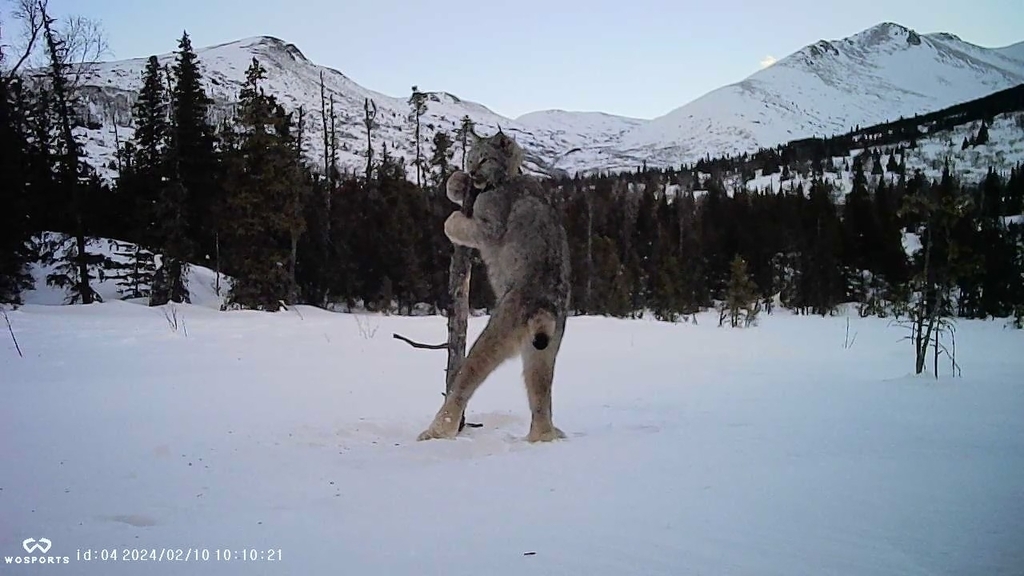
The Canada lynx is a medium-sized wild cat from the boreal forests of Canada and Alaska, defined almost entirely by one prey species: the snowshoe hare. Its population rises and falls in lockstep with the hare on a strict 10-year cycle, and its enormous padded feet are the single adaptation that gives it an edge in the deep snow habitat its prey depends on.
Canada Lynx
Lynx canadensis
- Type
- Mammal · Apex
- Rarity
- Epic
- Size
- 80–107 cm body length, 45–55 cm at shoulder
- Weight
- 8–11 kg
- Habitat
- Boreal conifer forest, Canada to northern US states
- Activity
- Crepuscular, solitary
Field marks: how to identify a Canada lynx
The Canada lynx is a medium-sized cat weighing 8 to 11 kg, roughly twice the size of a domestic cat. Its coat is silvery-grey to tawny-buff with faint dark mottling, much less dramatically spotted than most other wild cats. The facial ruff, a ring of longer fur around the face, is distinctive and more pronounced in winter. The ear tufts, long black extensions of fur from the tips of each ear, are immediately visible at distance and are longer than those of the bobcat.
The tail is short and blunt, black on the entire tip, which distinguishes the lynx from the bobcat, whose shorter tail is black only on the upper surface. The legs appear proportionally long and the hindquarters are higher than the shoulders, giving the animal a slightly hunched resting posture. The face is flat and wide, with large, round, pale eyes that provide good low-light vision.
The single most immediately striking feature in the field is the size of the feet. A Canada lynx's paw is comically large for its body weight, and a paw print in snow can be as wide as a hand span.
The snowshoe feet: engineering for powder
The lynx's oversized paws function as natural snowshoes. When the lynx places its foot on soft snow, the toes spread wide and the interdigital fur fills the gaps, creating a large surface area that distributes the animal's weight across the snow crust. A Canada lynx can travel over deep powder snow that a bobcat of similar weight would break through, limiting the bobcat's speed and energy budget severely.
This foot design is not accidental; it is the defining adaptation of the species and the reason the Canada lynx occupies a niche the bobcat cannot fill. It is mirrored almost exactly in the snowshoe hare's own outsized hind feet. In the arms race between predator and prey, both species have converged on the same solution: stay on top of the snow.
The paw fur also provides insulation during the long boreal winter, where ground temperatures can fall to minus 40 degrees on exposed hillsides. The foot of a lynx sitting motionless on packed snow in January loses remarkably little heat.
The snowshoe hare dependency
No predator-prey relationship in North American ecology is more tightly coupled than the Canada lynx and the snowshoe hare. Studies of stomach contents and tracking data across Canadian boreal habitat consistently return the same figure: snowshoe hare makes up approximately 96% of the lynx's diet. The remaining 4% covers grouse, voles, squirrels, and, in certain areas, deer fawns in summer.
This extreme specialisation is a calculated ecological strategy that works extremely well when hare numbers are high. A single adult lynx requires roughly 200 hares per year to maintain body condition. When hare densities reach their peak, as many as 1,000 to 1,500 animals per square kilometre in prime habitat, the lynx does not need to search widely. It moves short distances and eats well. Reproduction is high, and kitten survival into their first winter is good.
The 10-year cycle: boom and crash
The snowshoe hare population follows a near-clockwork 10-year oscillation across the Canadian boreal belt. Numbers build for roughly 8 to 10 years as the population expands into available habitat, then collapse suddenly as over-browsing strips the vegetation, disease spreads through dense populations, and predator numbers, including lynx, peak and take an increasing toll. The crash can reduce hare densities by 95% in two or three years.
The Canada lynx population follows the hare by approximately one to two years. As hare numbers start to fall, kitten survival drops first. Young lynx raised in the year before the crash may not find enough food to reach sexual maturity. Adult females that do not make condition fail to reproduce or produce single-kitten litters. Within two or three years of the hare crash, the lynx population has followed it down sharply.
What happens next is one of the most dramatic dispersal events in North American mammal ecology: in crash years, Canada lynx appear hundreds of kilometres south of their usual range, in places where they are rarely or never seen. Individual animals have been documented crossing open agricultural land and appearing in suburban fringe areas far into the United States. These are not territory-holding animals; they are thin, wandering individuals searching for food in a landscape where their usual prey has largely vanished. As the hare population recovers over the following years, the lynx dispersal ends and the animals either establish new territories or die before the recovery completes.
Hunting method: silence and a short sprint
The Canada lynx is a stalking and ambush predator, not a long-distance runner. It locates prey using the combination of its large facial ruff, which funnels sound like a satellite dish, and acute directional hearing. A lynx can detect the movement of a hare under 30 cm of snow. It moves slowly into position over a period of many minutes, then closes the final distance in a short sprint that usually ends within 5 to 10 metres of the launch point.
The kill is delivered by a bite to the back of the skull or nape, the felid standard. The lynx does not run prey down; if the first sprint does not result in a catch, it often abandons the attempt rather than pursuing. This conserves energy, which in a deep snow environment is a significant biological cost. Hunting at night or in the half-dark of boreal dusk reduces the chance of the hare detecting approach.
Lynx versus bobcat: where the range overlaps
The Canada lynx and the bobcat (Lynx rufus) are close relatives that overlap in range across southern Canada and the northernmost US states. In areas of overlap, the two species generally partition their habitat by snow depth: the lynx takes the deep snow boreal forest interior; the bobcat takes rocky terrain, forest edge, and areas with lighter snowfall. The mechanical advantage of the lynx's larger feet matters less in the latter habitat, and the bobcat, which is slightly more flexible in diet and habitat, can compete effectively.
Hybridisation between Canada lynx and bobcat has been confirmed in the wild. Hybrids appear capable of reproduction, but their ecological niche is less well defined than either parent species. In the deepest boreal snow country, a pure Canada lynx outcompetes the hybrid on energetic terms.
Range and habitat
The Canada lynx is broadly distributed across the boreal conifer belt from Newfoundland west to British Columbia and north into Yukon and Alaska. In the contiguous United States, a northern population exists in Montana, Idaho and Washington, and smaller populations have been documented in Minnesota and Maine. The US populations sit at the southern edge of viable boreal habitat and are more sensitive to snow-depth changes than the core Canadian population.
The species requires dense understorey cover, particularly young conifer regeneration after fire or logging, where snowshoe hares reach their highest densities. Mature open forest without understorey holds few hares and, consequently, few lynx. The relationship between forest disturbance, hare habitat and lynx presence is one of the more studied land-cover relationships in boreal ecology.
The Canada lynx in the Kaught catalog
The Canada lynx is No. 173, Epic tier, three diamonds in the Kaught catalog, reflecting the genuine rarity of a confirmed field observation. Most people who live across its entire range have never seen one in the wild; the combination of remote habitat, crepuscular activity and natural silence makes it one of the least frequently reported medium-sized carnivores in North America. The related bobcat is both more abundant and more tolerant of human-modified landscape, and is therefore more commonly photographed and submitted to observation databases. Even in crash-year dispersal events, when lynx appear in unusual places, they are typically seen only once before moving on.
For comparison with other felids in the catalog, see the most dangerous animals ranking, which covers the lion at Legendary tier, and the white-tailed eagle article for another northern-range apex predator with a similarly high rarity tier.
Canada lynx: frequently asked questions
What does a Canada lynx eat?
Up to 96% of a Canada lynx's diet is snowshoe hare. When hare numbers are high, lynx eat almost nothing else. In crash years they may take grouse, voles and occasional deer fawns, but none of these provide enough calories to sustain condition, and the lynx population declines sharply as a result.
Why do Canada lynx populations crash every 10 years?
The Canada lynx is tied to the 10-year snowshoe hare cycle. Hare populations boom roughly every decade, then collapse due to over-browsing, disease and predation pressure. When hares crash, lynx have almost nothing to eat, reproduction fails and the population crashes 1 to 2 years after the hare peak, then recovers as hares rebuild.
How big are a Canada lynx's feet?
The paws are disproportionately large for the lynx's body weight. Spread under pressure, each paw distributes weight across the snow surface, letting the lynx walk over crusts that would break under a bobcat of similar weight. This is the defining adaptation of the species and its primary edge over competing predators in deep snow habitat.
What is the difference between a Canada lynx and a bobcat?
Key differences: the Canada lynx is larger, has proportionally much bigger feet, longer ear tufts and a tail tipped black all the way around. The bobcat has a spotted coat and a shorter tail tipped black only on top. In deep snow, the lynx has a decisive advantage; in rocky or bare-ground habitat, bobcats compete effectively.
Where does the Canada lynx live?
The Canada lynx is found across boreal conifer forest from Newfoundland to Alaska, with isolated populations in several northern US states. It requires dense understorey cover, deep snow and territory with enough snowshoe hare density to support a year-round resident predator.
Is the Canada lynx nocturnal?
Primarily crepuscular, most active at dawn and dusk. It hunts by stealth, locates prey with its large facial ruff and acute hearing, and closes with a short sprint. Solitary except during mating, an adult lynx may range over 100 km2 of territory.
The next thing you see could be
your first catch.
Kaught is live on the App Store and Google Play. Free to start, and your first catch is one photo away.
Free to start · Live on the App Store and Google Play
Species data, type, rarity tier and measurements is drawn from the Kaught catalog, built on open biodiversity records from GBIF and iNaturalist. Rarity reflects how often a species is observed in the wild, not its conservation status.