
Species spotlight
The Andean Condor: how to identify South America's giant soaring vulture
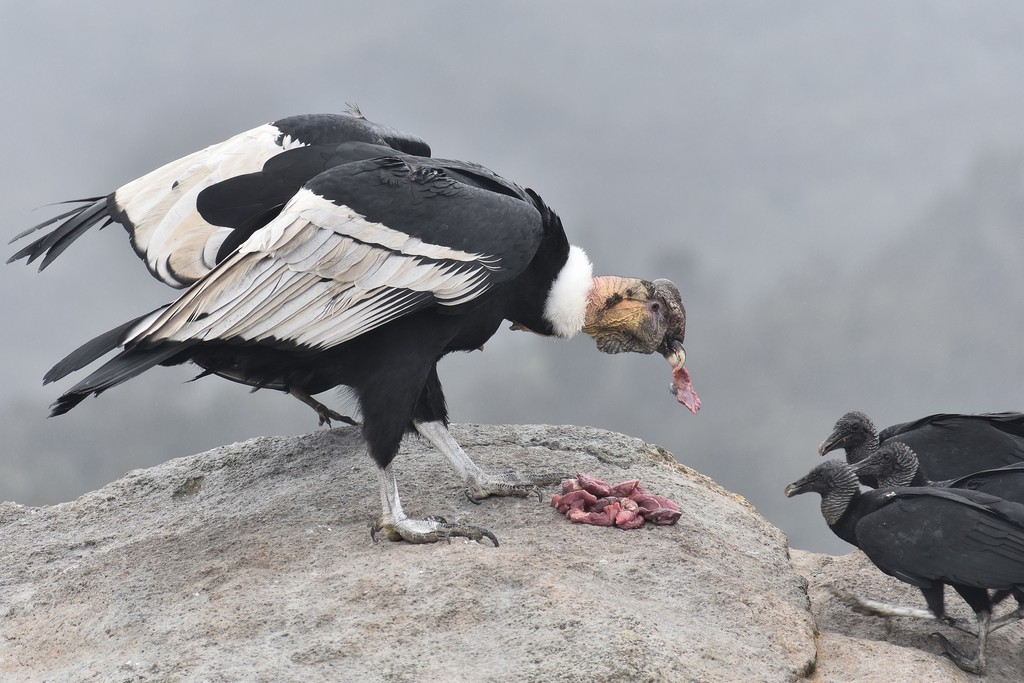
The Andean condor (Vultur gryphus) is the world's largest flying bird by combined wingspan and weight: up to 3.1 m across and 15 kg. It rides thermals along the Andes from Venezuela to Tierra del Fuego, covering up to 200 km a day without flapping, and feeds almost exclusively on carrion.
The Andean condor is not hard to identify once you are in the right mountain valley at the right time of morning. The problem is getting there. But when the thermals start to build over the Andean slopes an hour after sunrise and the first dark cross rises above the ridge line, there is nothing else it could be.
How to identify an Andean condor
Size is the first clue: nothing else in South America approaches this wingspan. In flight, look for:
- Wingspan: up to 3.1 m. In soaring profile, the wings are held flat or very slightly bowed upward. The wingtips splay into distinct primary feather "fingers".
- Plumage: adult birds are black overall with a large white patch on the upperwing (the secondary coverts) and a smaller white patch visible from below on the inner wing. Immatures are brown with a less distinct pattern and take five to six years to acquire full adult plumage.
- Head: completely bare and unfeathered. Adults have a red-to-pink skin head and neck. Males have a prominent fleshy caruncle (a comb-like growth) on the top of the head, absent in females.
- White neck ruff: a ring of white downy feathers at the base of the neck, visible at closer range.
- Flight style: minimal flapping. The condor holds its wings flat and adjusts the leading edge and wingtip position to steer. Watching one soar for 20 minutes without a single powered wingbeat is normal.
Confusion species: the black-and-chestnut eagle and the king vulture are also large, but neither approaches condor size. The Andean condor's white upperwing patches and bare head are diagnostic at any reasonable range.
Where Andean condors live
The condor's range follows the Andes: from the Venezuelan coast in the north through Colombia, Ecuador, Peru, Bolivia, Argentina and Chile, south to Patagonia and Tierra del Fuego. A separate coastal population inhabits the Pacific coast of South America from Peru to Chile, soaring over sea cliffs and rocky shorelines.
The bird needs two things: thermal-generating terrain (mountain slopes, coastal cliffs, or open grassland at altitude) and proximity to large carcasses. Historically this meant guanaco, llama, vicuña, and marine mammals along the coast. Today it includes livestock in Andean farming communities.
Best locations for reliable sightings: Colca Canyon in Peru, Condor Huasi in Argentina, Torres del Paine in Chilean Patagonia, and the coastal cliffs north of Lima. At Colca Canyon, condors reliably catch rising thermals over the canyon rim from about 07:30 onwards on clear days.
The bare head: a feature, not a flaw
The condor's bald head is not an aesthetic choice. It evolved for the same reason as the Old World vulture's bare head (despite no close relationship between the two groups: this is convergent evolution). Feeding inside a large carcass, a head covered in feathers would accumulate blood, fat, and bacteria rapidly. Bare skin is easier to clean. Condors sun their heads and necks to let UV radiation sterilise the exposed skin.
The red-to-pink skin on the face and neck changes colour noticeably during social interactions. Males flush the skin darker red during displays; it pales during subordination. The caruncle on the male's head appears to function as a visual signal of dominance at feeding groups: larger caruncle, higher position in the hierarchy.
At carcasses, condors land in dominance-ranked groups. Dominant adults eat first; immatures wait at the periphery. A single large carcass, such as a dead cow, may attract 20 or more condors and keep them occupied for a full day.
Soaring: covering 200 km without effort
A condor's skeleton weighs only about 1 kg despite the bird's overall mass of up to 15 kg. The bones are hollow and heavily pneumatised. The pectoral muscles, which power wing flapping in most birds, are proportionally reduced: the condor rarely needs them.
Instead, the bird uses thermals: columns of warm air rising from sun-heated terrain. By circling inside a thermal to gain altitude, then gliding across to the next one, a condor can cover 200 km in a single day with minimal energy expenditure. Tracking studies have recorded individual birds spending over five consecutive hours airborne without a powered wingbeat.
The primary feather tips function as slots, reducing turbulence at the wingtip and improving lift efficiency at low speeds, the same principle as the slotted primary feathers in hawks and eagles. Compare the condor's soaring strategy with that of the common buzzard, a much smaller raptor that uses thermals by the same principle.
Life history: slow reproduction, long life
Andean condors are among the longest-lived birds. Individuals in the wild reach 70 years or more. They reach sexual maturity at 5 to 6 years and pair for life. A pair raises a single chick every two years: one egg is laid on a bare cliff ledge, both parents incubate it for 55 to 65 days, and the chick fledges at around 6 months, then remains with the parents for up to 2 years before becoming independent.
This slow reproductive rate makes the condor sensitive to disruption: a pair that loses one adult may not breed successfully for several years.
How rare is the Andean condor?
The Kaught catalog places the Andean condor at the Epic tier, three diamonds out of four. This reflects observation frequency: outside the handful of well-known viewpoints (Colca Canyon is the most visited), reliable sightings require dedicated effort in Andean mountain habitat. The birds are low-density across a vast range, spend much of their time at altitude, and are wary of approaching on foot.
Compare with the golden eagle, a Northern Hemisphere raptor of similar rarity that uses the same thermal-soaring strategy.
Andean condor: frequently asked questions
What is an Andean condor?
The Andean condor (Vultur gryphus) is the largest flying bird in the world by combined wingspan and weight. It is a New World vulture found along the Andes from Venezuela to Tierra del Fuego, soaring on mountain thermals to locate carrion.
What is the wingspan of an Andean condor?
Up to 3.1 m, one of the widest wingspans of any bird alive. Combined with a body weight of 7.7 to 15 kg, this makes it the heaviest flying bird and among the longest-winged.
How do Andean condors find food?
Primarily by sight: soaring at altitude and watching other scavengers or predators below. They also watch each other; a descending condor attracts others from kilometres away. Unlike many New World vultures, the Andean condor does not rely heavily on smell.
How far can an Andean condor fly in one day?
Up to 200 km, by riding thermal currents without flapping. Tracking studies have recorded birds spending more than five hours continuously airborne without a single powered wingbeat.
How long do Andean condors live?
Up to 70 years in the wild. They reach sexual maturity at 5 to 6 years, pair for life, and raise only one chick every two years. This slow reproductive rate makes them sensitive to any loss of adults.
Why is the Andean condor Epic tier in Kaught?
Kaught's Epic tier reflects actual observation frequency. Andean condors require mountain and coastal cliff habitat, fly at altitude, and are low-density across their range. Outside a handful of known viewpoints, clear sightings are uncommon even within their range.
The next thing you see could be
your first catch.
Kaught is live on the App Store and Google Play. Free to start, and your first catch is one photo away.
Free to start · Live on the App Store and Google Play
Species data, type, rarity tier and measurements, is drawn from the Kaught catalog, built on open biodiversity records from GBIF and iNaturalist. Rarity reflects how often a species is observed in the wild, not its conservation status.