
Adaptation explainer
Eagle Owl: how the world's largest owl hunts in near-total darkness
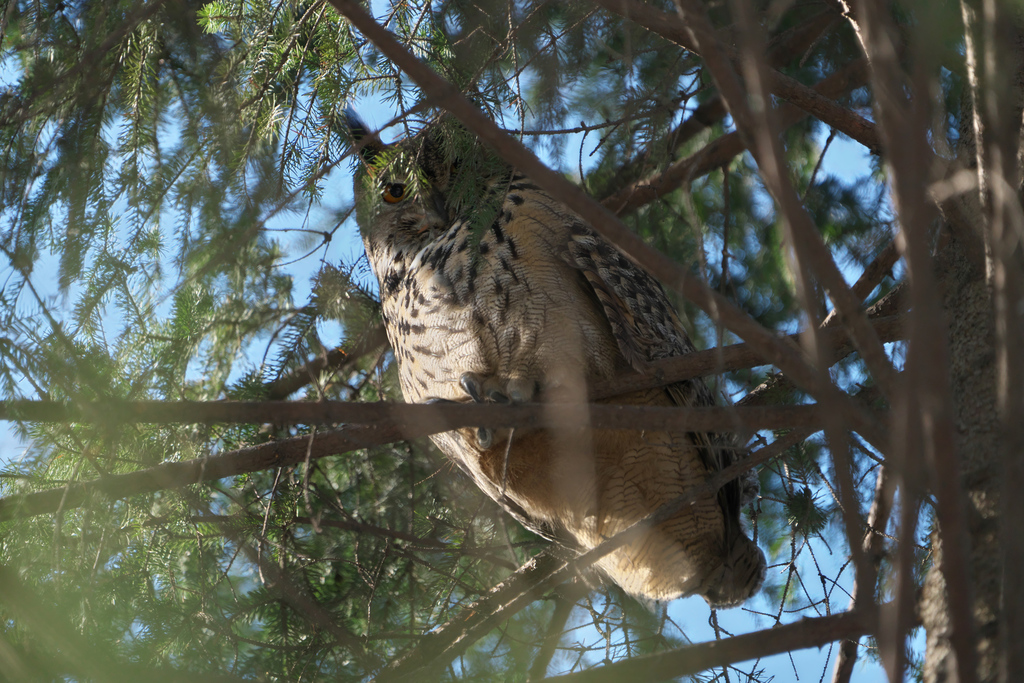
The eagle owl (Bubo bubo) is the largest owl in the world, weighing up to 4 kg with a wingspan reaching 2 metres. It hunts at night using four interlocking physical adaptations: a light-amplifying eye structure, an asymmetric-ear sound triangulation system, aerodynamically silent feathers, and talons strong enough to kill a young roe deer. Each adaptation solves a different problem posed by hunting in darkness.
Most owls are specialists in one narrow ecological niche. The eagle owl is not. It hunts everything from beetles to young roe deer, from frogs to other raptors, and it does so in conditions where most predators give up entirely. The reason it can do this is that it carries four separate precision tools for night hunting, each independently useful, each extraordinary in its engineering.
Adaptation 1: the eyes, extreme light capture
The eagle owl's eyes are enormous relative to its skull. They cannot move in their sockets (which is why owls swivel their entire heads) but they are fixed in a forward-facing orientation that gives binocular overlap and depth perception across a broad forward arc.
Inside each eye, the density of rod cells is far higher than in any diurnal bird. Rods are the photoreceptors responsible for low-light sensitivity. The pupil is correspondingly large, dilating to cover almost the full iris in darkness to admit maximum light. The result is a visual system that functions usefully at light levels equivalent to a moonless overcast sky.
A common myth: owls cannot see in absolute darkness. No vertebrate can. What the eagle owl can do is function reliably at light levels roughly ten times lower than a human can navigate by sight. In practice, no European night is truly lightless; there is always some ambient sky glow. The eagle owl exploits all of it.
The distinctive orange colour of the eagle owl's irises is not just visual: it may also reduce chromatic aberration and scatter in the lens, improving the sharpness of low-light images.
Adaptation 2: asymmetric ears, 3D sound triangulation
This is the adaptation that surprises most people. If you look closely at an eagle owl's skull, the two ear openings are not level. One sits higher on the skull than the other, offset by several millimetres. The difference is small but the consequence is large.
When a sound arrives at the owl from directly in front, it reaches both ears simultaneously. When it arrives slightly from the right, it reaches the right ear marginally sooner than the left. The brain computes this tiny time delay and converts it into a horizontal angle. But horizontal alone is not enough: a sound to the right could come from a mouse at ground level, a bat at height, or a rabbit at mid-level.
The vertical offset between the ear positions adds a second measurement. A sound from below reaches the lower ear fractionally sooner in a different pattern than a sound at the same horizontal angle but from above. The brain processes both delays simultaneously and computes a precise three-dimensional location for the source.
The facial disc, the disc of stiff, densely packed feathers that gives owls their distinctive face shape, functions as a parabolic reflector for sound, funnelling it toward the ear openings and amplifying incoming signals. The disc is not a static structure; muscles around the disc edge allow the owl to adjust its curvature, effectively pointing the acoustic dish toward a sound source.
The practical result of these two features combined: an eagle owl can locate a rustling mouse under leaf litter to within one to two degrees of angular accuracy using sound alone, in conditions where it cannot see it at all. Compare this to the grey heron's hunting approach, which is vision-first: the eagle owl can operate where the heron cannot.
Adaptation 3: silent wings
A predator that makes noise on approach is a predator that gives prey time to react. The eagle owl has solved this problem at the feather level.
The leading edge of each primary flight feather (the large outer wing feathers) carries a comb-like fringe of tiny filaments called flutings. As air flows over a normal wing surface, it breaks into turbulent vortices that produce sound. The flutings break these vortices into much smaller, quieter turbulence that dissipates without generating detectable noise.
The trailing edge feathers are also modified: soft, velvety fringes along the trailing edge of the flight feathers damp out residual vibrations before they propagate as sound.
The combined effect is flight that is nearly silent across the frequency range that most prey species can hear. A rabbit sitting in a field at night will not hear an eagle owl at all until the talons close on it. The owl is not just quiet; it approaches below the detection threshold of its prey.
This same structural adaptation is found in other owls, including the tawny owl, though the eagle owl's wing area makes the effect especially pronounced.
Adaptation 4: the talons, grip that kills instantly
An eagle owl's talons are not primarily cutting tools: they are grip tools. The killing mechanism is constriction rather than laceration. Each talon can exert a grip force estimated at 300 to 500 Newtons per toe, with all four toes engaging simultaneously in a closing action triggered automatically on impact.
This automatic closure is important. The owl does not choose to close its talons: the grip locks on contact and must be consciously released. This means that even if the owl is struck or surprised by struggling prey, the grip holds. The force required to reach vital organs through the ribcage of a rabbit or a young deer is applied in the first fraction of a second of contact.
The talons are also long: the hind talon (the hallux) of a large female eagle owl can reach 5 to 6 cm in curved length, longer than a human thumb. This reach allows it to grip prey much larger than itself and prevent escape.
The eagle owl can take prey up to its own body weight, a range that includes other large raptors. It has been recorded killing peregrine falcons, common buzzards, and herons in the wild.
Where and when to see an eagle owl
Eagle owls favour rocky gorges, quarries, cliff faces, and old ruins in or near forested country. They are found across Europe, Russia, the Middle East, and much of Asia, with strongholds in Scandinavia, the Iberian Peninsula, and Central Europe.
Best chance of a sighting: just after dusk or just before dawn in cliff-edge or quarry habitats during the breeding season (February to May), when territorial calling is most frequent. The call is a deep, resonant "bu-hoo" carrying for several kilometres on still nights. They are largely silent in summer and early winter.
The eagle owl sits at the Epic tier in Kaught (three diamonds out of four), reflecting its low observation frequency: low population density, strictly nocturnal habits, and large territories that keep individuals well separated. Even in prime habitat, a field sighting without deliberate searching is an unusual event.
Three records the eagle owl holds
- Largest owl in the world by average mass. The largest females weigh up to 4.2 kg, heavier than any other owl species.
- Widest prey range of any European owl. Documented prey species number in the hundreds, from insects to young ungulates. No other owl has comparable dietary breadth.
- One of the longest-lived wild birds. Eagle owls can live 20 to 25 years in the wild, with captive individuals recorded past 60 years. A lifespan that allows multi-decade occupation of a single territory.
Eagle owl: frequently asked questions
How large is an eagle owl?
The eagle owl is the largest owl in the world. Adults weigh 1.5 to 4 kg with a wingspan of 138 to 200 cm. Females are significantly larger than males. A large female stands about 75 cm tall, roughly the height of a primary-school child.
How does the eagle owl hear so accurately?
Its facial disc focuses sound toward the ear openings, and the two ear openings are placed asymmetrically on the skull: one higher than the other. This allows the owl to triangulate a sound source in three dimensions and pinpoint prey by hearing alone.
Why is eagle owl flight silent?
The leading edge of each primary wing feather has a comb-like fringe that breaks up airflow turbulence into smaller, quieter vortices, eliminating the swooshing sound of large wings. The trailing edge feathers are also softly fringed to damp residual vibration.
What does an eagle owl eat?
Eagle owls are generalist apex predators. They take mammals up to young roe deer size, large birds, frogs, and even fish. The prey range is far wider than any other European owl. A single eagle owl may take prey weighing two to three kilograms.
Where do eagle owls live?
Across Europe, Asia, and parts of Africa. They occupy rocky gorges, mountain cliffs, old quarries, and dense forest, typically nesting on cliff ledges or in large tree cavities. Most widespread in Scandinavia, the Iberian Peninsula, Russia, and Central Asia.
Why is the eagle owl Epic in Kaught?
Kaught's Epic tier reflects how rarely a species is recorded in the wild. The eagle owl is strictly nocturnal, inhabits remote cliff faces and dense forest, and keeps very large territories. Genuine sightings in the field are notable events even where the species is established.
The next thing you see could be
your first catch.
Kaught is live on the App Store and Google Play. Free to start, and your first catch is one photo away.
Free to start · Live on the App Store and Google Play
Species data, type, rarity tier and measurements, is drawn from the Kaught catalog, built on open biodiversity records from GBIF and iNaturalist. Rarity reflects how often a species is observed in the wild, not its conservation status.