
Evolution story
How do mudskippers walk on land? The fish that left the water
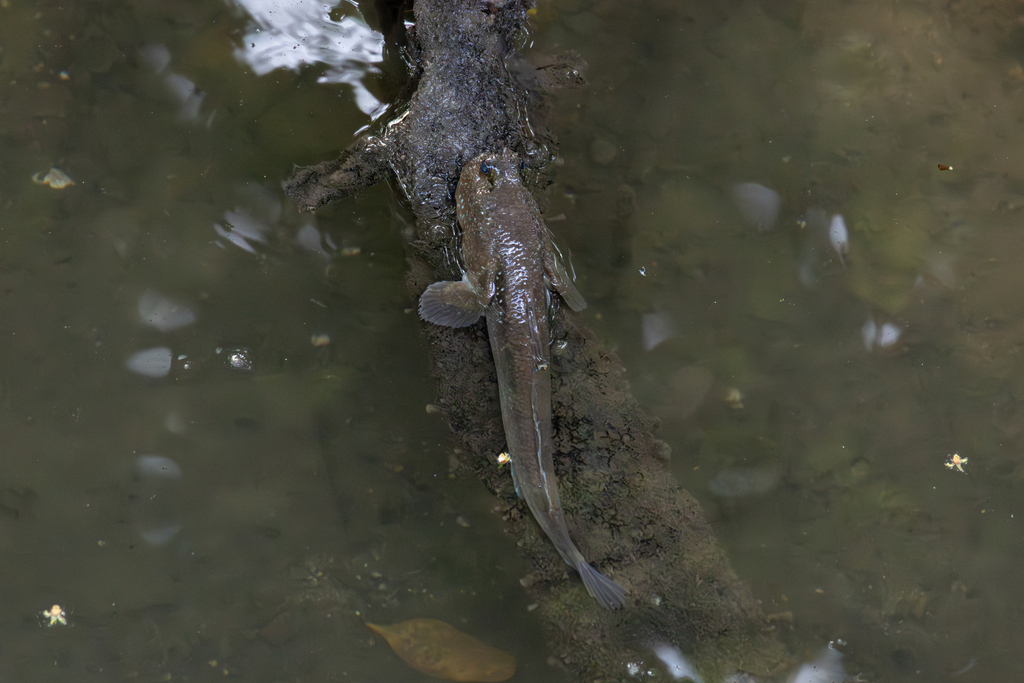
The giant mudskipper (Periophthalmodon schlosseri) breathes through its moist skin, walks using muscular pectoral fins, and sees better in air than water. It spends more time on land than in the sea, nests in mud burrows with sealed air pockets, and is a living demonstration of how independent evolution finds the same solutions.
Most fish spend their entire lives avoiding the air. The mudskipper went the other way. Walk a mangrove estuary in Southeast Asia at low tide and the mud is alive with fish, dozens of them, crawling across exposed roots, displaying from mud mounds, dragging themselves up tree roots several metres above the waterline. Each one is a mudskipper, and each one is doing something no ordinary fish is equipped to do.
The anatomy of land locomotion
Fish fins are controlled by arrays of small bones called radials and are normally used for steering in water. The giant mudskipper's pectoral fins are different: short, muscular, arm-like, with a distinct joint that allows the fin to plant on a surface and bear the animal's weight. The fin tips have an elbow-like bend that pushes into the mud.
On land the mudskipper moves by planting both pectoral fins simultaneously and swinging its body forward between them, a movement called crutching. It is slow and deliberate on firm ground. For faster travel or display, it uses a tail skip: coiling the tail against the substrate and launching the body briefly into the air. An alarmed mudskipper can cover a metre in a single skip and chain several together for a rapid escape.
Climbing is also possible. The giant mudskipper regularly ascends mangrove prop roots using its fins and tail, reaching heights of several metres above the mud. This is not incidental; elevated perches are territory markers, and the most prominent root gets the best view.
How a fish breathes air
This is where things get genuinely unusual. The mudskipper breathes through three surfaces simultaneously when on land:
- The skin: the body surface is densely supplied with capillaries. Gas exchange (oxygen in, carbon dioxide out) takes place directly across the moist skin, a process called cutaneous respiration. The skin must remain wet for this to work.
- The gill chamber: the mudskipper keeps its gill chamber (the space behind the mouth that normally holds water for gill ventilation) filled with a bubble of air. The gills stay moist and extract oxygen from this trapped bubble.
- The mouth lining: the roof and sides of the mouth are also vascularised and contribute to gas exchange.
The fish manages hydration by regularly returning to water, rolling in wet mud, or flicking itself with its tail. A mudskipper that dries out dies quickly: the respiratory surfaces collapse and gas exchange stops. This is the hard limit on how far from water it can venture.
Eyes evolved for a different world
Most fish eyes are optimised for underwater vision, where light refracts differently. Mudskippers have inverted this. Their eyes sit high on the skull and can be retracted into moist sockets to prevent drying. When extended, they are shaped to focus in air, not water. A mudskipper's aerial vision is sharp and long-range; its underwater vision is poor.
The eyes can swivel nearly independently, giving a wide field of view for spotting rivals, predators and mates on an open mudflat. This level of aerial situational awareness is unique among fish, and it works because the mudskipper's daily life takes place almost entirely in the open air.
The comparison with the panther chameleon is instructive: both animals have independently evolved independently-moving eyes on top of the head as a solution to the problem of a predator that lives in a landscape where threats come from multiple directions.
Mud burrows and the air pocket
The mudskipper does not simply live on the surface. The male excavates a burrow into the mud, sometimes 30 cm deep, which he guards fiercely and which serves as both den and nursery. The critical innovation is what is inside: an air pocket at the bottom of the burrow, maintained by the male physically transporting mouthfuls of air from the surface and releasing them underground.
Eggs are laid in the burrow and attach to the walls. The embryos breathe the air in the pocket. Without the male's maintenance behaviour, the pocket collapses and the embryos suffocate. No other fish builds a structure to supply air to eggs; it is a behavioural solution to the same problem that all terrestrial egg-layers solved structurally: keeping eggs viable in oxygen-rich but water-poor conditions.
The evolutionary context
It is tempting to see the mudskipper as a living intermediate, a fish partway through the evolutionary transition to land. The actual picture is more nuanced. The first terrestrial vertebrates appeared around 375 million years ago. They descended from lobe-finned fish (Sarcopterygii) such as Tiktaalik, not from the ray-finned fish (Actinopterygii) that mudskippers belong to. Those two lineages split more than 400 million years ago.
What mudskippers represent is convergent evolution: a completely separate lineage arriving at similar solutions to the same problem through independent means. Breathe through the skin, keep the respiratory surface wet, use the paired fins for locomotion, protect eggs in an air-filled space. The same adaptive pressures on a tidal mudflat produce the same toolkit, regardless of ancestry.
This is why mudskippers matter for biology. They are not a window back to our own origins. They are a working model of what the challenges of the water-to-land transition actually demanded, built in a modern animal we can watch in real time.
For comparison, the ribbon eel demonstrates a different axis of biological possibility: sequential sex change. The Atlantic salmon shows another: navigating thousands of kilometres by stored chemical memory. All three are fish, all three have taken a path almost no other vertebrate follows.
Where to find mudskippers
Mangrove estuaries and tidal mudflats of South and Southeast Asia, from the coasts of India, Bangladesh, Thailand, Malaysia, Indonesia, the Philippines and southern China. Also present along the west coast of Africa in similar habitats, and in parts of northern Australia. Low tide is the time to visit: when the mud is exposed, the mudskippers come out. They are most active and visible during the warmest hours of the day when competitors for territory are displaying.
The giant mudskipper is Rare tier in the Kaught catalog, two diamonds out of four. The tier reflects observation frequency. Mudskippers occupy a specific, limited habitat in a coastal tidal zone, and encounters require visiting the right estuary at the right tide. They are not secretive when present; they are simply not everywhere.
Mudskippers: frequently asked questions
How do mudskippers breathe on land?
Through their moist skin and through a bubble of air kept in the gill chamber. Both surfaces must stay wet. On land the mudskipper regularly wets itself or returns to water to keep the skin and gills moist, as cutaneous respiration stops the moment the skin dries out.
How do mudskippers move on land?
By crutching: planting both muscular pectoral fins on the mud and swinging the body forward between them. For faster movement, a tail skip launches the body briefly airborne. The fins have a distinct joint that allows them to bear weight, unlike the fins of most fish.
What is the mudskipper related to?
To gobies: they belong to the family Gobiidae, subfamily Oxudercinae. They are ray-finned fish (Actinopterygii), not related to the lobe-finned fish lineage that gave rise to land vertebrates. Their land adaptations evolved independently, as a parallel solution to the same challenges.
Where do mudskippers live?
Mangrove estuaries and tidal mudflats across South and Southeast Asia, west coastal Africa and northern Australia. They live exclusively in the tidal zone, spending the exposed low-tide period on the mud and retreating to burrows or water when the tide returns.
Why can mudskippers see better in air than water?
Their eyes evolved for aerial vision: the lens and cornea are shaped to focus in air, not water. The eyes sit on top of the skull, can be retracted into moist sockets to prevent drying, and swivel independently for a wide field of view. In water their vision is actually poor.
What is the mudskipper's rarity tier in Kaught?
Rare, two diamonds out of four. The tier reflects how often the species is observed in the wild. Mudskippers live in a specific tidal habitat in a limited geographic range; encountering one requires going to the right kind of mangrove estuary at low tide. They are conspicuous when present, just not present everywhere.
The next thing you see could be
your first catch.
Kaught is live on the App Store and Google Play. Free to start, and your first catch is one photo away.
Free to start · Live on the App Store and Google Play
Species data, type, rarity tier and measurements, is drawn from the Kaught catalog, built on open biodiversity records from GBIF and iNaturalist. Rarity reflects how often a species is observed in the wild, not its conservation status.