
Legendary spotlight
Morepork: New Zealand's last native owl
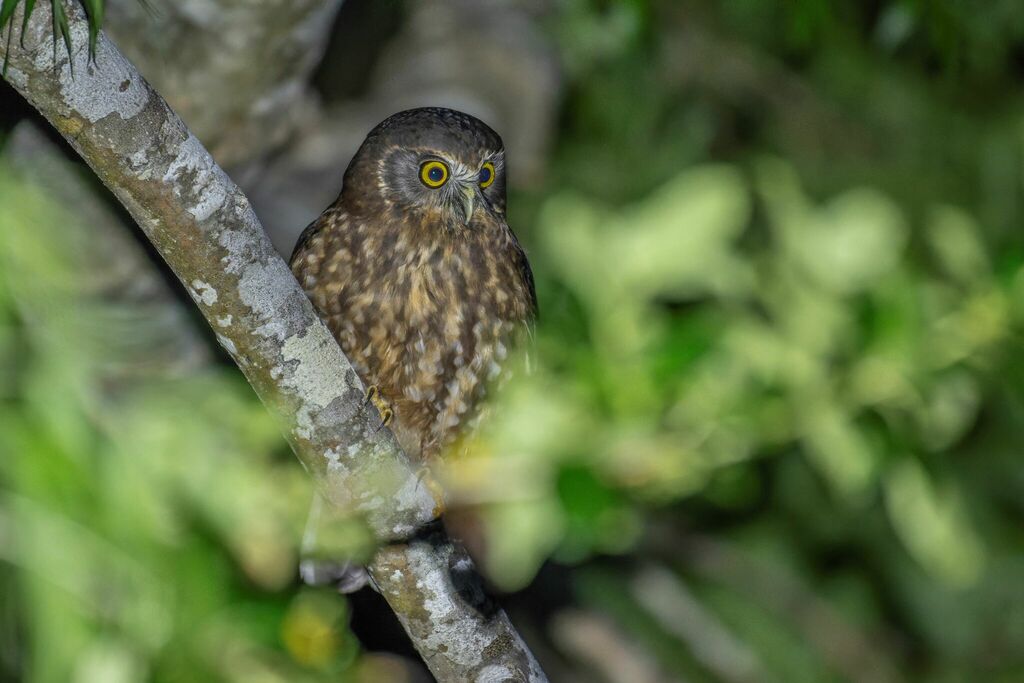
The morepork (known in te reo Maori as ruru) is the only owl native to New Zealand that is still alive. It weighs about 160 g, hunts insects, weta and lizards by night, and names itself with a two-note call that has given it the same phonetic name in two languages. It is Legendary tier in the Kaught catalog and one of the most culturally significant birds in New Zealand.
Morepork
Ninox novaeseelandiae
- Type
- Bird · Nocturnal
- Rarity
- Legendary
- Size
- 26–29 cm
- Weight
- 150–170 g
- Habitat
- Native forest, scrub and suburban bush, New Zealand and Tasmania
- Activity
- Nocturnal, solitary
Field marks: how to identify a morepork
The morepork is a small, compact owl, 26 to 29 cm from bill to tail, roughly the size of a large thrush. The plumage is dark brown overall with pale buff-white spots and streaks across the breast and upperparts, giving a heavily dappled appearance that provides excellent camouflage against bark and dense foliage in daylight. The face is round, with a prominent facial disc in shades of brown, and the eyes are large, forward-facing and distinctly yellow, bright enough to catch a torch beam at distance in the dark.
The bill is strongly hooked, dark grey, and shorter than in most larger owls. The legs are feathered to the feet. In flight, the morepork appears compact and rounded, with silent wingbeats produced by the comb-like leading edge to the primary feathers that is characteristic of all owls. The tail is banded brown-and-buff. Males and females are similar in plumage; females are slightly larger.
The most reliable way to detect a morepork is by call rather than sight. The bird is active from dusk to well after midnight and is rarely seen perched in daylight except in the breeding season when nest-attending birds may sit in tree cavities visible from below.
The call: where the name comes from
The morepork's primary call is a two-note whistle that sounds immediately and unambiguously like "more-pork", with the second note higher in pitch. This is the territorial and contact call, repeated at intervals of a few seconds throughout the night from a perch in the upper canopy. A secondary call, a sharper single "qui" note, is used as an alarm call. Both sexes call, but males are more persistent, particularly through the spring and early summer breeding period.
The Maori name ruru renders the same call in Maori phonetics: the two syllables of "ru-ru" represent the same double note that English listeners hear as "more-pork." The convergence of two naming traditions on the same acoustic origin, independently, reflects how distinctive and consistent the call is. The call carries well through dense native forest and can be heard several hundred metres away on still nights.
Hunting: ambush from the canopy
The morepork is a nocturnal ambush hunter. It locates prey using a combination of its large forward-facing eyes, which provide significant binocular overlap and good low-light sensitivity, and acute directional hearing. Like all owls, the morepork's facial disc functions as a parabolic sound collector, funnelling sound to asymmetrically positioned ear openings that allow it to triangulate sound in three dimensions. It can detect the position of a weta moving under leaf litter in near-darkness.
Hunting technique is a silent, still wait from a perch followed by a controlled drop to seize prey below. The morepork does not hover and does not pursue prey in sustained flight the way some larger owls do. It relies on the first silent strike. The talons are used to grip and kill; the hooked bill tears prey for consumption.
Diet: weta, lizards, small birds
The morepork's diet is broadly invertebrate, with large nocturnal insects forming the core. Weta, large native New Zealand crickets that can weigh 35 g or more, are a significant prey item and are sized to the morepork's carrying capacity. Beetles, moths, and other large-bodied invertebrates are taken regularly. The proportion of invertebrates versus vertebrates in the diet varies by season and location.
Lizards are taken, including geckos and small skinks. Small birds and their eggs or nestlings are occasionally taken, including introduced species in suburban settings. Where mice and rats are present due to introduction, the morepork takes them, which has a mixed ecological effect: it reduces rodent pressure on native invertebrates but creates a dependency on an introduced food source.
The large weta species, including the various giant weta (Deinacrida), are now much rarer than they were before human settlement due to introduced predators and habitat loss. The morepork's dietary flexibility, its ability to shift from weta to mice when the former are scarce, is one of the reasons it survived when other native predators could not.
The laughing owl: what the morepork outlived
New Zealand's pre-human fauna included several owl species that are now extinct. The most recent to disappear was the laughing owl (Sceloglaux albifacies), a larger and more terrestrial owl that the Maori called whekau. The laughing owl went extinct around 1914. The last confirmed specimen was collected in 1914 in Canterbury; unverified sightings continued into the 1920s but were never confirmed.
The laughing owl's extinction is attributed to the same combination of factors that drove many New Zealand bird extinctions after European settlement: introduced stoats, ferrets, cats and rats that predated eggs and chicks; habitat conversion of the grassland and rocky terrain it depended on; and direct persecution. The laughing owl was a ground-level predator that nested in rock crevices, which made its eggs and chicks directly accessible to introduced mammals in a way that the tree-nesting, smaller morepork was not.
The morepork survived because it nests in tree cavities above ground level and is small enough to be partially adapted to secondary and suburban habitats. It has established itself in some New Zealand city parks and gardens, where it is heard on most clear nights but still almost never seen.
Maori cultural significance: ruru as kaitiaki
In Maori tradition, the ruru carries a protective role. It is regarded as a kaitiaki, a guardian or watchful presence, and its appearance or call at unusual times has traditionally been interpreted as a sign or message. The owl's nocturnal presence, its association with the dark hours when the spirit world was considered closer, and the distinctive quality of its voice all contributed to this role.
The ruru is a recurrent figure in Maori poetry, proverb and whakatauki (saying). One of the best-known examples: "Hutia te rito o te harakeke, kei hea te komako e ko?" (Pull out the heart of the flax bush, where will the bellbird sing?) uses a similar logic of interconnected presence, and the ruru appears in comparable formulas representing watchfulness. With the laughing owl gone, the ruru is now the sole remaining owl in New Zealand's living fauna and, in that sense, the surviving representative of an entire ecological and cultural role.
Tasmania: the other morepork range
The morepork also occurs in Tasmania, where it is relatively common in forested areas and is the island's only owl. The Tasmanian population, sometimes designated as subspecies Ninox novaeseelandiae leucopsis, differs slightly in plumage tone from the New Zealand birds. The species does not occur on the Australian mainland as a breeding resident, though occasional vagrants have been recorded.
In Tasmania, the morepork occupies a similar ecological niche to the New Zealand bird: nocturnal forest predator of invertebrates and small vertebrates, calling from dusk through the night, nesting in tree hollows. The same two-note call is identifiable in Tasmania, though local acoustic environment gives it a slightly different quality. Tasmanian observers familiar with the Australian "boobook" call often note the two-note quality of the morepork as distinctly different from the mainland birds.
Rarity in the Kaught catalog
The morepork is No. 174, Legendary tier, four diamonds, the highest rarity tier in the Kaught catalog. The four-diamond rating reflects the extreme infrequency of documented wild sightings: the morepork is small, nocturnal and cryptically coloured. Even in native forest where it is certainly present, it is rarely seen in the day. Night observations require a torch, patience and some knowledge of where to look, usually near the source of the call. Photographic documentation sufficient for a verified catalog submission is genuinely rare.
Compare this to the white-tailed eagle, which is also difficult to observe but is large, diurnal and visible over open water; the morepork's nocturnal and arboreal lifestyle places it at a significantly higher difficulty threshold for a successful catch. The mudskipper article discusses another highly unusual animal whose behavior makes it difficult to observe in its natural context.
Morepork: frequently asked questions
Why is it called a morepork?
The name morepork is a phonetic rendering of the bird's two-note call, which sounds to English-speaking listeners like "more-pork." In te reo Maori, the same bird is called ruru, which renders the same call in Maori phonetics. Both names have the same origin: the call itself, repeated from dusk until late in the night.
Is the morepork the same as a boobook?
Closely related but currently classified as separate species. The New Zealand morepork is Ninox novaeseelandiae; the Australian southern boobook is Ninox boobook. The two were long treated as one species. The Tasmanian population is now considered a separate subspecies of the morepork. "Boobook" refers to the Australian birds; "morepork" to the New Zealand bird.
What does the morepork eat?
Primarily large invertebrates: weta, beetles, moths and other nocturnal insects. It also takes lizards, small birds and small mammals where available. It hunts by perching silently and dropping onto detected prey, using its large eyes and acute directional hearing to locate animals in near-darkness.
Is the morepork found outside New Zealand?
Yes, the morepork also occurs in Tasmania, where it is the island's only owl. The Tasmanian population is sometimes classified as a separate subspecies. Occasional vagrants have been recorded in mainland Australia but it is not established there.
What is the Maori significance of the morepork?
In Maori tradition, the ruru is a kaitiaki, a guardian or watchful presence. Its call at night was read as a sign or message, and its appearances were considered meaningful. With the laughing owl extinct since around 1914, the morepork is now the only representative of that ecological and cultural role still present in the New Zealand night.
What happened to New Zealand's other owls?
The laughing owl (Sceloglaux albifacies) went extinct around 1914 due to introduced mammalian predators, habitat loss and direct persecution. It was a ground-level predator nesting in rock crevices, which made its eggs and chicks accessible to stoats, ferrets, cats and rats. The morepork survived by being smaller, tree-nesting and adaptable enough to use secondary and suburban habitats.
The next thing you see could be
your first catch.
Kaught is live on the App Store and Google Play. Free to start, and your first catch is one photo away.
Free to start · Live on the App Store and Google Play
Species data, type, rarity tier and measurements is drawn from the Kaught catalog, built on open biodiversity records from GBIF and iNaturalist. Rarity reflects how often a species is observed in the wild, not its conservation status.