
Adaptation explainer
Tokay Gecko: the Lizard That Climbs Glass With No Glue at All
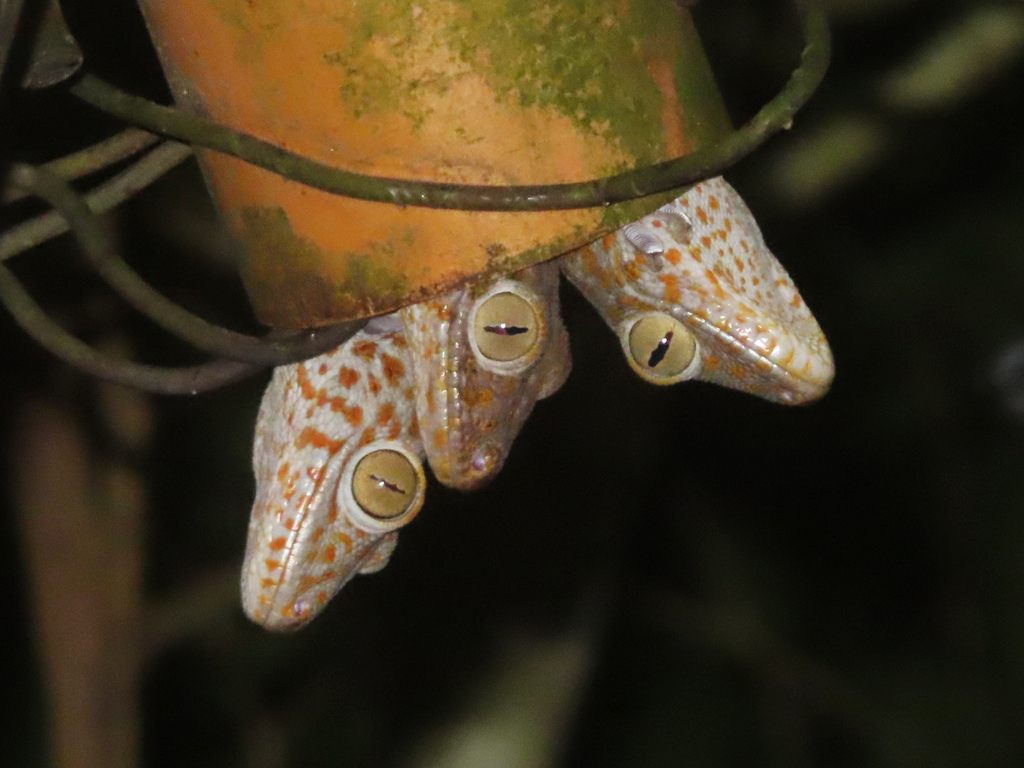
Geckos stick to walls using roughly half a million microscopic hairs (setae) on their toes, each splitting into hundreds of even smaller pads (spatulae). Packed that densely, they come close enough to a surface for van der Waals force, a weak molecular attraction, to add up to a grip strong enough to hold the whole animal upside down, no glue or suction involved.
Watch a tokay gecko cross a window pane at night and the obvious question is never "what is that," it's "why isn't it falling." No claws dig in. No visible fluid oozes from its toes. It simply walks across smooth glass, upside down if it has to, as if gravity had quietly stopped applying to its feet. The real answer turns out to be stranger and far more precise than glue: it's physics happening half a billion times over, on every step.
What is a tokay gecko?
The tokay gecko is one of the largest gecko species alive, a stout, big-headed lizard native to rainforest trees and cliffs across South and Southeast Asia, from India to Indonesia, with introduced populations now established in Florida and parts of the Caribbean. Males run 30-40 cm long and noticeably bulkier than females, which usually top out around 20-30 cm. Its skin is blue-grey to slate, scattered with bright orange-red spots, and its large, lidless eyes carry a vertical pupil built for hunting in the dark.
It takes its name from its call, a loud, barking "to-kay, to-kay" that carries for several metres and gives away a territory long before the lizard itself comes into view. Nocturnal and strongly territorial, it spends the day wedged into a crevice or roof gap, then emerges after dark to hunt insects, spiders and the occasional small vertebrate drawn in by porch lights and bare bulbs, which is exactly how so many city-dwellers across its range end up sharing a ceiling with one.
How does a gecko's foot actually stick?
Under a microscope, a gecko's toe pad isn't smooth at all. It's covered in row upon row of hair-like bristles called setae, and a tokay gecko carries roughly half a million of them across its four feet. Each seta then splits at its tip into anywhere from 100 to 1,000 even finer structures called spatulae, flattened pads just tens of nanometres across. Multiply that out and a single gecko's feet hold somewhere close to a billion of these tiny contact points.
Pack that many microscopic pads against a surface and something unusual happens: the spatulae get close enough, at the molecular scale, for van der Waals force to kick in, a weak attraction between molecules that exists everywhere but is normally far too small to matter. One spatula contributes almost nothing. A billion of them, all in intimate contact at once, add up to a grip strong enough to support the gecko's full body weight on a single toe, with no sticky secretion, no suction cups and no mechanical hooking into the surface at all.
Why doesn't it stay stuck forever? The peeling trick
An adhesive that strong would be useless if the gecko couldn't let go in a hurry, and a gecko crossing a ceiling needs to detach and reattach each foot dozens of times a second. The release mechanism is almost as elegant as the grip: the gecko peels each toe upward from the tip, curling it back the way a piece of tape is lifted rather than pulled straight off. That changes the angle of the setae past a critical threshold, and the adhesive force collapses almost instantly, letting the foot swing free for the next step.
It's this peel-and-reset cycle, not brute strength, that lets a tokay gecko sprint across a vertical trunk or a window frame at genuine speed. The same toolkit for solving a hard physical problem with hardware rather than muscle shows up elsewhere in the lizard world; the frilled dragon opens an entire fan of skin with two hinged bones, and the common basilisk uses its hind feet to slap across open water, three very different mechanical tricks built from the same basic reptile parts.
Why doesn't dirt clog the system?
A billion microscopic pads sound like a dust magnet, and gecko feet do pick up particles as they walk. But researchers studying the mechanism found that the same hyperextending motion used to detach each toe also flicks debris off the setae as it happens. In lab tests, geckos regained roughly 80 percent of their original stickiness within about four ordinary steps, with no grooming, licking or dedicated cleaning behaviour needed. The grip effectively cleans itself as a side effect of walking.
What a gecko's foot can't do
The system has real limits, which is part of how scientists confirmed van der Waals force was the explanation in the first place rather than suction or static electricity. Adhesion drops off sharply underwater, since water molecules get between the spatulae and the surface and disrupt the effect. And on Teflon, a coating specifically engineered to have almost no surface energy for other molecules to attract to, a gecko's grip barely works at all, even though the surface looks just as smooth as glass to the eye.
Humans are still trying to copy it
Gecko adhesion has become one of biology's favourite templates for engineers. So-called "gecko tape," built from synthetic setae-like micro-structures, aims for the same trick nature pulled off first: a bond strong enough to hold real weight, yet one that releases cleanly and can be reused thousands of times without leaving residue, unlike almost any adhesive humans had built before studying the lizard's foot. It's one more entry in a long list of real animal abilities that sound invented until you check the source, cataloged alongside stranger tricks in our roundup of animal abilities that sound impossible.
Is the tokay gecko dangerous?
Not venomous, but not exactly gentle either. Tokay geckos are famously short-tempered for a gecko, and a cornered or handled individual will bite hard with its strong jaws, often holding on rather than letting go. The bite can draw blood but carries no toxin and poses no serious medical risk, it's a defensive reflex from an animal that would much rather be left alone on its wall. For a fuller sense of how strange real lizard biology gets, see our list of the weirdest animals in the world.
How rare is the tokay gecko in Kaught?
In the Kaught catalog the tokay gecko sits at the Common tier, one diamond out of four. That reflects how often it's actually recorded, not how interesting it is: a loud call, a large body and a habit of moving into houses across its range all make it one of the more frequently logged reptiles people encounter, in sharp contrast to a species like the desert monitor, which earns a Legendary tier for being genuinely hard to find rather than hard to notice once it's there.
Three things that make gecko feet stranger than they look
- A single seta's adhesive force is tiny, around 20-40 micronewtons, but multiplied across roughly a billion spatulae per gecko, the combined grip comfortably supports the animal's full weight on one toe.
- The release mechanism works by angle, not force: peel a toe past its critical detachment angle and the adhesion switches off almost instantly, which is why a gecko can run at speed without ever getting stuck.
- The same foot that grips glass fails almost completely on Teflon, a surface engineered specifically to defeat the molecular attraction the gecko relies on.
Tokay gecko: frequently asked questions
How do geckos stick to walls?
Their toes are covered in hundreds of thousands of microscopic hairs called setae, each tipped with hundreds of even smaller pads called spatulae. Packed this densely, the spatulae come close enough to a surface for van der Waals force, a weak molecular attraction, to add up to a powerful grip.
What are gecko setae made of, and how many does a gecko have?
Setae are made of keratin, the same protein as hair and claws. A tokay gecko carries roughly half a million of them across its four feet, each one splitting into 100 to 1,000 spatulae, for a total approaching a billion contact points.
Can geckos stick to any surface, like glass or wet rock?
Almost any smooth, dry surface, including glass, which is exactly why geckos can cross a window pane upside down. Adhesion drops sharply underwater and the system barely works at all on Teflon, whose very low surface energy defeats the van der Waals effect.
How does a gecko release its grip to run so fast?
It peels each toe upward from the tip, changing the angle of its setae past a critical point where the adhesive force switches off almost instantly. That peeling action, not raw muscle, is what lets a gecko detach and reattach dozens of times a second.
Do gecko feet get dirty, and how do they stay sticky?
They do pick up dust, but every step flexes the toes in a way that flings loose particles off the setae. Researchers measured geckos regaining about 80 percent of their original stickiness within four ordinary steps, with no cleaning behaviour required.
Is the tokay gecko dangerous to humans?
It carries no venom, but it is famously bad-tempered. Handled or cornered, a tokay gecko bites hard with its strong jaws and will often refuse to let go, which draws blood more often than it causes any real harm.
Why is the tokay gecko "Common" in Kaught?
Kaught's rarity tiers track how often a species is actually recorded, not its biology. Tokay geckos are loud, large, and happy to live on the walls of houses across South and Southeast Asia, so sightings are frequent, placing it at the Common tier.
The next thing you see could be
your first catch.
Kaught is live on the App Store and Google Play. Free to start, and your first catch is one photo away.
Free to start · Live on the App Store and Google Play
Species data, type, rarity tier and measurements, is drawn from the Kaught catalog, built on open biodiversity records from GBIF and iNaturalist. Rarity reflects how often a species is observed in the wild, not its conservation status.