
Adaptation explainer
Frilled Dragon: the lizard that opens an umbrella of skin to scare you off
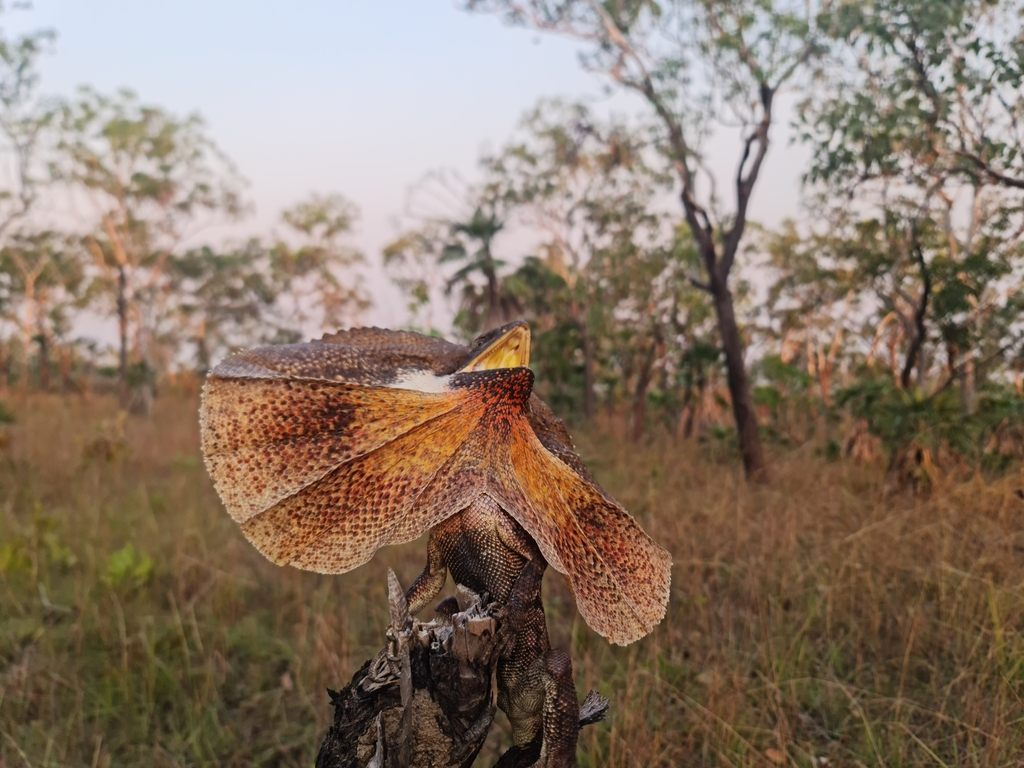
The frilled dragon (Chlamydosaurus kingii) is an Australian lizard that snaps open a huge neck frill, up to 30 cm wide, in a fraction of a second to look bigger and scarier. If the bluff fails, it rises onto its hind legs and sprints for the nearest tree.
Most lizards try not to be noticed. The frilled dragon does the opposite. Startled on its tree trunk, it spins to face the threat, gapes a bright pink or yellow mouth, and snaps open a disc of skin around its neck nearly as wide as its own body. For a split second it looks less like a lizard and more like a small, furious umbrella. Here's how the trick actually works, and why it only goes this far when it has to.
What is a frilled dragon?
The frilled dragon is the only member of its genus, a member of the dragon lizard family (Agamidae) native to the open eucalypt woodland and monsoon forest of northern Australia and southern New Guinea. It spends most of its life vertical, clinging motionless to a tree trunk or branch, where its mottled grey-brown skin reads as bark to almost anything passing below. Total length, including the long tail that makes up most of it, runs 70–95 cm; males, noticeably bulkier than females, can weigh twice as much at around 900 g against a female's 450 g.
It descends to the ground to hunt, mostly for ants, termites, beetles and spiders, and occasionally another small lizard, then climbs straight back up. For almost all of that time, the frill stays folded flat, an unremarkable ruff of skin against its shoulders. Nobody would call it a dragon until it decides to become one.
How does the frill actually open?
The frill isn't muscle, and it doesn't billow open the way a cape catches wind. It's a fold of skin stiffened by two long, rod-like hyoid bones (part of the same hyoid apparatus every reptile uses to support its tongue), plus a pair of supporting cartilages known as Grey's cartilages. In a resting lizard, those rods lie folded back against the throat. The instant the lizard opens its mouth wide, the hyoid bones and cartilages swing forward together, and the whole fan of skin snaps taut in well under a second, not unlike yanking open a collapsed umbrella by its spokes.
Spread fully, the frill can reach roughly 30 cm across, bordered in pale scales with a core of vivid orange and red, coloured by pigments called carotenoids, the same family of pigments behind a flamingo's pink or a robin's orange breast. Against the washed-out browns of a dry woodland, that sudden flash of colour is most of the point.
Why does it bother at all?
The full display, gaping mouth, spread frill, raised body, hissing, sometimes a lifted tail, is what biologists call a deimatic display: a bluff designed to startle a predator, such as a dingo, a bird of prey or a snake, into hesitating just long enough for the lizard to make its real move. A frilled dragon with its frill open isn't attacking. It's trying to end the encounter without a fight, by looking suddenly, briefly, much too dangerous to bother with.
Males use a gentler version of the same toolkit on each other and on prospective mates: a smaller, repeated partial flaring of the frill paired with head-bobbing, tail-lashing and forelimb waving, more a stereotyped signal than a genuine threat. The same hardware, tuned down, doubles as a social semaphore.
When the frill isn't enough: the bipedal sprint
A startle display only buys time. If a predator keeps coming, the frilled dragon drops its frill, drops onto all fours for an instant, and then does something stranger still: it rises onto its hind legs alone, forelimbs lifted clear of the ground, tail raised behind it as a counterbalance, and sprints for the nearest tree trunk at speeds approaching 9 mph. Scientists estimate the upright posture raises its stride length and shifts its centre of mass forward over longer back legs built for exactly this.
It isn't the only lizard with this trick. The common basilisk of Central America uses a near-identical bipedal gait to sprint across open water, a case of two unrelated lizard lineages arriving independently at the same four-legs-to-two-legs solution under pressure, real convergent evolution rather than a shared ancestor. Australia's deserts hold another Agamidae oddity worth a detour too, the spine-covered thorny devil, proof the family's solutions to predators rarely look alike twice.
Is the frilled dragon dangerous?
Not to people. It carries no venom, and the entire performance, frill, gape, hiss, is a bluff aimed at looking dangerous rather than being it. Cornered and handled roughly it may deliver a startled nip, but given any opening at all it will choose the tree over a fight, every time. For more animal abilities that sound invented until you check the source, see our roundup of animal abilities that sound impossible.
How rare is the frilled dragon in Kaught?
In the Kaught catalog the frilled dragon sits at the Rare tier, two diamonds out of four. That's a statement about how often it's actually confirmed in the field, not about its biology: for all its colour when displayed, a frilled dragon spends nearly its whole life pressed flat and still against bark it matches almost perfectly, only breaking cover when threatened or hunting. A clear sighting, let alone one mid-display, takes real luck. It's one more entry in a catalog full of species that look ordinary right up until they don't, alongside stranger company still in our list of the weirdest animals in the world.
Frilled dragon: frequently asked questions
Why does the frilled dragon open its frill?
To look bigger and more dangerous than it actually is. Facing a predator or rival, it gapes its mouth, fans its neck frill wide, raises its body and hisses, a bluff meant to end the encounter before it has to fight or flee.
How does the frilled dragon's frill actually open?
The frill is a fold of skin stiffened by two long rod-like hyoid bones and a pair of supporting cartilages in the throat. Opening the mouth pulls these bones forward, snapping the whole fan open in a fraction of a second.
How big does a frilled dragon's frill get?
Fully spread, the frill can reach roughly 30 cm across, nearly as wide as the lizard is long from nose to vent. The scales are often bright orange or red from pigments called carotenoids, bordered by a pale edge.
Can frilled dragons really run on two legs?
Yes. If the frill display doesn't deter a threat, a frilled dragon drops onto its hind legs, lifts its forelimbs clear of the ground, and sprints for the nearest tree, using its long tail as a counterbalance.
Is the frilled dragon dangerous to humans?
No. It has no venom and its frightening display is a bluff, not a prelude to attack. Left alone it will almost always choose to flee up a tree rather than confront a person, and bites are rare even when handled.
Why is the frilled dragon "Rare" in Kaught?
Kaught's rarity reflects how often a species is actually recorded, not its biology. A frilled dragon spends most of its life motionless on a tree trunk, bark-coloured and still, so a confirmed sighting is uncommon even where the species itself is widespread.
The next thing you see could be
your first catch.
Kaught is live on the App Store and Google Play. Free to start, and your first catch is one photo away.
Free to start · Live on the App Store and Google Play
Species data, type, rarity tier and measurements, is drawn from the Kaught catalog, built on open biodiversity records from GBIF and iNaturalist. Rarity reflects how often a species is observed in the wild, not its conservation status.