
Adaptation explainer
How does the basilisk lizard walk on water? It sprints faster than it sinks.
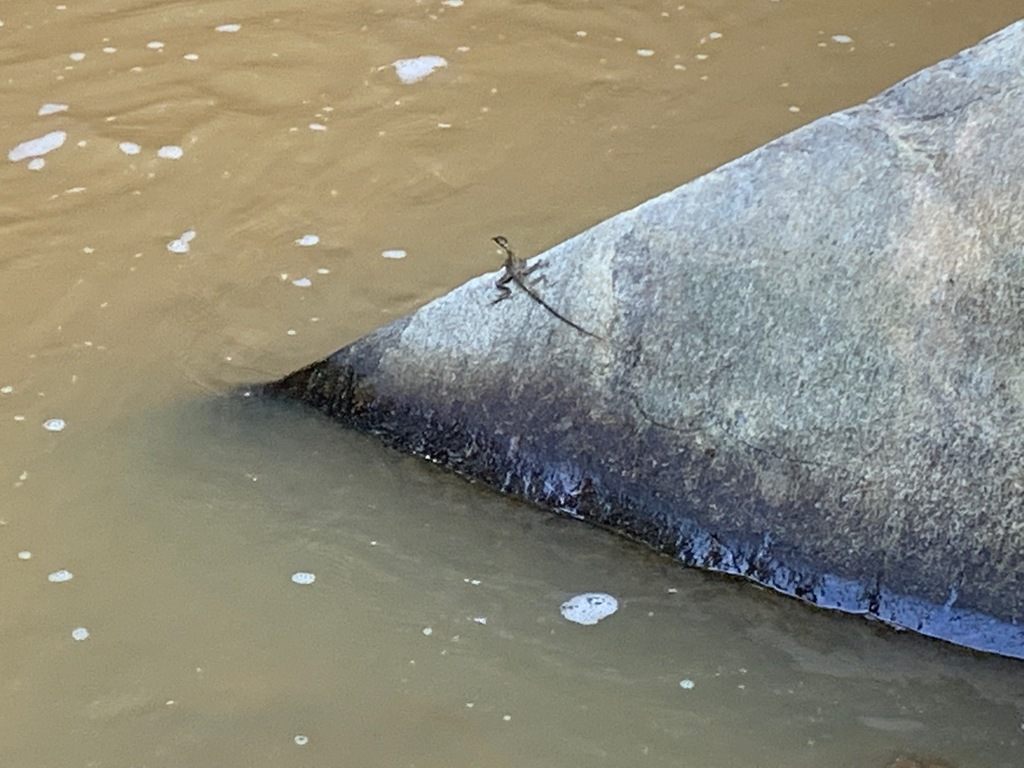
The common basilisk (Basiliscus basiliscus) runs across open water on its hind legs alone, slapping long, fringed toes flat to trap a pocket of air and pushing down before the surface can give way. Hatchlings cover 10 to 20 metres this way; heavier adults typically manage only a few before they sink and swim.
Startle a common basilisk on a riverbank in Central America and it does not scramble for the nearest branch. It goes the other way, straight off the bank and onto the surface of the water, upright on its hind legs, crossing open river the way everything else in the forest has to swim it. The trick has earned it a nickname long before biologists worked out how it actually happens: the Jesus Christ lizard.
How the basilisk lizard runs on water
Water-running is not a single motion. High-speed film of the common basilisk's stride breaks it into three phases, each doing a different job:
- The slap. The foot comes down flat and fast, peak velocity around 3.75 metres per second, and the impact alone generates roughly 15 to 30% of the force needed to keep the lizard up.
- The stroke. The foot then drives straight down through the surface, punching an air cavity beneath it. Pushing against that pocket of trapped air and displaced water supplies most of the remaining lift and forward thrust.
- The retraction. Before the cavity can collapse and drag the foot back down with it, the lizard yanks the leg clear and swings it forward for the next slap.
None of it works without the feet themselves. Long fringes of skin run along the third, fourth and fifth toes, folded flat while the lizard is on land. The instant it hits water they unfurl, roughly doubling the surface area of each foot and turning a narrow toe into something closer to a paddle.
The forces involved, and why adults sink but hatchlings don't
To stay above the surface rather than punching straight through it, a basilisk has to generate force with each stride worth several times its own body weight, by some estimates up to 15 times over. For comparison, matching that ratio at human scale would mean sprinting at something over 100 km/h, well beyond even the sprint speeds of the fastest animals in the world.
That requirement scales badly with size. A lizard's weight increases roughly with the cube of its length as it grows, but the force its relatively small feet can slap and push against the water does not keep pace. The result is a hard ceiling written into basic physics: hatchling basilisks, at only a couple of grams, can sprint 10 to 20 metres across open water before finally breaking through. Full-grown adults, which can weigh well over a hundred grams, are usually down to a few metres before gravity wins.
It is the same scaling problem the common water monitor never has to solve, since it swims rather than sprints across the surface, and a useful reminder that a "superpower" in a small animal often does not translate cleanly to a bigger one.
What happens once it sinks
Sinking is not really a failure mode for this lizard. The common basilisk is an accomplished swimmer, using its laterally flattened tail and the same fringed toes to move through open water, and it will happily dive and swim rather than run when the distance is too far to cross on the surface. Once submerged, it can also sit still and wait, commonly cited as able to stay underwater for up to half an hour, effectively turning "sink" into a second escape option rather than a setback.
Where to find a common basilisk
The species is native to a band of Central American rainforest from southwestern Nicaragua down through Panama and into northwestern Colombia and Venezuela, almost always found within easy reach of the rivers and streams it depends on, from sea level up to around 600 metres. It has also turned up in South Florida, most likely via the pet trade.
Away from the water it is an equally capable climber, spending time in low branches and streamside vegetation. Diet is broadly omnivorous: insects such as beetles and dragonflies, flowers, and, for a lizard with the size and speed to manage it, the occasional small vertebrate including fish, frogs and even birds' eggs. Males carry the tall, fin-like head and back crest that gives the whole genus its name, after basilískos, Greek for "little king"; females are crestless or nearly so.
Three things worth knowing about the basilisk lizard
- Four basilisk species exist across Central and South America, and each one runs on water using the same fringed-toe mechanism, so the trick is a genus-wide trait, not a one-off.
- A basilisk's water sprint is a last resort, not routine transport. Most daily movement is on land or in the trees; the water dash only comes out when something is chasing it.
- The thorny devil and the basilisk both solve survival problems with skin engineering rather than muscle, one channelling water through capillary grooves, the other unfurling toe fringes, a reminder that reptile skin does far more than just cover the animal. The panther chameleon takes the same idea further still, building colour itself into its skin.
Basilisk lizard: frequently asked questions
How does a basilisk lizard walk on water?
It runs, not walks, using its hind legs alone in a three-part stride: a slap that flattens its long, fringed toes against the surface, a downward stroke that drives an air cavity beneath the foot for traction, and a fast retraction that pulls the foot clear before the cavity collapses and pulls it under.
How fast can basilisk lizards run on water?
Around 24 km/h (15 mph), close to its running speed on land. Each footfall lands at roughly 3.75 metres per second and must generate a force many times the lizard's body weight to stay on the surface rather than punching through it.
Why do adult basilisks sink but hatchlings don't?
It is a matter of scale. A hatchling's weight grows with the cube of its length but the force its foot can generate grows more slowly, so small, light hatchlings can cover 10 to 20 metres before sinking, while heavier adults typically manage only a few metres before dropping through the surface.
Can basilisk lizards swim?
Yes, and well. Once a basilisk sinks below the surface it switches to a strong swimming stroke, and can stay submerged for extended periods, commonly cited at up to half an hour, to sit out a threat on the riverbed before surfacing again.
Are basilisk lizards dangerous to humans?
No. The common basilisk is not venomous and poses no real threat to people. It is a shy, fast-fleeing lizard that relies on speed and water to escape rather than confrontation, and it will bite only if it is caught and handled.
Why is the common basilisk "Common" in Kaught?
Kaught's rarity tier reflects how often a species is actually recorded in the wild, not whether it's endangered. The common basilisk is abundant and conspicuous along the rivers and streams of its Central American range, so sightings are reported often, placing it at the Common tier: one diamond out of four.
The next thing you see could be
your first catch.
Kaught is live on the App Store and Google Play. Free to start, and your first catch is one photo away.
Free to start · Live on the App Store and Google Play
Species data, type, rarity tier and measurements, is drawn from the Kaught catalog, built on open biodiversity records from GBIF and iNaturalist. Rarity reflects how often a species is observed in the wild, not its conservation status.