Adaptation explainer
Flying Dragon Lizard: how elongated ribs became the only vertebrate gliding wing
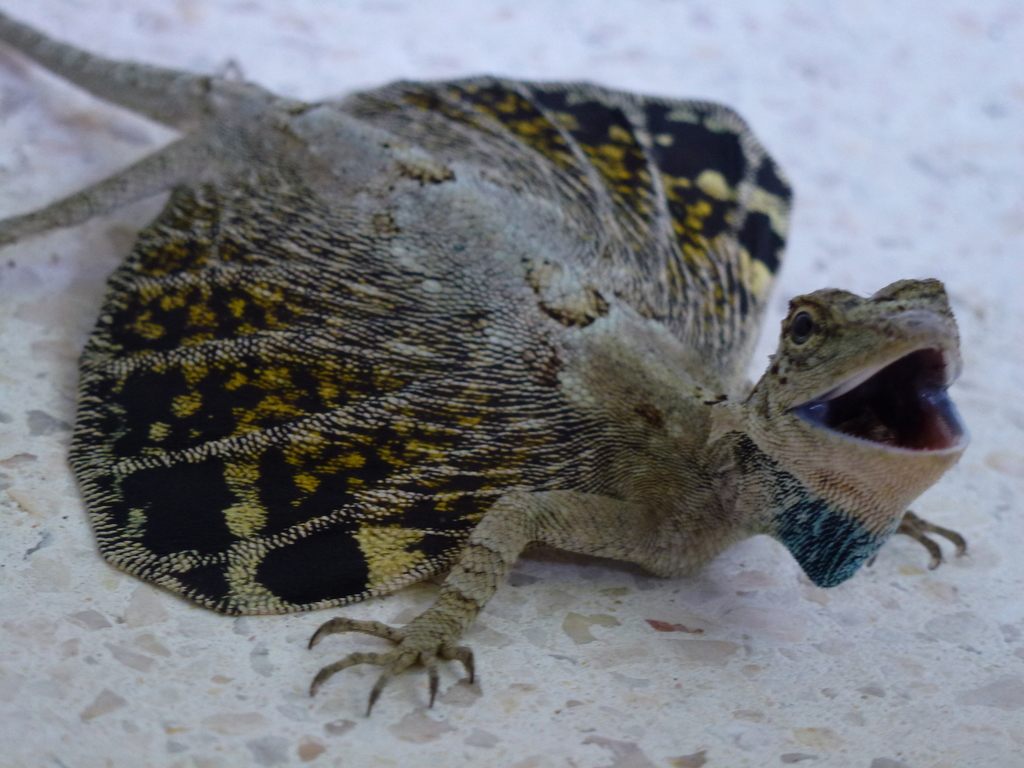
The common flying dragon (Draco volans) is the only living vertebrate that glides on stretched ribs. It extends five to seven elongated ribs like fan blades, spreading a skin membrane and gliding up to 60 m between trees with a 6:1 glide ratio.
Every vertebrate that glides uses the same basic toolkit: modified skin between limbs, stretched fingers, or extended membranes growing from the flanks. The common flying dragon did something different. It repurposed the ribs themselves, extending five to seven of them outward like the spokes of a fan and stretching a thin, colourful skin membrane between them. No other living vertebrate has taken this path.
The anatomy of a rib-wing
A Draco volans at rest looks like a plain brown lizard clinging to a trunk, roughly 15 to 20 cm of body with a tapering tail. The folded ribs lie flat against the flanks, invisible beneath the skin. Nothing about the animal at rest suggests what it does next.
When the lizard launches, it angles its body outward, contracts the muscles that hinge each elongated rib, and fans them perpendicular to the body axis. The skin membrane between them, called the patagium, snaps taut. In less than a second, the animal transforms from a static brown stick into a small airfoil patterned with orange, yellow and blue, depending on sex and population.
The glide ratio is approximately 6:1: for every metre dropped in height, the lizard travels six metres forward. From a perch 10 m up a rainforest tree, it can reach a trunk 60 m away. On landing, the ribs fold back and the creature resumes its bark-coloured stillness almost instantly.
How does it compare to other gliding animals?
The flying squirrel and the colugo glide on membranes stretched between their limbs. The paradise tree snake ripples its body into a concave aerofoil. The Wallace's flying frog uses webbed feet. All these solutions grow from limbs or skin. Only Draco recruits the skeleton directly: the ribs themselves are the wing structure.
This is why the flying dragon sits at the top of Kaught's rarity system. Kaught's Legendary tier reflects observation frequency, not comparative anatomy. But the reason the animal is genuinely hard to observe is directly connected to what it is: tiny, fast, bark-coloured, and spending most of its time pressed flat against a trunk in a rainforest canopy. You can stand beneath one for minutes without seeing it.
Territory and the dewlap display
Males hold a territory of one to three trees, which they defend by displaying their dewlap: a loose flap of bright yellow skin under the chin that they extend by pushing the hyoid bone forward. The display is rapid and conspicuous, a yellow flash against the bark, then gone. Rival males that do not retreat are chased with a gliding interception flight.
Females are drabber and move through male territories. When a female is receptive, the male glides alongside her in a synchronised parallel flight to initiate courtship. It is one of the few cases in which a lizard courts by flying.
Eggs are the only reason a female descends to the ground. She digs a small hole at the base of her resident tree, deposits a clutch of two to five eggs, pats the soil flat with her nose, and climbs back up. She does not return. The eggs hatch independently after roughly 30 days.
Where and how to spot one
The common flying dragon is found in lowland and montane rainforests across Southeast Asia: Borneo, Sulawesi, Java, the Philippines, Peninsular Malaysia and parts of southern Thailand. It is almost entirely arboreal, foraging for ants and termites on the bark of large-diameter trees.
The best strategy is slow and patient. Walk a forest trail at dawn or mid-morning, stop at large trees, and scan the bark at eye level and above. Males give themselves away with the yellow dewlap flash. When a lizard glides, watch where it lands and walk to that tree rather than tracking the animal in flight.
Other tropical forest reptiles worth watching for in the same habitats include the forest gecko and various skinks, but none share the flying dragon's signature ability. If you see a small lizard leave a trunk and sail through the air to another tree, you are almost certainly looking at a Draco. Confirm the rib-wings from the patagium pattern on landing.
Why four diamonds in Kaught?
The flying dragon earns Legendary status, four out of four diamonds, because confirmed sightings with a photo are genuinely rare in iNaturalist and GBIF records despite the species living alongside millions of people in Southeast Asia. The reasons are simple: it is small, it blends into bark, it is motionless except in brief explosive glides, and those glides are short enough to miss entirely. Finding one and capturing a photo worth submitting is a real achievement.
Flying dragon lizard: frequently asked questions
What is a flying dragon lizard?
Draco volans is a small agamid lizard from Southeast Asian rainforests, reaching 15-20 cm. It is the only vertebrate alive that glides on elongated ribs stretched with skin, not modified legs or fingers. Males display a bright yellow dewlap from the throat.
How does a flying dragon lizard fly?
It glides by extending five to seven elongated ribs outward, stretching a colourful wing membrane called the patagium. Glide ratio is roughly 6:1, covering up to 60 m from a high tree trunk to the next. It cannot flap and cannot gain altitude.
Where do flying dragon lizards live?
In lowland and montane rainforests across Southeast Asia: the Philippines, Indonesia (Borneo, Sulawesi, Java), Peninsular Malaysia and southern Thailand. Almost entirely arboreal, spending nearly all time on large-diameter tree trunks.
Why is the flying dragon legendary in Kaught?
Draco volans sits at the Legendary tier, four diamonds. Kaught's rarity reflects observation frequency. Despite living near human populations, the flying dragon is tiny, fast, and bark-coloured. A confirmed sighting with a photo is genuinely rare in global biodiversity records.
What does a flying dragon lizard eat?
Almost entirely ants and termites. It sits motionless on tree trunks, watches for columns of passing insects, then sprints down the bark to take them. Most daylight hours are spent on one or two territorial trees scanning for prey.
Do female flying dragons glide differently from males?
Both sexes glide equally well. Females descend to the ground only to lay eggs, burying a small clutch at the base of their resident tree, then climb back up and rarely return to ground. Males are more conspicuous, displaying their dewlap and gliding to contest territory.
Is the flying dragon dangerous?
No. Draco volans is tiny and insectivorous. It avoids humans, retreats to the far side of a trunk when approached, and does not bite unless handled forcefully. It is harmless in every respect.
The next thing you see could be
your first catch.
Kaught launches soon. Join the waitlist and be first to start a collection of the living world, one photo at a time.
Free at launch · No spam, just one email on launch day
Species data, type, rarity tier and measurements, is drawn from the Kaught catalog, built on open biodiversity records from GBIF and iNaturalist. Rarity reflects how often a species is observed in the wild, not its conservation status.