
Exotic spotlight
Southern Screamer: the South American bird whose skin crackles like bubble wrap
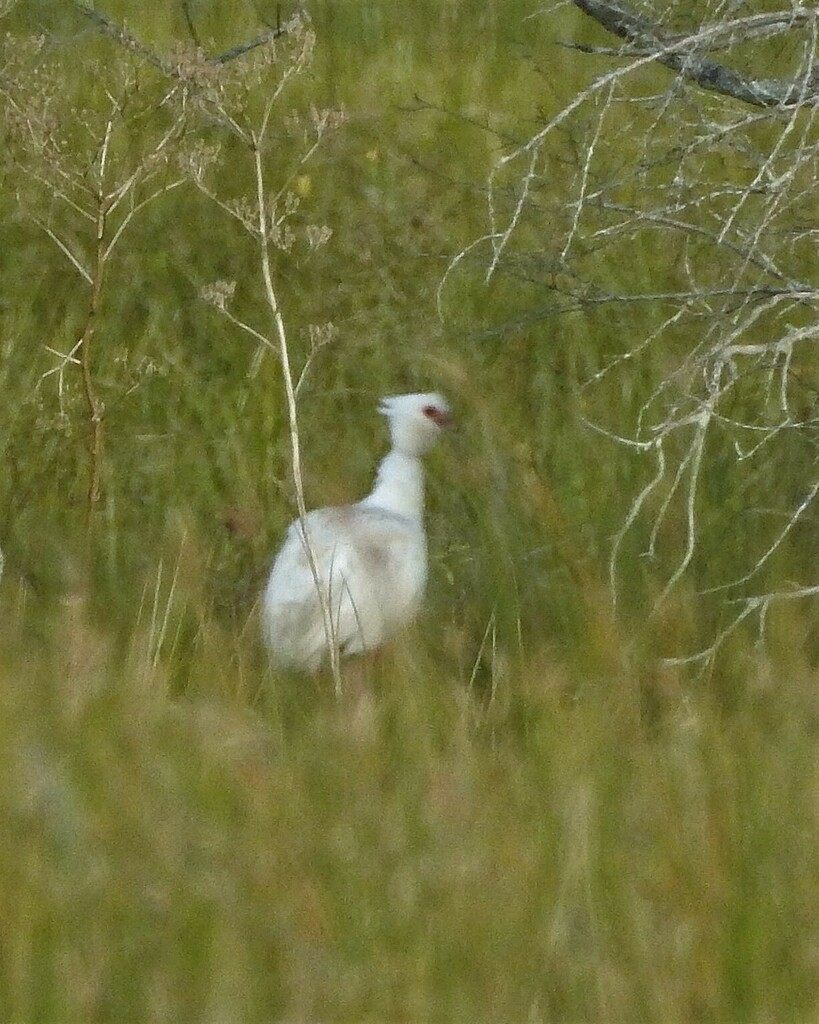
The southern screamer is a pale grey South American wetland bird whose skin is packed with air sacs that crackle like bubble wrap when touched. It carries two bony spurs on each wing, calls that carry over a mile, and sits on the oldest branch of the waterfowl family tree.
Walk the marshes of the Pantanal, or the wet grassland fringing almost any lake in southern South America, and you may hear the southern screamer before you ever see it: a trumpeting, two-note call rolling across open water for kilometres. Up close it looks almost ordinary, a pale grey, goose-sized bird standing hock-deep in reeds. Almost everything that makes it strange is either buried under its skin or written into its family tree, and none of it shows up in a quick glance through binoculars.
What does a southern screamer look like?
A southern screamer stands 81 to 95 cm tall and weighs 3 to 5 kg, roughly the bulk of a small turkey. The body is pale grey, the crown a shade darker, and a patch of bare red skin rings each eye. A thin dark line crosses the base of the neck like a collar, the detail behind its scientific name, torquata, meaning "collared". The legs are long, pink and only partially webbed, built more for walking through marsh vegetation than for serious swimming.
A bird packed with bubble wrap
Reach under the feathers of a southern screamer and the skin itself is strange to the touch: soft, spongy and threaded with hundreds of tiny air-filled pockets called subcutaneous diverticula. Press one and it collapses with an audible crackle, the same sound as popping the cells of a sheet of bubble wrap. The bird uses this deliberately: during a threat display it flexes the skin hard enough that a person standing nearby can hear it crackle, no vocal cords involved. The genus name Chauna even comes from a Greek word meaning spongy or porous, chosen for exactly this trait.
The most air-filled skeleton of any bird
The crackling skin is only the visible part of a bigger story. Southern screamers carry the most extensively air-filled, or pneumatic, skeleton recorded in any bird, extending the internal air sacs of a normal bird's respiratory system out under the skin itself. They also lack uncinate processes, the small bony hooks that reinforce the ribcage in almost every other bird. Between the missing rib hooks and the sub-skin air pockets, a screamer is structurally one of the lightest large birds for its size, which likely helps explain how a 4 kg animal can soar for hours on end with barely a wingbeat.
Two spurs on every wing
A southern screamer carries no talons worth mentioning and rarely bites. Its weapons are on the wings: two sharp, bony spurs project from the leading edge at the bend of each one. Rival males and defending pairs strike with these spurs in disputes over nesting ground and mates, a fighting style closer to a spurred gamecock than to any duck or goose.
Built like a goose, living like neither
Despite the superficial resemblance to a goose, a screamer's habits diverge fast. It is almost entirely herbivorous, grazing on soft aquatic plants, seeds and the shoots of cultivated crops rather than hunting for anything. Its feet are only partially webbed, so while it swims capably when it needs to, it spends most of its life walking the shoreline on foot rather than paddling open water. Outside the breeding season it gathers in large mixed flocks that feed together on wet grassland, then splits into monogamous pairs, bonds that last roughly the pair's 15-year lifespan, once nesting begins.
Chicks ready to walk on day one
A pair builds a large platform nest of reeds and aquatic plants near water and shares incubation duty, the female typically sitting by day and the male by night, over 43 to 46 days for a clutch of two to seven white eggs. The chicks that hatch are precocial: downy, alert and able to walk within hours, unlike the blind, naked hatchlings of many other birds. They follow both parents on foot for 60 to 75 days, learning what to graze before striking out on their own.
A voice built to cross a marsh
The name "screamer" is not an exaggeration. A pair's duetting trumpet call carries up to roughly two kilometres across open wetland, one of the far-carrying calls of any South American bird. It serves much the same purpose a fox's scent-marking does elsewhere: announcing ownership of a stretch of marsh to every neighbour within earshot, long before a rival gets close enough to see.
The oldest branch on the waterfowl tree
The screamer family, Anhimidae, is not a strange offshoot of ducks and geese. It is the sister lineage to every other living waterfowl species combined. Fossil evidence places the split between the screamers and the ancestors of all ducks, geese and swans, the group ornithologists call Anseres, at more than 50 million years ago, in tropical swamps that existed long before most modern bird families had evolved. Every duck on every pond alive today shares a more recent common ancestor with a goose than either does with a screamer. The resemblance to a goose turns out to be skin deep, or in this case, rather less than skin deep.
How rare is the southern screamer in Kaught?
In the Kaught catalog the southern screamer sits at the Epic tier, three diamonds out of four. That tier is purely a record of how often a species is actually logged in the wild, not a statement about its conservation status. The screamer's range is large but entirely confined to South American wetlands, habitat most of the world's naturalists never visit, so confirmed sightings stay far scarcer than for a familiar bird an ocean away.
South America already holds one of Kaught's rarest waterbirds in the black-necked swan, the continent's only true swan, and shares its taste for eye-catching wetland plumage with the flamingos whose diet turns them pink. Africa's goliath heron plays a similar "giant wetland bird nobody expects" role on another continent entirely, and if you want a second animal whose family tree overturned appearances, the golden jackal looked exactly like a jackal for two centuries before DNA proved otherwise.
Southern screamer: frequently asked questions
Why does a southern screamer's skin crackle?
Its skin is riddled with small air sacs, called subcutaneous diverticula, that sit just under the surface. Pressed or flexed hard during a threat display, the sacs collapse suddenly and produce a crackling sound like bubble wrap, not a call from the throat.
What does a southern screamer eat?
It is almost entirely a plant eater, grazing on soft aquatic vegetation, seeds, leaves and the shoots of cultivated crops along the edges of South American marshes and wet grassland. It rarely hunts, spending most of its day walking and grazing on foot.
Is the southern screamer related to ducks and geese?
Yes, distantly. It belongs to the same order, Anseriformes, but sits on the oldest surviving branch, one that split from the ancestors of every duck, goose and swan more than 50 million years ago, so its body plan never converged toward theirs.
How loud is a southern screamer's call?
Its trumpeting duet call is one of the loudest sounds any South American wetland bird makes, audible up to roughly two kilometres away across open marsh. The name "screamer" comes directly from this far-carrying voice.
What are the spurs on a southern screamer's wings for?
Each wing carries two sharp bony spurs at the bend, used as weapons in fights over territory and mates. Southern screamers strike with the leading edge of the wing rather than the beak or feet when defending a nesting site.
Where do southern screamers live?
Marshes, wet grassland and the muddy margins of lakes and slow rivers across Argentina, Bolivia, Brazil, Paraguay, Peru and Uruguay. Outside the breeding season it gathers in large flocks that feed together on open ground.
Why is the southern screamer "Epic" in Kaught?
Kaught's rarity tier reflects how often a species is actually logged in the wild, not conservation status. The southern screamer is confined to South American wetlands and recorded far less often than common backyard species, which places it at the Epic tier: three diamonds out of four.
The next thing you see could be
your first catch.
Kaught is live on the App Store and Google Play. Free to start, and your first catch is one photo away.
Free to start · Live on the App Store and Google Play
Species data, type, rarity tier and measurements, is drawn from the Kaught catalog, built on open biodiversity records from GBIF and iNaturalist. Rarity reflects how often a species is observed in the wild, not its conservation status.