
Exotic spotlight
Goliath Heron: the world's largest heron, and the African wetland's most patient hunter
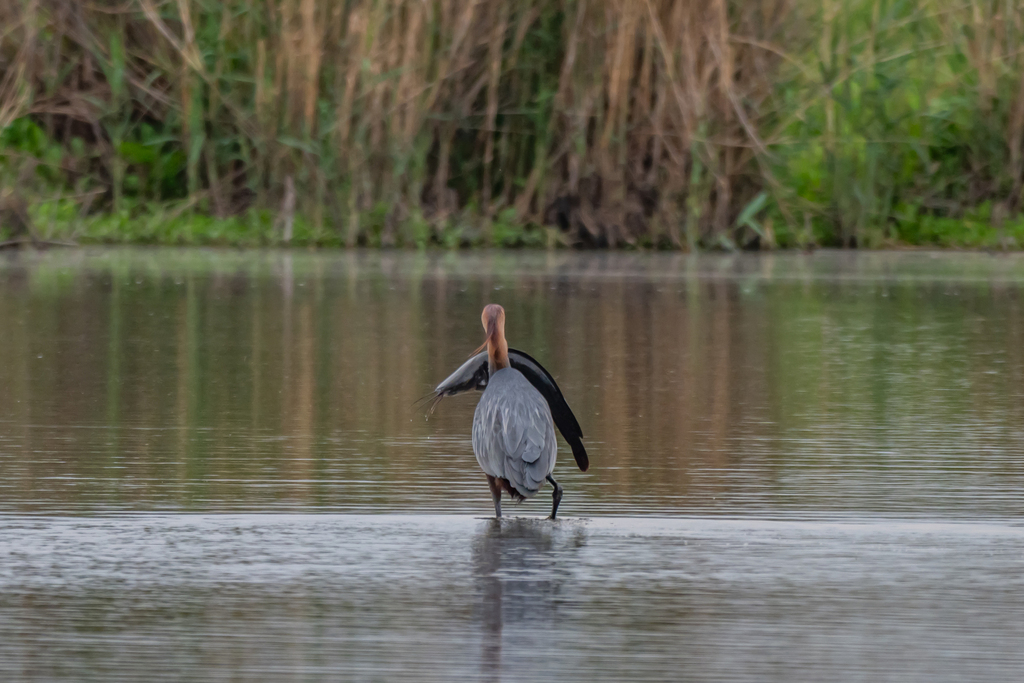
The Goliath Heron (Ardea goliath) is the world's largest heron: 1.5 m tall, 2.3 m wingspan, with a deep maroon-chestnut neck and a bill large enough to seize a 50 cm catfish. It hunts alone at African lakes and rivers by standing chest-deep and motionless until prey comes within reach. Legendary tier in the Kaught catalog, four diamonds.
Stand at the edge of a large African lake and you might see a grey heron-shaped bird in the reeds. Look more carefully, and the scale is wrong. Much too tall. Much too heavy. That is the Goliath Heron, and once you have seen one, nothing else looks like it.
How to identify a Goliath Heron
Size is the first and usually decisive field mark. The Goliath Heron stands roughly 1.5 m from foot to crown, half a metre taller than the familiar Grey Heron, and its wingspan reaches 2.3 m. Next to a Great White Egret, which itself seems large, a Goliath Heron looks like an entirely different category of bird.
- Head and neck: the crown is grey-blue. The neck and breast are a distinctive deep maroon-chestnut, a rich rust-red that is visible from a significant distance.
- Back and wings: grey-blue, similar in tone to a Grey Heron but darker and more slaty.
- Bill: massive, dagger-shaped, dark grey-brown above and yellowish below, noticeably larger than that of any other heron in Africa.
- Legs: long, dark and powerful.
- In flight: slow, deep wingbeats on enormous wings with the neck folded back in the typical heron S-curve. The maroon neck and large size make it unmistakable overhead.
Juveniles are duller overall, with the chestnut replaced by buff and the grey parts browner, but the size is already apparent from the first weeks.
Where does the Goliath Heron live?
The Goliath Heron's range covers most of sub-Saharan Africa wherever large, slow bodies of water exist: the Nile and its tributaries, the major lakes of the Rift Valley (Victoria, Tanganyika, Malawi, Turkana), the Okavango Delta, the Zambezi, the Congo and numerous coastal estuaries. A separate, smaller population inhabits coastal marshes of the Arabian Peninsula and Iraq.
It is not a bird of small garden ponds or narrow streams. It selects large bodies of water with open banks or stands of papyrus, good fish stocks, and minimal disturbance. Remote sections of river often hold single birds in established territories they defend year-round with the same deep calls and display postures a Grey Heron would recognize.
Unlike some herons, the Goliath Heron is a genuine stay-at-home. It does not participate in large mixed wading-bird colonies and rarely appears far from its chosen stretch of water. Its Legendary rarity tier in the Kaught catalog reflects that solitary, site-faithful lifestyle: there are simply far fewer reliable places to find one than there are for common waterbirds, and records in iNaturalist reflect exactly this scarcity.
What the Goliath Heron eats: prey on a different scale
The size of the bill tells the story. A Grey Heron targets fish up to about 25 cm. The Goliath Heron routinely takes catfish and lungfish up to 50 cm, a prey item that would be physically impossible for most other herons to handle. Large individuals have been recorded taking young crocodilians, monitor lizards, water snakes and frogs, in addition to the fish that make up the bulk of the diet.
This is not a bird that skims the shallows. Goliath Herons wade to chest depth to reach fish in water that smaller herons cannot enter, which is one reason they require large, open water bodies rather than stream margins.
After catching a large fish, the heron carries it to a bank or exposed rock to subdue it before swallowing. Prey too large to swallow whole is stabbed repeatedly and held until it stops moving. The bird will stand over a single fish for 30 minutes or more before swallowing it headfirst.
The hunting method: stillness as a weapon
The hunting strategy is the same as the Grey Heron's but taken to an extreme. The Goliath Heron can remain absolutely motionless for long periods, neck retracted, looking more like a weathered post than a living animal. Then, when a fish moves within range, it drives the bill downward with sudden, violent speed.
At chest depth in a large lake, a standing heron is above the sight-line of most fish looking upward through the surface. The maroon neck may also play a role: the colouration is similar to the reddish-brown papyrus stems that edge many African wetlands, which could help break the heron's outline to approaching fish.
The Goliath Heron and the Kaught catalog
The Goliath Heron is a Legendary-tier bird in Kaught's catalog, four diamonds out of four. That is a direct reflection of its iNaturalist observation count, which is small relative to the size of its African range. This is not a claim about whether the species is in good health. It means that in practice, in the catalog's observation record, Goliath Herons are genuinely uncommon to encounter, far rarer than widespread waterbirds like the Grey Heron or Great White Egret.
Finding one requires a specific type of habitat, patience, and usually a deliberate search in a known wetland. That is the kind of observation the Legendary tier was built for.
Three things worth knowing about the Goliath Heron
- It wades in water too deep for almost any other heron, using its leg length as a competitive advantage over smaller rivals at the same lake.
- The same pair of Goliath Herons will often use the same nest site in a large tree or stand of reeds for multiple years, adding material each season until the structure becomes enormous.
- Its call, a deep booming "kraak," carries for several hundred metres across open water and is often the first sign that one is nearby, audible before the bird becomes visible through the shoreline vegetation.
Goliath Heron: frequently asked questions
How big is a Goliath Heron?
The world's largest heron, standing up to 1.5 m tall with a wingspan of up to 2.3 m and a body weight of 4 to 5 kg. It is roughly twice the height of a Grey Heron and dwarfs every other wading bird in its African range.
Where does the Goliath Heron live?
Across sub-Saharan Africa at large, slow bodies of water: rivers, lakes, estuaries and coastal wetlands. A smaller population lives in coastal marshes of the Arabian Peninsula and Iraq. It prefers remote, undisturbed wetlands with good fish stocks.
What does the Goliath Heron eat?
Mainly large fish, including catfish up to 50 cm, that are too big for other herons to handle. Also takes lungfish, frogs, water snakes and occasionally young crocodilians. A single large fish can sustain it for several hours.
How does the Goliath Heron hunt?
It stands absolutely still, often chest-deep in water, until a fish moves within strike range, then drives its bill downward with sudden force. The strike is too fast to follow with the naked eye. It will hold position for long periods between strikes.
How is the Goliath Heron different from a Grey Heron?
Roughly twice the size, with a deep maroon-chestnut neck and breast rather than white and grey. The bill is much heavier. The Goliath Heron wades in significantly deeper water and takes prey far larger than anything a Grey Heron could manage.
Is the Goliath Heron rare?
Uncommon to find. It sits at Legendary, four diamonds, in the Kaught catalog, reflecting how rarely it is recorded in iNaturalist compared to common waterbirds. It favors remote wetlands and lives alone, so a genuine sighting takes planning and often a specific trip.
What sound does the Goliath Heron make?
A deep, resonant 'kraak,' lower in pitch than a Grey Heron and carrying farther across open water. Also a series of slow honking calls in flight. The call often signals presence before the bird itself becomes visible through shoreline vegetation.
The next thing you see could be
your first catch.
Kaught is live on the App Store and Google Play. Free to start, and your first catch is one photo away.
Free to start · Live on the App Store and Google Play
Species data, type, rarity tier and measurements, is drawn from the Kaught catalog, built on open biodiversity records from GBIF and iNaturalist. Rarity reflects how often a species is observed in the wild, not its conservation status.